
in this issue

Understanding the Customer Experience Journey: A Comprehensive Overview
How does the AI-powered CX journey of the modern age revolutionize the customer engagement process?
By Brian Trampler, Senior Strategy Manager at Black Box
Customer experience (CX) has emerged as a crucial differentiator for organizations across industries in the fast-paced, hyperconnected world of today. Technology improvements and shifting customer expectations have spurred a remarkable transformation in the CX journey. Right now, the utilization of artificial intelligence (AI) to enhance and customize customer experience (CX) stands out as a significant milestone in the ongoing transformation of the CX journey.
However, many businesses lack the essential plans and expertise to fully leverage AI and bridge the capacity gaps. It is important for leaders to assess their company’s readiness for change and seek the right guidance to achieve their objectives. In this article, we will discuss the milestones of the customer experience journey and how the AI-powered CX journey of the modern age can revolutionize the customer engagement process.
What You Need to Know About the CX Journey
The CX journey is a crucial idea in contemporary business that focuses on comprehending and maximizing interactions between customers and enterprises. It includes every interaction and touchpoint a customer has gone through, from the first point of contact through interactions after purchase, to provide a seamless and positive experience at every stage.
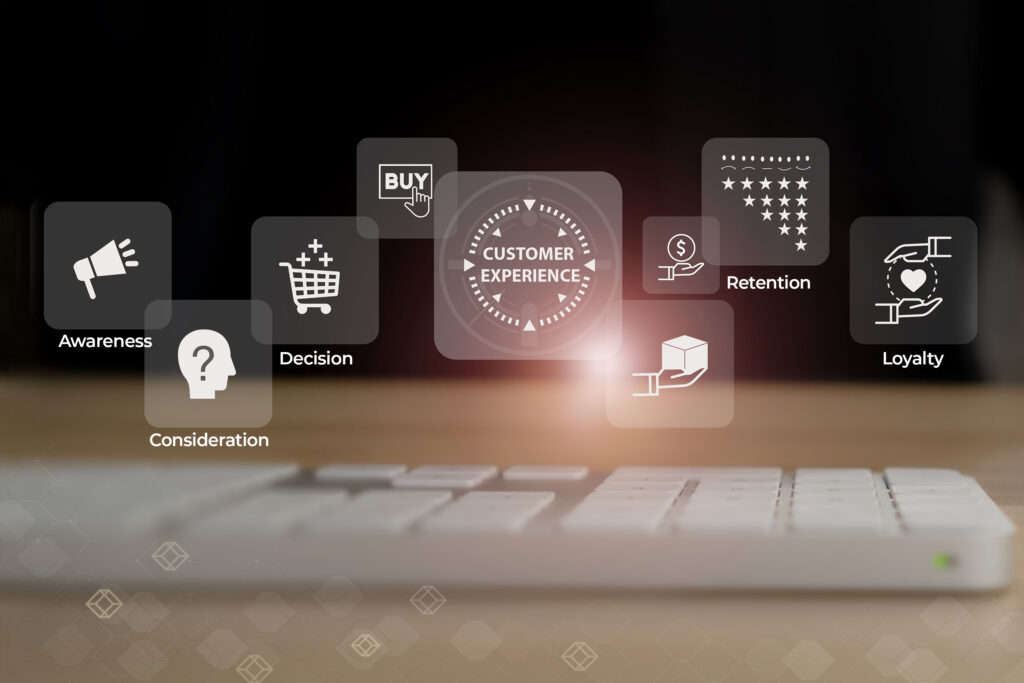
The customer journey is not a straight line; instead, it is a collection of connected stages that customers move through in accordance with their needs, preferences, and objectives. Awareness, consideration, decision, retention, and loyalty/advocacy are examples of
these stages.
Let’s delve deeper into each phase:
Awareness
The stage of awareness is when a customer first learns that a brand or a product exists. It is usually started while looking for a solution to a problem the consumer has. There are many ways for it to happen, including advertising, word-of-mouth, and web research.
The goal in this phase is to be seen, so online visibility via as many forms as possible – including optimizing your website for SEO – is important. Blog posts, social media posts, and demonstrating knowledge leadership in your industry helps you show up.
Consideration
Once informed, the customer begins to explore the company or product as a potential remedy for their challenges or requirements. To make an informed decision, they can weigh several possibilities, read reviews, and gather data. Differentiation is key in this phase – what sets you apart from your competition needs to be part of the message.
Decision
The customer makes a decision to buy at this point and completes the transaction. The transaction should happen as seamlessly as possible. Any friction in this stage will rapidly turn customers away, so it is important to have use cases, case studies, or even online reviews available at this phase in the customer journey.
Retention
Did you know that a 5% increase in customer retention can lead to as much as a 25% increase in company profit? This demonstrates that your interactions matter well after the initial sale. Customer service interactions, problem-solving, customer surveys, and new services are all part of this stage. It is important to follow up and take action on any feedback you are given.
Loyalty
At this phase, your customer becomes a voice of your brand and helps to expand it to new customers. This is all about creating a community that continues to talk about your brand. The feedback that you gathered earlier is its own voice, so it is important to respond to any feedback in a positive and timely manner. Adding incentives, rewards, and referral benefits can help to create that loyalty to your brand.
The Evolution of the CX Journey

The evolution of the CX journey over time has been largely influenced by changes in technology, consumer behavior, and the business environment.
Let’s examine the prime features of its development:
Conventional Offline Experience
In the past, conventional offline channels including brick-and-mortar storefronts, print marketing, and in-person encounters were the main ways that the customer journey was carried out. Customers relied on sparse information sources, and their contacts with enterprises were frequently limited to particular places and operating times.
Rise of Online Interactions
As e-commerce and the Internet took off, online interactions began to take a more prominent place in the CX journey. Customers now have the convenience of shopping from the comfort of their homes after doing product research and price comparisons.
Multichannel and Omnichannel Experiences
As technology developed, companies started to realize how crucial it was to deliver a consistent user experience across many channels. To seamlessly combine online and offline touchpoints, the concepts of multichannel and later omnichannel experiences developed. Whether a customer interacted with a business through a website, mobile app, social media, or in-store, they anticipated a consistent experience.
Personalization and Data-Driven Insights
Businesses began utilizing personalization strategies to improve the customer journey as a result of the wealth of consumer data made available through digital interactions. They made use of client data to deliver relevant product recommendations, target marketing messages, and personalize experiences according to user preferences. Understanding consumer behavior and improving the CX journey now require the use of data analytics and customer relationship management (CRM) solutions.
Mobile-First and Mobile-Only Experiences
As smartphones and other mobile devices proliferated, these concepts gained popularity. Customers increasingly used mobile apps and websites that were mobile-friendly to do product research, make purchases, and communicate with businesses. Throughout the customer journey, the mobile channel has grown to be an essential touchpoint, mandating responsive design and frictionless mobile experiences.
Voice Assistants and Chatbots
The development of voice assistants like Siri, Alexa, and Google Assistant as well as breakthroughs in AI and natural language processing opened new possibilities for customer interactions. With voice search, voice commands, and chatbot-based customer assistance, the CX journey has become more convenient and information can be accessed more quickly.
Integration of Augmented Reality (AR) and Virtual Reality (VR)
In particular sectors like retail and tourism, AR and VR technologies have started to impact the consumer experience journey. Through immersive experiences, customers can virtually try on items, picture furniture in their homes, or explore trip locations. These innovations improve the pre-purchase analysis phase and enable buyers to make more educated choices.
Customer Journey Mapping and Design Thinking
Businesses have embraced customer journey mapping and design thinking approaches to understand the CX journey more thoroughly. Companies started pinpointing areas for development and innovation by mapping out the customer’s interactions, emotions, and pain points at each stage.
Agent journey mapping is an area that is often overlooked when considering the CX journey. But removing barriers to success for your agents is crucial if you want to provide superior customer service. By using agent journey mapping, businesses can create a better agent experience by freeing up an agent’s mental and emotional energies to engage with the employee on a human level. This translates into a better employee experience, which in turn leads to a better CX.
Emphasis on Customer Delight and Emotional Involvement
In recent years, there has been a movement toward providing memorable experiences and emotional involvement. Businesses understand that the attitudes and loyalty of their customers are greatly influenced by their emotions. Delivering individualized, genuine, and pleasurable experiences that go above and beyond fulfilling functional demands is the focus of efforts to forge a deep emotional
bond with clients.
Integration of AI and Automation
The CX journey is hugely influenced by AI and automation technologies. Businesses can now offer real-time support, individualized recommendations, and proactive customer service, thanks to chatbots, AI-powered recommendation engines, and predictive analytics. Processes are streamlined, response times are decreased, and efficiency is increased through automation, which enhances the overall CX. AI can even be utilized to streamline call wrap-up for agents and provide consistent feedback and training recommendations, further enhancing the
agent journey.
The Changing CX Landscape: Is AI the Future?

Over the past 10 years, the CX landscape has undergone a profound transformation. The time when only call centers and conventional brick-and-mortar retailers could communicate with customers is long gone. Customers now expect personalized, frictionless, and convenient experiences throughout their journey, thanks to this transformation that has empowered them.
Businesses have realized they must use technology to satisfy these changing
customer expectations. In today’s aspect, AI has proven to be a game-changer. Personalization, sentiment analysis, predictive analytics, chatbots, and other AI-powered customer insights and CX tools have completely changed how companies
connect with their customers.
Concluding Thoughts
In conclusion, the AI-based CX journey enables companies to give customers individualized, effective, and proactive experiences. Organizations are now able to obtain important insights, automate repetitive operations, personalize interactions, anticipate customer demands, and provide seamless experiences across channels by utilizing AI technologies throughout the CX lifecycle.
AI and the future of CX require a fresh perspective and a well-designed framework. By integrating back-end CRM, enhancing commerce, personalizing experiences, and introducing new touchpoints, we can predict behaviors, trends, and expectations. To ensure successful AI implementations, we need to adopt a new blueprint that prioritizes customer intent, preferences, and behaviors.
It’s important to recognize that customer engagement is not a cost center, but rather an investment in building strong customer relationships. With imagination and ingenuity, AI has the potential to not only enhance CX but also improve every aspect of our business.

Senior Strategy Manager at Black Box

Brian has been in the collaboration and communications space for over 25 years. He’s held positions as a global help desk manager, technical sales engineer, technical account manager, and senior product manager with video-centric applications, contact center and customer experience, collaboration, and A/V experience.
Empowering businesses to deliver the experiences customers expect with the right guidance, platforms, and services.
Go Back to All Articles. Have a story idea? Submit to [email protected].
Want to get this publication in your inbox? Subscribe here!