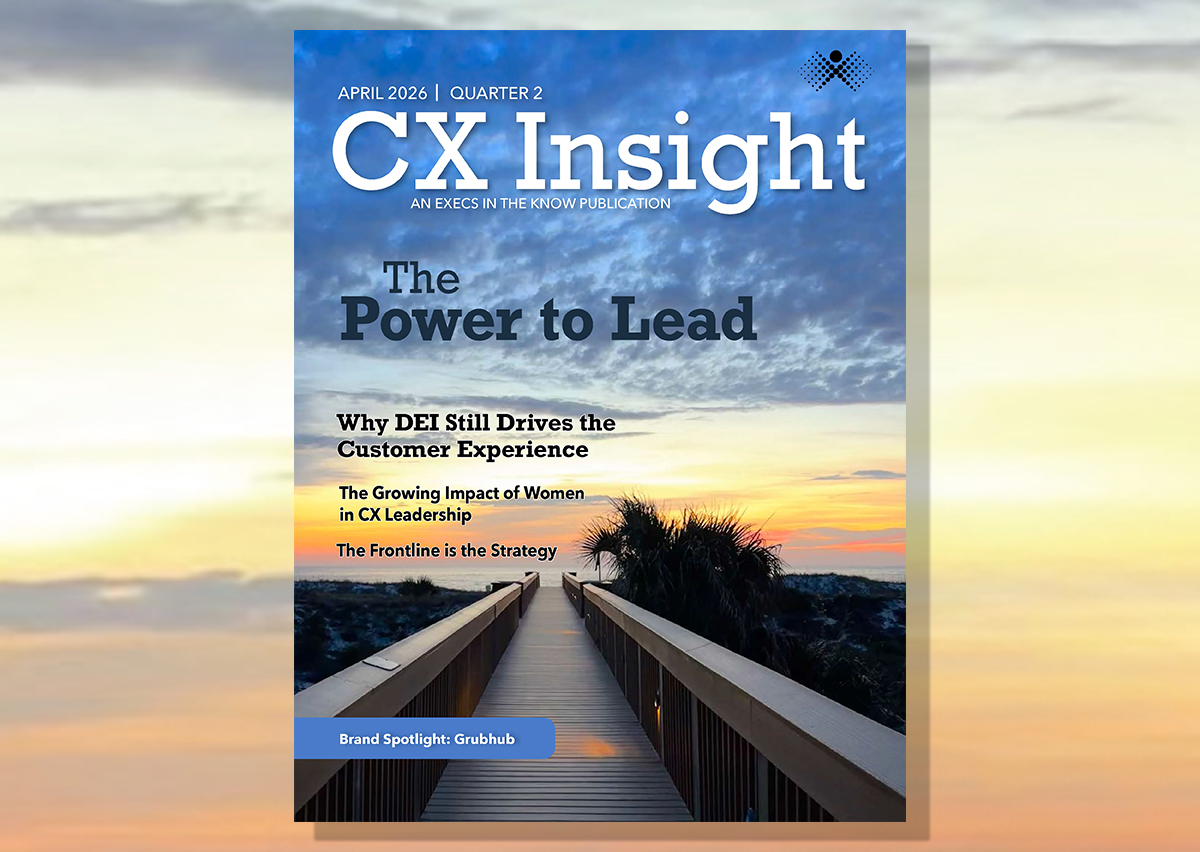
Customer experience (CX) has always been a people business. But in 2026, the stakes have shifted.
Artificial intelligence (AI) is absorbing routine interactions at an unprecedented scale. Diversity, equity, and inclusion (DEI) commitments are being publicly tested. Frontline agents are navigating more complexity than ever before. And as customer expectations continue to rise, organizations are being forced to reckon with a more fundamental question, not just how to serve customers faster, but how to serve them better, more inclusively, and with the kind of human judgment and empathy that no technology can replicate at scale.
Our April issue of CX Insight magazine brings together research, practitioner perspectives, and real-world case studies to examine the forces reshaping CX leadership and how organizations can stay ahead of them.
The DEI Performance Gap Is Widening
The business case for inclusive customer experience has never been stronger, or more urgent. Yet a critical gap persists. CX leaders rate their own accessibility and inclusion efforts 18 points higher than consumers do. That disconnect does not resolve itself. It shows up in churn, in negative sentiment, and in the quiet erosion of loyalty over time. This article examines what closing that gap actually requires operationally, structurally, and strategically.
The Frontline is Not a Support Function
Kevin McDorman, Vice President of Customer Care at Southwest Airlines, made the case plainly at CRS Amelia Island: brands will not differentiate by how much they automate. They will differentiate by how well they equip their people for the moments automation cannot handle. The shift from rigid scripts to empowering guardrails is not a cultural preference; it is a strategic imperative. This article explores what that shift looks like in practice and why organizations that get it right will find it difficult to replicate.
Brand Spotlight: How Grubhub Maintains Service Reliability at Global Scale
Behind every seamless food delivery experience is an operational infrastructure most customers never see. In this issue’s Brand Spotlight, Tanisha Parker, Associate Director at Grubhub, pulls back the curtain on how one of the world’s most recognized food delivery platforms manages global BPO partnerships, workforce strategy, and service consistency across a vast and dynamic ecosystem of couriers, merchants, and diners. Her perspective on eliminating operational friction, without compromising customer value, is one of the most practically useful conversations on this issue.
Case Study: How Uber Is Closing the Customer Feedback Gap with AI
Traditional customer satisfaction surveys capture only a fraction of the experience. Uber decided that was not good enough. In this issue’s case study, Anindya Sundar Das, Senior Director and Head of Global Digital Experience at Uber, details how Uber’s Global Digital Experience team deployed an AI engine that infers customer satisfaction across every single support interaction. It was structured around three core metrics: Resolution, Effort, and Sentiment. The result is a real-time quality signal that enables proactive improvement at a global scale and fundamentally changes how Uber understands and responds to the experience it is delivering.
KIA Spotlight: Balancing AI and Human Connection at Carrier Enterprise
In a service environment where HVAC contractors rely on fast, accurate support to keep their businesses running, the balance between technology and human connection is not an abstract leadership question; it is an operational reality. Michael Luyster, Director of Customer Experience at Carrier Enterprise and a KIA Champion, shares how Carrier Enterprise has built a hybrid service model grounded in customer choice, operational consistency, and trust. His conviction that AI should augment human capability rather than replace it offers a model worth studying across industries.
The Growing Impact of Women in CX Leadership
CX is one of the most cross-functional, human-centered disciplines in business, and women are leading it with measurable impact. The feature on women in CX leadership examines why the pipeline still narrows too early, what structural barriers remain, and why advancing women into senior leadership roles is one of the most strategically sound decisions a CX organization can make. Contributing their perspectives to this important conversation are Lisa Oswald of Travelzoo, Maureen Barnett of Fanatics, Jessica Patel of Belk, and Dima Cichi of Microsoft: four leaders who are actively shaping what modern CX leadership looks like and what it can become.
When AI Improves Metrics but Not Outcomes
Organizations across industries are deploying AI to reduce costs and increase efficiency. By conventional measures, it appears to be working. Automation rates are rising, and handling times are falling. Containment continues to improve, yet retention remains flat. Customer experience remains inconsistent, and business outcomes remain unchanged.
Cortney Jonas Burnos, Vice President of AI & Digital at Transcom, offers a sharp diagnosis: the problem is not the technology. It is the misalignment between how customer experience is measured and where it actually creates value. As AI absorbs the most repeatable interactions, what remains for human agents is more complex, more consequential, and more emotionally demanding — and most organizations have not restructured around that reality.
The Trillion-Dollar Cost That Never Appears on the P&L
According to Qualtrics XM Institute, businesses worldwide risk losing $3.8 trillion annually due to poor customer experiences. More than half of negative interactions lead customers to reduce or stop their spending entirely. Yet this cost rarely surfaces on a standard profit and loss statement. It disappears into churn metrics, missing renewals, and referrals that were never made. This article from Procedureflow provides the framework CX leaders need to translate experience quality into financial risk and bring that conversation into the boardroom where it belongs.
The question this issue keeps returning to is this: what does it actually take to lead well in this moment?
The answer, across every article and every conversation, is the same. It begins with people. The organizations that understand this and build accordingly are the ones that will emerge from this period of disruption with something the competition will find very difficult to replicate: the trust of the people they serve.
Read and download the full April 2026 issue of CX Insight magazine.