
in this issue
|
The Frontline
is the Strategy |
|
As AI transforms customer service, the most important CX advantage remains human. This article explores why the frontline is the strategy, and how empowered agents drive trust, loyalty, and better outcomes.
|

by Execs In The Know
Customer experience (CX) transformation does not ultimately succeed in strategy decks, artificial intelligence (AI) pilots, or new technology stacks. It succeeds or fails at the point of human contact. Brands that embrace the understanding that human interactions enable superior CX know that the frontline is the strategy. These brands also recognize the critical balance of using technology to increase efficiency and effectiveness.
While the AI boom and rush to increase automation are reshaping contact center operations, the role of human agents is also transforming. Human interaction plays a vital role in building trust, empathy, confidence, and authentic connection with customers. It empowers employees to navigate complex or emotionally charged situations effectively, ultimately increasing satisfaction and reducing churn.
The Frontline Matters More Than Ever
Traditional service interactions often place a heavy burden on the customer, requiring them to choose the right channel, wait for help, and repeat information or complete repetitive tasks to get
an issue resolved. AI and automation are fundamentally changing this model, with the aim to make experiences faster and more efficient. AI agents are now able to effectively resolve certain contacts that organizations previously tried to deflect, shifting the goal from avoidance to resolution.
The result? The scale and bottom-line impacts of AI and automation in CX are unprecedented and expanding rapidly. The shift of contact volume from live channels to virtual assistants is transforming customer care. AI-driven solutions can already solve simple transactional issues with virtual voice and chat assistants using internal and external knowledge bases to deliver personalized customer service.1
Another equally dramatic result of the AI boom is the impact on frontline human agents. As automation absorbs routine tasks and transactional interactions, the nature of frontline work is undergoing dramatic change. AI excels at repetitive resolutions, while human agents are masters at high stakes, emotionally complex, and brand-defining interactions. These human exchanges are the mind-over-machine moments that deepen relationships between customers and brands.
Empowered frontline human agents are particularly important when customers need intervention to handle exceptions and recovery. Customers are increasingly judging brands by their service recovery standards.
Turning negative experiences into positive ones is a critical business priority, and research shows just how important it is. According to Qualtrics,2 when a customer issue is resolved positively, that customer is likely to demonstrate more customer loyalty over time than people who never encountered these issues (service failures). This is known as the Service Recovery Paradox.
Unlike AI, human agents can address service disruptions in three steps with authenticity and empathy.
When executed effectively, customers leave the interaction with a sense of confidence, a positive emotion, and a resolved issue. They often won’t remember the disruption, and the quality of the recovery interaction can increase customer satisfaction and loyalty.
1. Actively listen to understand the recurring issue/service failure
2. Offer a genuine apology and take ownership without excuse
3. Swiftly resolve the issue, perhaps offering a make-good gesture for the customer’s high effort and frustration
What Frontline Empowerment Looks Like in Practice
One of the clearest examples of this idea came into focus at CRS Amelia Island when Kevin McDorman, Vice President of Customer Care at Southwest Airlines, took the stage and reframed what transformation really means in customer experience.
In a moment when so many conversations are centered on AI, automation, and modernization, his message was grounding: the real story of CX is still about people. Technology may reshape the environment, but the frontline is where the brand is ultimately experienced, and where strategy either comes to life or falls apart.
McDorman challenged leaders to think differently about the role of the frontline. Too often, organizations treat frontline teams as the final step in execution, asked to carry out decisions already made elsewhere. But, in practice, the frontline is where friction becomes visible, where customer effort becomes real, and where trust is either strengthened or lost.
Customers do not experience transformation through a roadmap or an org chart. They experience it in the moment they need help, when something goes wrong, or when they are looking for clarity, confidence, and resolution. That is why frontline empowerment is not a support tactic layered onto CX strategy. It is the strategy.
What made the point especially compelling was McDorman’s emphasis on empowerment as structure, not chaos. He spoke to the shift from rigid policies and scripts toward guardrails that give employees room to use judgment, empathy, and autonomy in the moments that matter most. That distinction is critical.
In an AI-powered environment where more transactional contacts are handled through automation, the interactions that reach human employees are often the ones that are more emotionally charged, complex, and consequential.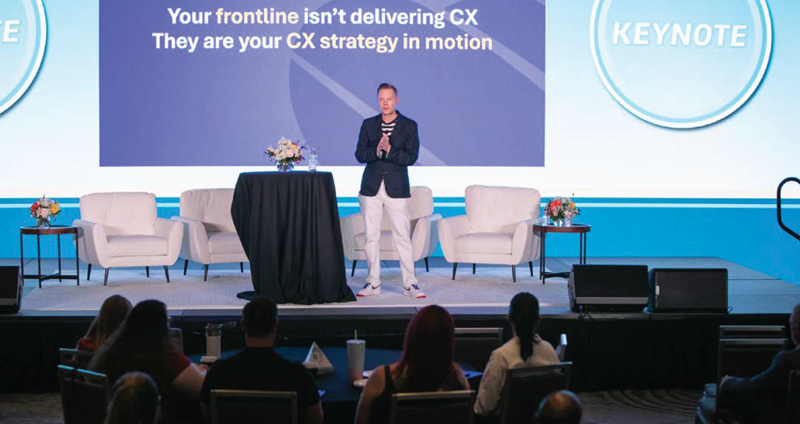
Those moments demand more than compliance. They require discernment, ownership, and the ability to recover trust in real time.
For CX leaders, the takeaway is both simple and urgent: if the future of service is being redesigned around AI, the human role must be elevated with equal intention. Southwest’s perspective reinforces a broader truth for the industry: brands will not differentiate solely by how much they automate, but by how well they equip their people to respond when automation reaches its limit.
The frontline is not separate from transformation. It is where transformation is tested, proven, and felt by the customer.
The End of Scripts: Why Traditional Structures Fail
The service recovery model is arguably most effective when it follows an interaction flow
as described above, instead of being tightly scripted. Leading organizations use a more conversational approach with this type of interaction.
 Agents are trained to follow a series of steps and have the freedom to inject their own personality as they rely on their soft skills. This is just one example of why rigid frontline operating models are becoming outdated.
As AI agents take on the more transactional contacts, human agents are freed up to handle interactions that can strengthen the relationship. Legacy contact center models were not built to accommodate today’s modern technology. Instead, these models train agents to rely on scripts, follow escalation layers, and adhere to strict permissions. These systems slow resolution and undermine trust with customers and employees alike.
To integrate AI agents and additional automation tools, leading companies are updating their operating models. A big part of this modernization effort is aimed at giving human agents the flexibility to have more fluid conversations with customers and replace scripts with recommended guardrails or talking points, particularly for tenured agents. Guardrails set parameters that allow agents to act quickly while staying aligned with brand values. These talking points suggest key messages, important information, and tone for agents to consider during interactions. Employees are empowered to adapt naturally to the conversation and use their judgement as they respond to a customer’s unique situation. What better way to handle emotionally charged or complex interactions than with authentic, empathetic, personalized service?
Empowerment as Infrastructure
As technology advances, human agents become increasingly empowered to take on more important roles as advocates and advisors. Empowerment is not a slogan or catchy phrase; it must be intentionally embedded in the operating model and reinforced through the culture. It becomes part of the organization’s infrastructure as both technology and human roles are elevated, along with the critical intersection between them.
A key contributor to frontline empowerment is AI itself. One of the most promising applications of AI in the contact center is as human agent support across the employee journey. From hiring to onboarding and training to taking live contacts to coaching, AI has an important role to play.
For example, “simulation-led agent onboarding and training are helping address the perennial issue of high agent churn. By simulating complex customer scenarios, agents can learn how to handle these situations effectively before encountering them in real life.”3 This type of training builds confidence and increases decision-making authority at the frontline. It helps increase consistency and prepares agents to add more value and contribute to the organization at higher levels.
AI-led training can cover the fundamentals of the human agent’s duties, but perhaps more important, its ability to develop, test, and reinforce soft skills is truly unique. Training focused on judgment, empathy, and problem-solving is more important than ever given the human agent’s elevated role. AI-led soft skills training offers a safe environment for agents to immerse themselves in role plays, targeted skill development, and real-time personalized feedback, leading to enhanced outcomes for the employee and the organization.
In live environments, human agents can partner with AI as a real-time, steady, consistent source
of support during interactions. These systems enable faster, more informed actions tailored to the needs of the agent, the customer, or both while streamlining problem-solving and escalation processes.
AI co-pilots assist with knowledge retrieval, next-best action guidance, sentiment analysis, and auto-summarization, lightening some aspects of the agents’ load and allowing them to focus more on the customer. “Creating a human and AI operating model is essential to positioning AI as a true contact center teammate that complements human agents, enhances performance, and enables seamless collaboration.”4
What AI Cannot Replace
Advances in AI are making it increasingly human-like, yet essential human characteristics — judgment, empathy, trust, accountability, and leadership — cannot be replicated at this time. In customer service, ethical decision-making and soft skills are critically important to resolve high-stakes issues and deliver the brand promise. Human agents excel at probing, active listening, voice tone, mirroring, and empathy, particularly when customer emotions are heightened.
In fact, simply interacting with AI can elicit negative emotions for customers. An unproductive interaction with AI can result in “disgust, potentially harming the company’s reputation. Such service failures often limit the use of subsequent services by evoking negative emotions in consumers, such as anger, frustration, and helplessness.” The same likely is true for employees.
Human application of emotional intelligence and empathy to understand a customer’s feelings and resolve the issue is irreplaceable in service interactions. Further, the connections that employees make with customers as well as leaders and colleagues are crucial in deepening relationships, understanding the human experience, and delivering value.

Another key skill reserved for humans is the development, training, and tuning of AI. Human expertise remains central to work that advances AI and makes it more effective. Technology does not become valuable on its own; instead, the value emerges with human guidance, refinement, and governance. Humans have real-world experiences and understanding that AI lacks. Human work is required to improve the quality and accuracy of AI outputs, ultimately making it more useful, relevant, and precise in supporting customers and employees.
 Leading the New Frontline
Leadership will also not be replaced by AI. But, like human agents, it will be reshaped. As technology continues to advance, it’s human capabilities that define how, when, where, and why to use it. This is the future of CX leadership.
With frontline as the strategy and technology as the supporter, leaders must ensure that human agents are willing and able to exhibit sound judgment in ambiguous situations and emotional intelligence and empathy in moments of truth. Leaders need to provide training on context and nuance in complex service scenarios, ensuring that employees build trust and confidence as they deliver the brand promise and strengthen loyalty.
Leaders must clearly understand and communicate that AI will not replace human judgment, but will augment it. The most effective leaders will carry the message that AI is a tool to supplement the core human capabilities, including using active listening, handling nuanced scenarios, demonstrating sensitivity to unique issues, delivering empathy, and employing helpful problem-solving skills. They will champion AI as a powerful enabler that elevates the employee and customer experience. They will lead the human advantage in the AI-powered CX environments of today and the future, preparing for the frontline of 2030 and beyond.
The Frontline of 2030
The contact center has always been a dynamic space, but the recent mass deployment of AI and automation tools has greatly accelerated change. While new technology implementations, product launches, and process changes will also be part of the mission, looking ahead to 2030 is promising. Ideally, a clearer picture of technology and human roles will have emerged by then; a leveling out of AI deployments may also occur.
From the human agent perspective, the workforce will have higher emotional intelligence and problem-solving capabilities due to increased training and experience with a new contact mix. They will better understand the customer perspective and have stronger skills to handle contactors’ mindsets and needs.
AI agent assist and insights will support human agents on every contact and increase agent confidence, experience, and overall performance. Leaders will have addressed the balance between technology and humanity, and the interaction types will be more clearly defined and predictable for employees.
In top-performing organizations, the change in roles and responsibilities of human agents will have altered the entire employee journey. Changes will have been implemented in hiring practices and profiles, compensation structures, onboarding, career pathing, and many aspects of training, coaching, and continuous improvement.
Leading organizations will have made great progress in implementing this new workforce design strategy and culture, and leaders will be monitoring key performance indicators, the employee experience, technology stack, and other operational inputs to address any challenges that arise.
The Culture of the Empowered Frontline
As the shift to the frontline as the strategy takes shape, organizations that deliver empowered service must design systems that include support for employees in their new roles. A culture of transparency, innovation, psychological safety, and high performance is an integral part of this transition. With trust in leadership, updated training and development, and strong operational support systems, employees will thrive in this culture of empowerment. And the operational metrics will show it!
Ensuring that the employees that are closest to customers and have a unique understanding of the CX are listened to and nurtured will help ensure targeted support of empowered frontline teams. A new look at the end-to-end employee journey will provide keen insight into where resources should be allocated to gain further improvements and higher performance. Leaders should strive for a culture that is better at caring for the frontline than at caring for customers. It is, in fact, these employees who can make or break key elements of the customer service experience.
The future of CX and, more broadly, leadership, is not about choosing between AI and humans. It’s about identifying the intersection and designing the operating model where each does what it does best. When companies design for an empowered frontline, they can expect better outcomes, stronger cultures, and memorable experiences that resonate with customers and employees. The balance of humanity and technology unlocks and unleashes the best capabilities of both, driving scale and sustainable positive impacts.
Article Links
- https://www.mckinsey.com/capabilities/operations/our-insights/the-contact-center-crossroads-finding-the-right-mix-of-humans-and-ai
- https://www.qualtrics.com/articles/customer-experience/customer-service-recovery/
- https://www.mckinsey.com/capabilities/operations/our-insights/the-contact-center-crossroads-finding-the-right-mix-of-humans-and-ai
- https://execsintheknow.com/magazines/july-2025/agentic-ai-the-new-contact-center-teammate/
- https://www.sciencedirect.com/science/article/pii/S0001691825000204