
in this issue
|
Beyond the App: Inside the Global Strategy Supporting Grubhub’s Courier and Merchant Ecosystem
|

 
Tanisha Parker
Associate Director
|
Go behind the scenes with Tanisha Parker, Associate Director at Grubhub, to discover how the food delivery giant uses global BPO partnerships and workforce strategy to maintain service reliability at scale.
|

For more than two decades, Grubhub has helped shape the modern food delivery landscape. What began as one of the earliest online platforms connecting diners with local restaurants has evolved into a vast logistics network serving hundreds of thousands of merchants across thousands of cities. Today, the platform supports a dynamic ecosystem of diners, merchants, and delivery partners; each interaction is powered by a sophisticated operational engine working behind the scenes.
At the center of that engine are the global service teams that support couriers and merchants when something needs attention. Tanisha Parker, Associate Director at Grubhub, leads the strategy and operational governance behind those teams. Her role spans global BPO partnerships, workforce planning, and service performance across multiple regions to ensure the systems supporting Grubhub’s marketplace remain scalable, resilient, and customer-focused.
Operating in the fast-moving world of food delivery means the experience must keep pace with constant change. Order volumes fluctuate, logistics evolve, and customer expectations continue to rise. For Parker, maintaining reliability across this environment requires a balance of operational discipline and adaptability; aligning partners, technology, and workforce strategy around clear service standards.
In this Brand Spotlight, Parker shares how Grubhub designs support ecosystems that meet customers where they are, how strong partnerships help maintain consistency at scale, and why removing operational friction (not customer value) is the real path to efficiency. Her perspective offers a behind-the-scenes look at the systems, teams, and leadership principles that help keep one of the industry’s most complex service environments running smoothly.
Execs In The Know (EITK): Tell us a bit about your role at Grubhub. What does a typical week look like as you oversee global operations, BPO strategy, and workforce management supporting Courier and Merchant Care?
Tanisha: I lead global partner programs for Grubhub, which means I oversee the strategy, governance, and operational performance of the external teams around the world that support our Courier and Merchant Care experiences. Those teams are distributed across several regions and partners, so my role sits at the intersection of operations, workforce strategy, and vendor management.
A typical week involves a lot of cross-functional alignment. I’m working with our internal CX leaders on service strategy, partnering with BPO providers to ensure performance and quality remain strong, and collaborating with the workforce management team to make sure we have the right staffing models in place to support demand.
At the same time, a big part of the role is thinking about the long-term structure of our network. How do we scale effectively? Where should certain workstreams live geographically? How do we balance cost, quality, and resiliency? So, while I’m always managing the day-to-day health of the operation, I’m also constantly designing the next iteration of it all.
EITK: As a panelist at CRS, you mentioned that Grubhub’s acquisition by Wonder and its relationship with Blue Apron have created an opportunity to unify CX platforms, partnerships, and operating models across brands. From your perspective in global operations, what does it actually take to bring different organizations and different CX cultures together into one cohesive experience?
Tanisha: It starts with recognizing that every organization comes with its own history and its own way of serving customers. When companies come together, the goal shouldn’t be to erase that overnight. Instead, the work is about identifying the best elements from each environment and designing a shared operating model around them.
From a CX perspective, that means aligning on common standards. Things like service philosophy, quality expectations, escalation frameworks, and how we measure success. Once those guardrails are in place, you can begin to unify technology platforms, workflows, and partner strategies.
What I’ve learned is that integration is as much about culture as it is about systems. Teams need to understand the “why” behind the changes. When people see how the pieces fit together to create a stronger experience for customers, alignment tends to follow.
EITK: You also shared a powerful point: “one size does not fit all” when it comes to customer experience. How do you design service experiences that meet people where they are across different generations, comfort levels with technology, and support preferences?
Tanisha: One of the realities of modern customer experience is that people interact with support very differently. Some customers want to solve things instantly through self-service. Others prefer speaking with a human. And both expectations are valid!
Our goal is to design support ecosystems rather than a single support channel. That means building strong digital experiences that include help centers, chat, and automated tools while ensuring that when someone does need human support, they reach a well-equipped, knowledgeable agent quickly.
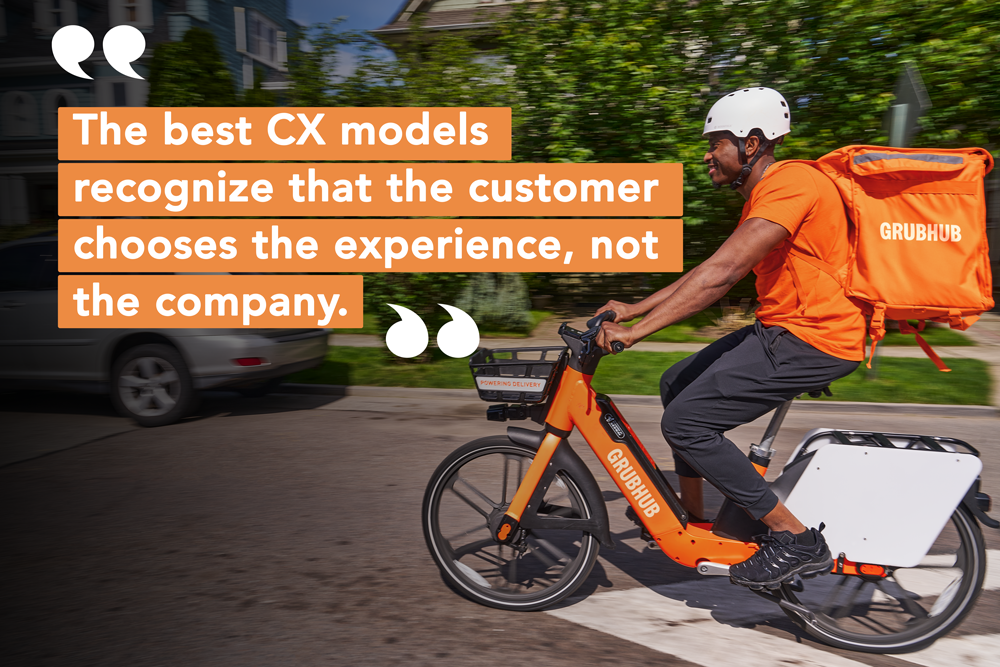
It’s really about flexibility. The best CX models recognize that the customer chooses the experience, not the company. Our job is to make sure whichever path they take works seamlessly.
EITK: Grubhub operates in a fast-moving, high-volume environment. How do you and your team ensure the customer experience stays consistent and reliable for couriers, merchants, and diners across such a complex ecosystem?
Tanisha: Consistency in the large ecosystem comes from strong operational discipline. We spend a lot of time defining what “good” looks like. For example, clear performance standards, quality expectations, and escalation protocols that apply across all of our partners and geographies. Equally important is visibility.
We track performance closely through shared reporting and governance frameworks so we can quickly identify where something is working well and where we need to intervene. When you combine those things (clear standards and real-time visibility), you create an environment where teams can move quickly without losing control of the experience.
EITK: You oversee performance and governance across multiple BPO partners. What does a strong partnership look like in that model, and how do you align external teams with Grubhub’s standards for service quality and operational excellence?
Tanisha: Strong partnerships start with transparency and shared accountability. Our partners aren’t simply vendors executing tasks; they’re an extension of our organization. That means we operate with common performance scorecards, shared improvement plans, and regular strategic reviews where we look beyond daily metrics to talk about innovation, efficiency, and long-term capacity building. The best partnerships are collaborative. When something isn’t working, we solve it together. When something is working exceptionally well, we replicate it across the network.
EITK: Workforce planning is a critical lever in service operations. How do you approach workforce strategy in an environment where demand, order volume, and customer needs can change quickly?
Tanisha: Flexibility is essential. In delivery and logistics environments, demand can shift quickly due to seasonality, promotions, weather, or broader market conditions. Our workforce strategy focuses on building a network that can adapt. That includes geographic diversification, cross-trained teams, and strong forecasting models that allow us to anticipate changes in volume before they hit the operation. When those elements are working together, we can scale up or down while still maintaining service quality.

EITK: Many CX leaders are navigating the balance between efficiency and experience. How do you ensure cost management
and operational efficiency never come at the expense of the human experience for merchants and couriers who rely on your teams?
Tanisha: Efficiency should never come from removing value from the customer experience. The real opportunity is to eliminate friction in the operation. Technology, workflow design, and better knowledge systems allow agents to resolve issues faster and with greater confidence. When we remove unnecessary complexity from the process, we improve both efficiency and experience at the same time. In other words, operational discipline should empower better service, not limit it.

EITK: Courier and Merchant Care are unique service environments compared to traditional contact centers. What are some of the biggest differences you see in supporting these audiences, and how has that shaped the way your teams operate?
Tanisha: Courier and merchant support operates much closer to real-time logistics than traditional customer care. When a courier contacts us, they’re often in the middle of a delivery. When a merchant reaches out, it could be during a busy service window. Because of that, speed and clarity matter even more. Our teams have to diagnose issues quickly and provide solutions that keep the ecosystem moving. That urgency has shaped the way we train teams, structure workflows, and design escalation paths. The goal is always to resolve issues in a way that minimizes disruption for everyone involved.
 |
 |
 |
|
EITK: You’ve built performance frameworks that guide decision-making at scale. What metrics or signals tell you that the experience is truly working for customers, not just that operations are running smoothly?
Tanisha: Operational metrics like handle time, average speed of answer, and service level tell us whether the engine is running efficiently, but they don’t nearly tell us the full story. We pay close attention to signals that reflect the customer’s actual experience.
That means things like repeat contact rates, repeat order rates, and satisfaction feedback from couriers and merchants. When those indicators improve alongside operational performance, that’s when we know the system is working the way it should
 EITK: Grubhub operates in a highly dynamic industry where technology and logistics intersect. How is technology helping your teams deliver faster, smarter support while still keeping the experience human?
Tanisha: Technology is incredibly powerful when it’s used to support the human element of service rather than replace it. Automation can handle simple requests, surface relevant information to agents, and streamline workflows so that agents spend less time searching for answers and more time helping customers. While done well, technology removes friction from the process and allows human interactions to focus on empathy, judgment, and problem-solving, which are the things people still do best.
EITK: Looking back over your career in global operations and workforce strategy, what experiences have most shaped the way you approach customer experience and operational leadership today?
Tanisha: Working across different operational environments has probably shaped my perspective the most. Every organization operates differently, but the core principles of strong operations tend to remain the same: clarity, accountability, and adaptability.
I’ve also learned that great CX doesn’t happen in isolation. It requires alignment across technology, workforce strategy, partner management, and leadership. When those elements move in the same direction, the results are powerful.
EITK: What’s something about Grubhub’s approach to customer support that might surprise people outside the organization?
Tanisha: I think people would be surprised by just how many people are working behind the scenes to make the experience feel simple. When someone orders food, it feels like a quick digital interaction. But there’s an entire ecosystem supporting that moment. From couriers on the road to merchants preparing means to support teams around the world, making sure issues are resolved quickly if something doesn’t go as planned. Our job in operations is to make sure that the system works smoothly for everyone involved. When it does, customers rarely see the complexity behind it. They just experience reliability. And honestly, that’s exactly how it should feel.
| Execs In The Know partners with brands that provide outstanding customer service (CX) experiences. The Brand Spotlight Series showcases innovations and solutions to CX challenges faced by today’s leading brands.
Thank you to Tanisha Parker and the Grubhub team for contributing to this Execs In The Know Brand Spotlight. |