
in this issue
 |
|
The Growing Impact of Women in CX Leadership Why women are succeeding in customer experience leadership, the barriers that remain, and why advancing women is one of the smartest business decisions a CX organization can make. |
by Execs In The Know
Great customer experience (CX) leadership begins with people, not process, policy, or metrics. The most impactful CX leaders know that culture shapes outcomes long before any dashboard can measure them. The way a leader builds trust, creates clarity, encourages accountability, and makes people feel genuinely seen affects everything that follows. It shapes how teams work together, how customers are treated, how problems are solved, and how organizations respond under pressure. So, here is the question worth asking: In an era defined by artificial intelligence (AI) adoption, rising expectations, and relentless change, what does it actually take to lead well? The answer, it turns out, is deeply human.
The strongest leaders, regardless of gender, blend discipline with empathy. They build environments where people speak honestly, think clearly, and perform at a high level. They understand that exceptional CX is not delivered by technology alone, but by people who feel trusted, supported, and equipped to do their best work. That kind of leadership is showing up across the industry. And, increasingly, it is being shaped and modeled by women.
Research consistently shows that the qualities that define high-performing CX organizations (psychological safety, empathetic leadership, systems-level thinking, and trust) are in high demand and are measurably linked to better outcomes. These are not soft traits; they are the engine of retention, engagement, and customer loyalty. And they are showing up prominently among women leaders across the industry.
Within the Execs In The Know community, this impact is visible in the leaders driving change, in the cultures they are building, and in the growing recognition that women in CX are helping define what modern leadership looks like. Industry research reinforces this, underscoring the strategic importance of trust, adaptive systems, and human-centered AI in the future of CX leadership. This article spotlights that leadership. It examines why women are succeeding in CX, what practices drive their effectiveness, what barriers remain, and why advancing more qualified women into leadership roles makes real business sense, well beyond simply doing the right thing.
The Gap Is Real, and It Shouldn’t Be
Before examining what strong CX leadership looks like in practice, it is worth noting a structural reality: women make up a significant share of the CX workforce, yet that representation does not translate proportionally into management and executive roles. The result is a leadership pipeline that narrows too early, too often, and at exactly the moments when more women should be moving forward. For all the progress women are making in CX leadership, the representation gap remains too large to ignore.
Women make up a significant share of the CX workforce, yet that representation does not carry through proportionally into management and executive roles. The result is a leadership pipeline that narrows too early, too often, and at exactly the moments when more women should be moving forward. McKinsey & Company’s Women in the Workplace 20251 found that only 93 women are promoted to manager for every 100 men, with the number falling further for women of color. At the highest levels, Fortune reported in June 2025 that women held just 11% of CEO roles in the Fortune 500.2 The 2025 Women’s Power Gap CEO Report3 adds that women hold only a fraction of common CEO pipeline roles and are appointed to the top job at even lower rates from those same positions. For many women, the challenge extends beyond advancement. It is about visibility, sponsorship, and being recognized as strategic leaders who belong at the decision-making table, not just operators managing the work. That is a structural problem. And the following section makes clear it is also a solvable one.
The Best CX Leadership Starts with People
Walk into any high-performing CX organization, and the signs of strong leadership are usually felt before they are measured.
There is trust, ownership, and openness. People feel safe asking questions, raising concerns, and discussing what is not working. Teams are more aligned, decisions are clearer, and customers feel the difference, even if they cannot see it directly. That connection between internal culture and external experience is not incidental; it is the mechanism. How a leader builds trust inside an organization shapes how customers are treated and how problems get solved.
Research on high-performing CX organizations points clearly to the leadership behaviors that drive these outcomes. A Boston Consulting Group survey of approximately 28,000 employees across 16 countries found a direct and powerful relationship between empathetic leadership and feelings of psychological safety, and that when psychological safety is high, retention risk drops from 12% likely-to-quit down to just 3%.4
O.C. Tanner’s 2024 Global Culture Report: Practical Empathy5 found that employees who perceive their leader as empathetic are significantly more likely to be highly engaged. Catalyst’s research, The Power of Empathy in Times of Crisis and Beyond6, connects that same quality to stronger retention, more inclusive cultures, and higher performance during disruption. In CX, those internal outcomes flow directly into the customer relationship.
And customers are raising the bar. Today, they want more than fast, frictionless transactions. They want clarity, confidence, and experiences that feel human and trustworthy. PwC’s 2025 Customer Experience Survey7 underscored how directly trust shapes loyalty, engagement, and retention. Meeting that bar requires leaders who understand not just operational efficiency, but the full arc of how a customer feels doing business with a brand.
These are exactly the leadership traits that women in CX are demonstrating at high rates — driving stronger cross-functional collaboration, designing more thoughtful escalation paths, building more inclusive experience strategies, and making sharper decisions about where and how technology should be deployed. That last point is increasingly critical. As AI takes on a larger role in customer interactions, the question of how to preserve human connection at scale is one of the defining leadership challenges.
Women leaders in CX are helping organizations meet that imperative in concrete ways, driving stronger cross-functional collaboration, designing more thoughtful escalation paths, building more inclusive experience strategies, and making sharper decisions about where and how technology should be deployed. That last point is increasingly critical. As AI takes on a larger role in customer interactions, the question of how to preserve human connection at scale is one of the defining leadership challenges.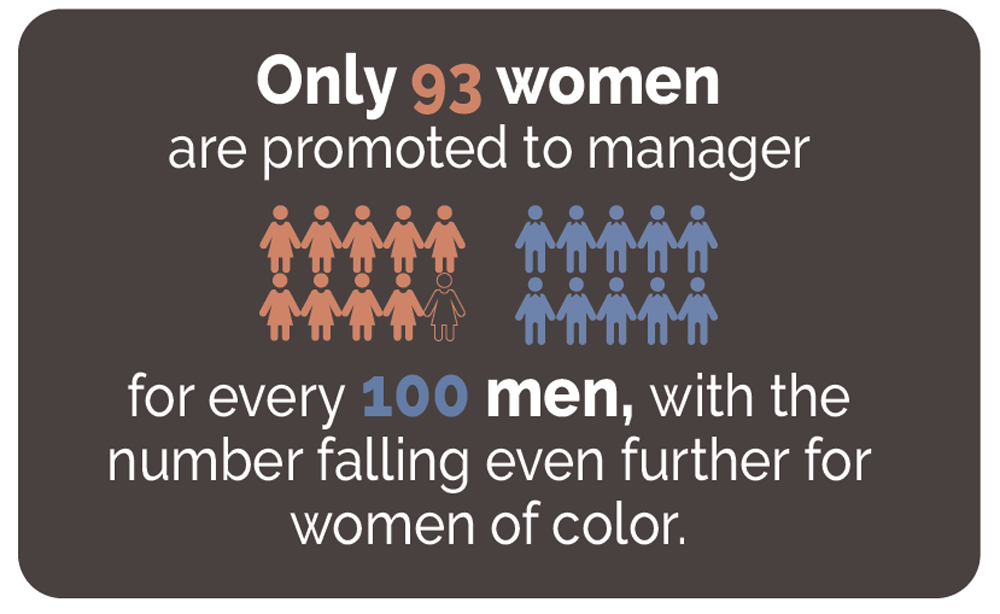
Women in leadership are helping teams navigate complexity without creating more fear, building trust while driving accountability, and asking sharp questions about what customers actually need, what employees need to succeed, and what responsible leadership should look like under pressure. They are bringing judgment, adaptability, operational discipline, and a broader view of what long-term success requires. Publications like CMSWire’s Bridging the Gender Gap in Customer Experience Leadership8 have also highlighted women leaders’ strengths in building stronger customer experiences through collaboration, systems thinking, and people-centered leadership.
“Women are succeeding in CX leadership because CX has shifted from a support function to a strategic driver of growth,” says Maureen Barnett, Head of Global Fan Experience at Fanatics. “Modern CX sits at the intersection of operations, technology, data, and human behavior. This space requires emotional intelligence, systems thinking, and the ability to translate human needs into business strategy. These are areas where many women leaders naturally excel. The impact is significant. Women are helping organizations move from transactional service models to experience-driven cultures. They are reframing CX from handling issues
to end-to-end journeys that shape culture and strengthen loyalty that directly influences business outcomes.”
The future of CX will not be shaped by automation alone. It will be shaped by leaders who know how to balance efficiency with empathy, innovation with responsibility, and scale with genuine human connection. Jessica Patel, Senior Director of Customer Experience at Belk, notes that “women are successful in CX leadership because the
role naturally requires empathy, adaptability, and strong communication — helping shift organizations to be more customer-focused and driving more thoughtful decisions that directly impact loyalty and retention.”
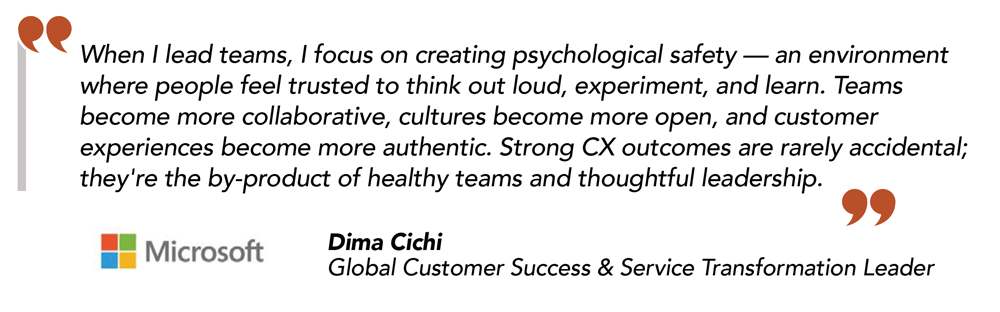
Dima Cichi, Global Customer Success & Service Transformation Leader at Microsoft, brings a similar perspective. “CX is not just about fixing issues — it’s about seeing the whole system: the technology, the process, and the human emotion flowing through it,” she says. “Women tend to lead with that systems-level view, balancing analytical rigor with empathy. We’re seeing more intentional journey design, more inclusive experiences, and organizations that listen first and optimize second.”

The Barriers Are Structural, and They Are Solvable
The obstacles holding women back from senior leadership are not usually about readiness. They are about structures. And understanding those systems clearly is the first step toward building organizations that are stronger for everyone.
The first barrier is often the earliest one: the move into management. When women are promoted at lower rates than men at that initial stage, the pipeline narrows before leadership trajectories have a real chance to develop. McKinsey & Company and LeanIn.org identify this as the “broken rung,”9 and it remains one of the most persistent structural barriers in leadership advancement. Over time, that early imbalance compounds.
Beyond the broken rung, there are subtler but equally powerful forces at work: biased assumptions about what executive presence looks like, uneven access to high-visibility assignments, leadership norms that reward a narrower style of authority, and sponsorship gaps that leave talented women doing the work without anyone actively opening doors for them. As Barnett has observed, CX leadership is still too often viewed as an operational function rather than a strategic one, which means women in those roles can struggle to be seen as candidates for broader enterprise leadership, even when their scope and impact clearly qualify them.
“Women need advocates at the executive table who actively open doors, expand their exposure to enterprise-level decisions, and position them for broader leadership roles,” says Barnett. “Increasing visibility and sponsorship is essential for advancement.”
These are not impossible problems, but require organizations to stop treating leadership advancement as something that unfolds naturally on its own. It does not. When companies invest intentionally in development, sponsorship, visibility, and more equitable promotion practices, they build stronger pipelines and better outcomes. When they do not, they continue reproducing the same imbalance and calling it meritocracy.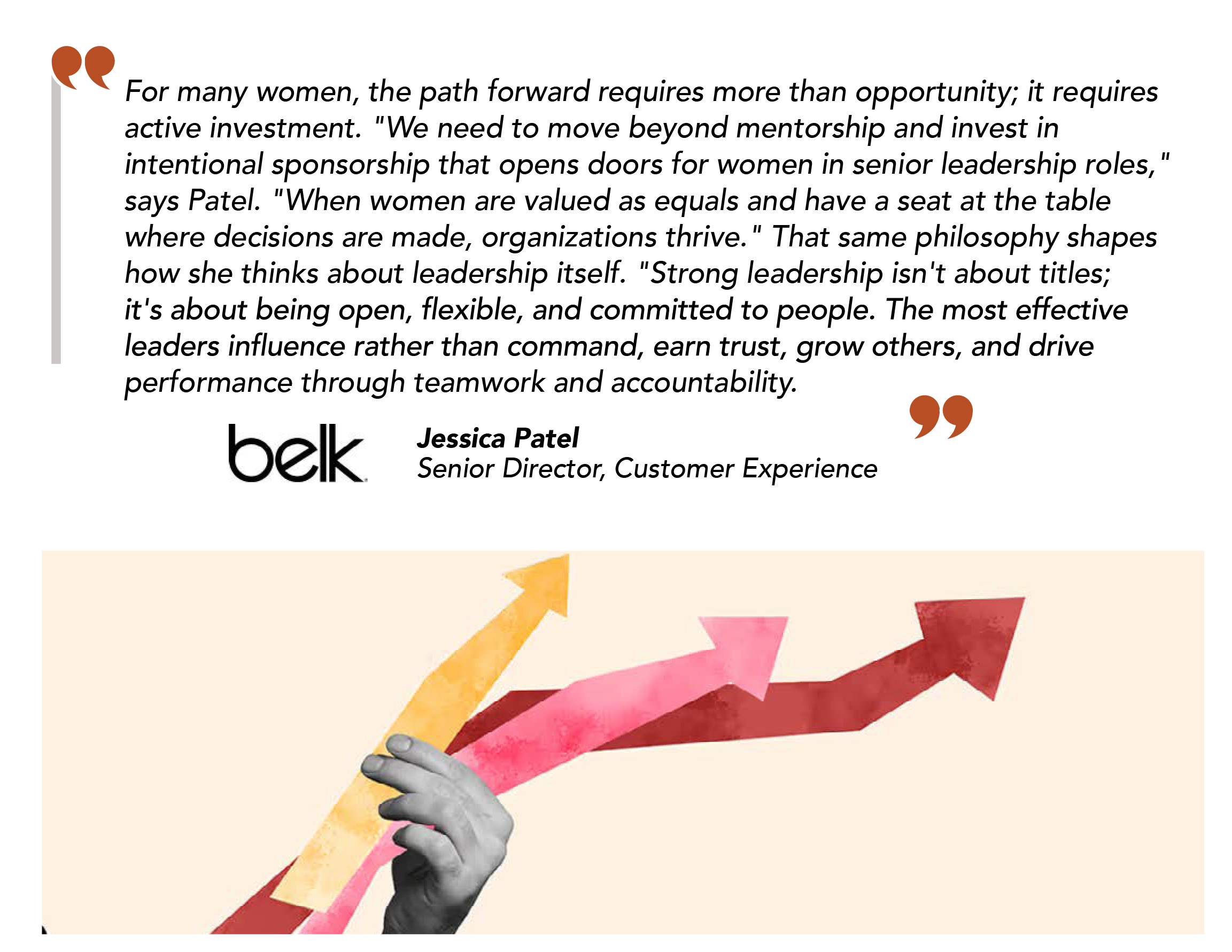
Advancing More Women in Leadership is a Business Strategy
The business case for gender-diverse leadership is well-documented. McKinsey & Company’s Diversity Wins: How Inclusion Matters report10 found that companies in the top quartile for gender diversity in leadership are 39% more likely to outperform their peers financially. Even more striking: there is a 48% difference in the likelihood of financial outperformance between the most and least gender-diverse companies. That is not a marginal edge. That is a structural advantage, and it widens every year organizations fail to act. In CX, that advantage is especially tangible.
Customer experience is one of the most cross-functional disciplines in the business. It requires leaders who can connect teams, align priorities, navigate ambiguity, and keep the customer perspective present even when organizational pressures mount. It requires strong communication, sound judgment, and the ability to build cultures where people feel motivated to contribute at a high level. Women leaders are delivering in those areas every day.
The cultural impact of that leadership is measurable. “Women leaders tend to create more people-centered cultures where employees feel heard, supported, and empowered,” says Patel, “and that directly translates to better engagement, stronger performance, and improved customer experiences and satisfaction scores.” Looking ahead, she adds, “I would love to see more women move beyond leading CX teams and start influencing strategy across the business.”
They are helping organizations design better experiences, lead stronger teams, and build cultures that support both performance and retention. They are not only contributing to business success, they’re helping expand the leadership bench and strengthen the future of customer-centered business. Broader reporting from sources like CXM Today11 also reflect the growing visibility and influence of women shaping the future of CX leadership. “I hope to see more women in CX move into enterprise leadership roles where their perspective shapes overall business strategy and not just customer strategy. CX leaders understand customer behavior, operational realities, technology enablement, and workforce engagement — exactly the combination organizations need at the highest levels influencing the future of the organization,” added Barnett.
What Comes Next is Up to All of Us
Women leaders in CX are not exceptions to the rule. They are part of a broader movement shaping where leadership is already heading. The organizations that will lead in CX over the next decade are not waiting to see how this plays out. They are actively building leadership pipelines that reflect the full range of talent available to them, investing in sponsorship, removing structural friction, and making room at the table before it becomes urgent. Advancing women in CX leadership is not a diversity initiative. It is a competitive decision. And the companies advancing the leadership model CX now requires already have an edge.
Article Links
1. https://www.mckinsey.com/capabilities/people-and-organizational-performance/our-insights/women-in-the-workplace
2. https://fortune.com/2025/06/02/fortune-500-companies-run-by-female-ceos-women-2025/
3. https://www.womenspowergap.org/corporate-report/
4. https://www.bcg.com/publications/2024/psychological-safety-levels-playing-field-for-employees
5. https://www.octanner.com/global-culture-report/2024-practical-empathy
6. https://www.catalyst.org/en-us/insights/2025/empathy-work-strategy-crisis
7. https://www.pwc.com/us/en/services/consulting/business-transformation/library/2025-customer-experience-survey.html
8. https://www.cmswire.com/customer-experience/bridging-the-gender-gap-in-customer-experience-leadership/
9. https://www.mckinsey.com/capabilities/people-and-organizational-performance/our-insights/women-in-the-workplace
10. https://www.mckinsey.com/featured-insights/diversity-and-inclusion/diversity-wins-how-inclusion-matters
11. https://cxmtoday.com/featured/meet-the-women-at-the-helm-of-the-most-loved-brands/