
in this issue

Will AI Render the Human Call Center Agent Obsolete?
AI technologies have the potential to revolutionize call center customer service by making it more efficient, productive, and personalized.
By Nick Jiwa, Founder and President, CustomerServ
Artificial intelligence (AI) and Robotic Process Automation (RPA) remain two of the hottest topics in call centers. The promise of AI and RPA to solve service issues and reduce labor costs is gradually becoming a reality.
Thanks to technological improvements and broader adoption, AI is beyond the “hype storm” and has demonstrated significant value across industries. Similarly, RPA has proved valuable in automating routine tasks, improving service delivery, and increasing efficiency.
Not only that, but recent advancements like Generative AI and ChatGPT have emerged as powerful solutions for customer service. (More on that later.)
The End of Human Interaction in Call Centers?
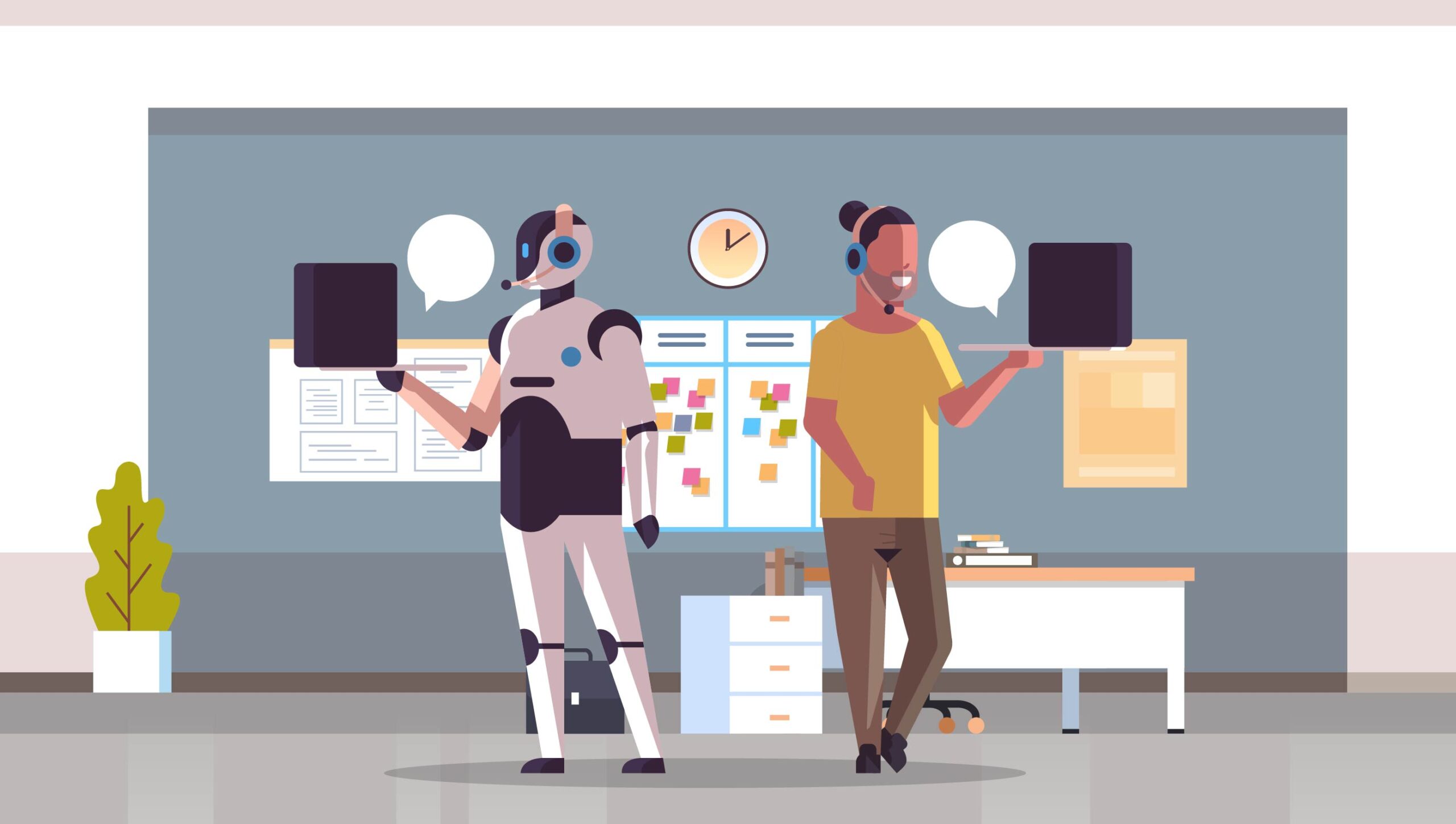
Despite these advancements, the hyperbolic sales pitches foretelling the end of human interaction in call centers are irresponsible. We don’t believe that R2D2 will replace the human agent anytime soon.
Studies have shown that the average consumer would rather interact with a live agent than a chatbot. For example, a March 2023 survey by IPSOS on artificial intelligence found that despite the growing acceptance of AI, most people still prefer to talk with a human customer service agent (88%). Only 35% of respondents claimed that chatbots solved their problems effectively, while 77% felt that customer service chatbots were frustrating.
That said, dismissing the potential impact of automation in the call center would be unrealistic, particularly when AI is combined with RPA. There is consensus that call center agents will continue to provide a critical touchpoint in the customer journey and that the technology will be used to augment human performance in the call center to deliver more efficient, effective, and value-added experiences.
Separating Science Fiction from Fact: What Is AI & RPA?
Ask six people to define AI, and you will likely get six very different answers. Many claims, exaggerations, and fears around AI stem from differing views on what it is and how to apply it in the call center.
First, to understand how AI and RPA can work with human agents to improve service delivery, let us clarify what we mean when referring to these technologies used in a call center context.
The following is what we believe them to be:
What Is Artificial Intelligence?
Artificial intelligence is a machine’s ability to imitate a human’s way of sensing things, making decisions, and communicating. AI is a judgment-based technology designed to think and do as a human would.
There are two main types of AI: narrow (or “weak”) and general-purpose.
Narrow AI is currently in use today in intelligent software that appears to learn how to carry out simple tasks without being programmed. Virtual assistants like Apple’s Siri or Amazon’s Alexa are examples of narrow AI — they can perform simple tasks and answer questions while collecting information that helps them tailor their responses to the user’s preferences.
General Purpose AI (GPMI) refers to the original vision of AI, which can be traced to a 1955 Dartmouth research program where computer scientists explored the viability of creating a machine that could simulate human learning, understanding, and intelligence. (Think HAL, the sentient computer from “2001: A Space Odyssey.”) GPMI systems are being developed, but are still many years away from becoming a reality.
It’s worth noting that the term is gradually giving way to another, Artificial General Intelligence (AGI), a form of GPMI but a more specific term that refers to an AI system that can perform any task a human can. No AGI systems have been developed to date.
There are also several types of AI besides these main two. They include:
- Machine learning – an AI that allows machines to learn from data without being explicitly programmed.
- Deep learning – a version of machine learning that uses artificial neural networks to learn from data.
- Natural language processing (NLP) – AI that allows machines to understand and process human language.
- Computer vision – a form of AI that lets machines see and understand the world around them.
- Intelligent Virtual Assistants (IVA) – IVAs use voice recognition and speech synthesis to automate simple customer service tasks, such as providing account balance information or transferring calls to the appropriate department.
- Chatbots – computer programs that can simulate human conversation. They can be used to answer customer questions, provide support, and even sell products.
- Sentiment analysis – the process of identifying the emotional tone of a piece of text. This technology can monitor customer feedback and identify potential problems.
- Predictive analytics – a type of AI that uses historical data to predict future events like customer churn, identify at-risk customers, and optimize call center resources.
As AI continues to develop, we will likely see more forms emerge. It is also likely that the lines between different kinds of AI will blur as machines become more capable of performing a more comprehensive range of tasks.
What Is Robotic Process Automation?
Robotic process automation is software that mimics behavior. RPA is digitized with structured inputs and is rules-based. RPA is about “doing,” not “thinking.” RPA can be “unattended” or “attended,” depending on its use.
Unattended RPA works behind the scenes (machine-to-machine) to complete sequential tasks, such as automating large volumes of repetitive “grunt” work like processing claims, payments, and applications or automating data integration across various systems, such as order processing and fulfillment systems.
Attended RPA resides on the agent’s desktop and is triggered by specific events, actions, or commands within a particular workflow. For example, attended RPA can provide screen prompts with instructions to agents as they work through a process with a customer. It can instantly pull up or populate a customer profile and complete routine tasks for agents, such as filling in forms, logging details, or tagging cases.
RPA is comprised of “dumb robots” that require rule-based processes and a set of instructions, after which they will perform the same tasks over and over in the same way, consistently and accurately.
The Current State of AI and RPA in Call Centers

AI and RPA are no longer futuristic concepts but practical tools revolutionizing call centers today. While customers still prefer human interaction for complex issues, they also appreciate the instant responses and round-the-clock service AI-powered bots offer.
AI has been instrumental in offering personalized customer experiences, learning from interactions, and evolving to provide better service over time. Meanwhile, RPA’s ability to automate repetitive tasks frees agents to focus on higher-value responsibilities requiring creativity and decision-making. That is significant for one very good reason: it significantly impacts staff engagement.
One of agents’ top complaints about their job — and a critical factor in the decision to leave — is that they find the work too repetitive and boring. Removing tedious tasks frees agents to focus on the work’s more valuable and interesting aspects that require creativity, decision-making, and customer interaction.
Integrating AI with RPA, especially with the addition of Generative AI and models like ChatGPT, has created an ideal scenario for using automation with machine analysis. This combination relieves frontline agents of recurring administrative tasks, assists with frequent inquiries, and learns from agent interactions to improve its responses over time.
While adopting AI and RPA in call centers is challenging, with thoughtful implementation and a focus on augmenting rather than replacing human agents, these technologies hold great potential. It’s clear that AI and RPA are not replacing call centers, but are transforming them into more efficient, customer-focused, and innovative operations.
What Is Generative AI and ChatGPT?
Generative AI is a type of AI that can create new content from scratch, such as text, images, or music, based on a set of instructions or data input. ChatGPT is a generative AI chatbot developed by OpenAI. AI scientists train ChatGPT on a massive dataset of text and code, allowing it to generate realistic and coherent conversations.
Generative AI and ChatGPT in Call Centers
These technologies can revolutionize call center customer service by allowing agents to create personalized responses to customer inquiries, generate detailed reports, and even draft emails or messages based on the context of a conversation.
ChatGPT has been used in various customer service applications, including answering customer questions, providing support, and even resolving complaints. Its ability to comprehend context, handle multiple subjects simultaneously, and learn from past interactions has significantly improved the efficiency and effectiveness of automated customer service.
ChatGPT can be used in tandem with human agents, providing them with suggested responses or handling lower-level queries autonomously, allowing agents to focus on more complex or sensitive issues.
Conclusion
AI technologies have the potential to revolutionize call center customer service by making it more efficient, productive, and personalized. AI can automate many tasks but cannot provide the same level of empathy, understanding, and compassion as a human agent. Studies show that customers still prefer to interact with a human when they have a problem. For these reasons, human call center agents will likely continue to play an essential role in customer engagement.
However, it’s also likely that AI’s role will increase in importance. Call center executives must develop strategies for integrating AI into their operations as AI evolves. This transition will require a careful balance of human and machine intelligence. By embracing AI, call center executives can create a more efficient, productive, and customer-centric organization.

Founder and President, CustomerServ

Nick is an outsourcing industry veteran of 36 years and the founder of CustomerServ. He advises and guides leaders at Fortune 500 brands and companies of all sizes maximize “people performance” by outsourcing smarter with better-matched BPO partners and more successful outsourcing strategies. Nick is a founding member of the business process outsourcing (BPO) industry, a thought leader, matchmaker, CX champion, and impact sourcing advocate.
CustomerServ is a BPO industry pioneer, thought leader and matchmaking ecosystem that helps brands outsource smarter.
Go Back to All Articles. Have a story idea? Submit to [email protected].
Want to get this publication in your inbox? Subscribe here!