
in this issue

How Work and Leadership Will Change as AI Advances
The rapid advancement of AI is reshaping how we work and how we lead.
by Execs In The Know
For over a century, the relentless rise of machines has captivated our collective imagination. Today, artificial intelligence (AI) is undergoing a profound transformation that continues to shape our world and permeate diverse facets of our lives.
In the ever-evolving landscape of the modern workforce, AI is reshaping how we work and how we lead. Beneath the surface of AI’s disruptive capabilities lies its remarkable potential to complement and even elevate the art of leadership.
Leaders find themselves at a crossroads in an age where collaboration between humans and machines is becoming increasingly pervasive. Adapting their leadership style is imperative as they manage teams augmented by the capabilities of AI. It’s not merely about embracing AI; it’s about fostering a harmonious synergy.
 Redefining Leadership Qualities
AI obliges customer experience (CX) leaders to redefine what it means to be a great leader. While charisma and authority used to be primary leadership traits, today’s leaders must be empathetic, open to change, and adept at working alongside AI. The capacity to inspire, lead with a human touch, and motivate a team remain invaluable assets.
Still, in a landscape awash with technological marvels, it’s now accompanied by a need for adaptability and a willingness to embrace technology. Emotional agility, an extension of emotional intelligence, distinguishes outstanding leadership. AI opens up new avenues for leaders to enhance this trait. AI’s ability to interpret emotions in speech, facial expressions, and body language provides leaders with real-time feedback, enabling more effective responses and improving decision-making and conflict resolution.
AI-powered emotional analysis can identify emotional patterns in text, helping leaders better manage their own emotions. Additionally, AI can create interactive, game-based learning scenarios where leaders can practice recognizing and managing emotions in a safe environment. AI’s capacity to monitor team dynamics and pinpoint potential sources of conflict allows leaders to foster a more emotionally agile team culture.
For example, Affectiva, an emotion recognition company, offers AI that analyzes facial and voice cues in real-time to provide leaders with instant feedback on the emotional climate during meetings or presentations. By identifying subtle signals of dissatisfaction, stress, or disengagement, this AI could help leaders adjust their approach on the fly. Such applications improve a leader’s emotional agility and promote a more empathetic and responsive leadership style.
With the assistance of these AI-powered learning platforms, leadership development is undergoing a profound transformation into a more efficient, effective, and engaging process.
The Evolving Workforce: Humans and Machines

As AI technologies become more sophisticated, it’s crucial to recognize that they are not here to replace us, but rather to augment our capabilities. Think of AI as a partner, not a competitor. This transformation will require a fundamental shift in the way we perceive work.
A promising future is ahead, where humans and machines collaborate to redefine how we lead.
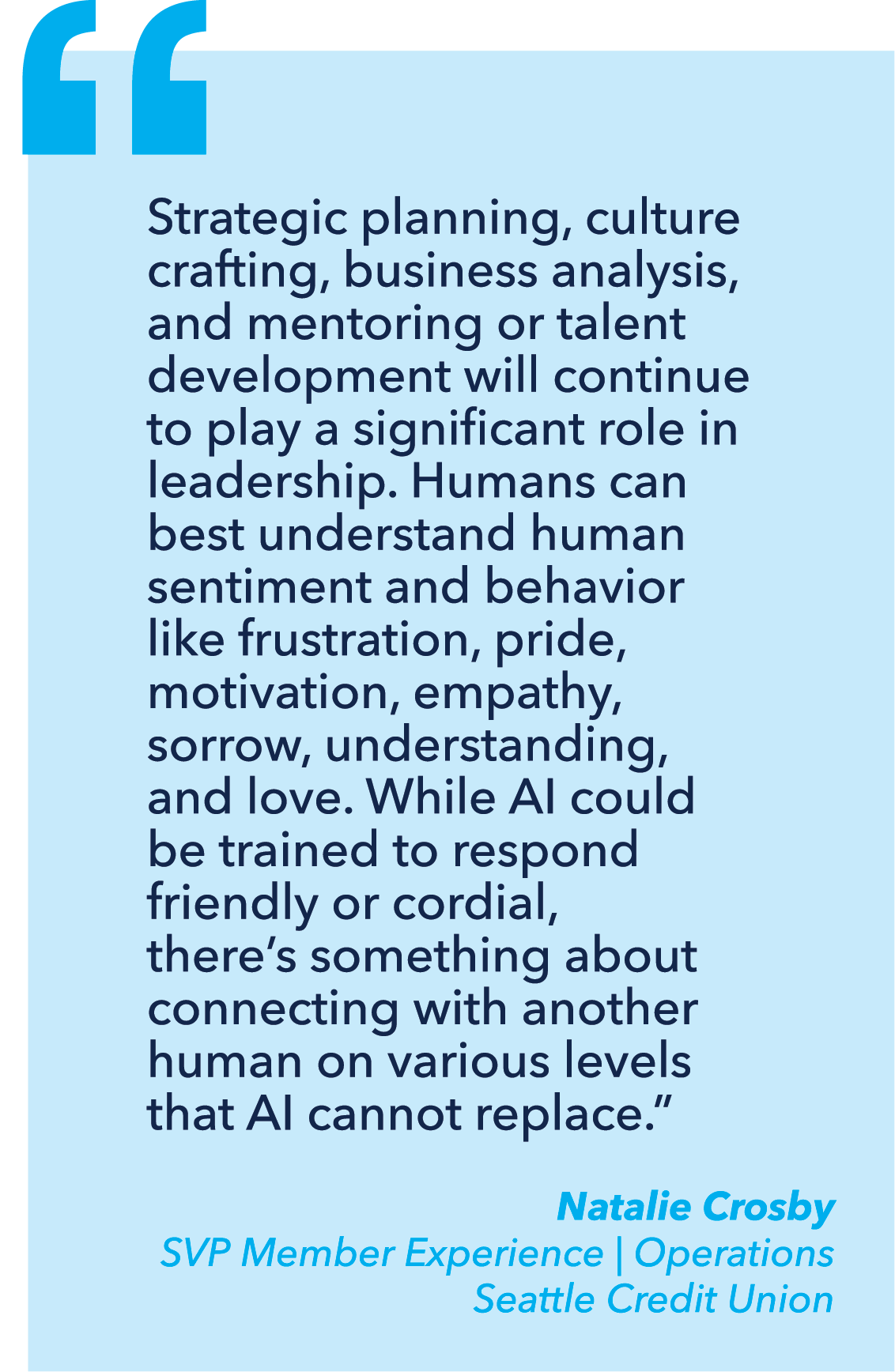
“AI needs to be demystified so many are not in fear,” says Natalie Crosby, Senior Vice President of Member Experience and Operations at Seattle Credit Union, says. “It is an efficiency gain for all businesses and, of course, it will change the work that we do or how we do it, but that is what has been happening all along. In my own career, I can reminisce word processors over typewriters, cell phones over pagers, automatic cars over standard ‘stick’ shifts, the internet over encyclopedias research, etc. As for leadership, I think AI will be a significant success factor in business, bringing insights and data faster to leaders to make better decisions with more immediate improvements and efficiency gains. I think the rate at which we create and process work will grow in expedience. Similar to the internet, we will need to focus on safeguards, be diligent with risk and quality assessments, and check for relevance (ruling out bad actors). Oh! Sounds like a new job, doesn’t it? And humans do that well – we pivot and adjust, and we will become curators of AI.”
AI-Powered Decision-Making
One of the most significant impacts of AI on leadership is the potential to make data-driven decisions with unparalleled accuracy. AI can process vast amounts of data, identify trends, and offer insights that were once impossible to obtain. This empowers leaders to make informed choices and steer their organizations in the right direction.
“Leaders can leverage AI to improve their performance and efficiency. AI can help us analyze large amounts of data, identify trends, and generate insights and recommendations much faster than any human can – and possibly find patterns or come to conclusions that a human may miss. As a user of AI, I can attest to its ability to automate routine and mundane tasks, freeing up my time for more strategic and creative work,” explains Ebrahim Hyder, Vice President of Customer Service at Michael Kors.
However, CX leaders must also be cautious to avoid becoming overly reliant on AI. Gut instincts and human intuition still play a vital role in decision-making. The best leaders will know how to strike a balance between data-driven insights and their own judgment.

“Technology is great when it works and when leaders understand how it works. The focus on Key Performance Indicators (KPIs) and coaching will remain the same. Still, AI will provide a plethora of data that will need analytics solutions to determine best what to do with and about the data,” adds Luanne M. Lo Monte, MBA, Director of Customer Care at Glass America.
In a world where AI systems help with decision-making, it’s essential to remember that these systems are only as good as the data they are trained on. This raises questions about bias and ethics in leadership. AI, if not carefully monitored and curated, can perpetuate biases present in the data it’s trained on.
Leaders should take an active role in ensuring that AI systems are designed and used ethically. This includes promoting diversity in AI development teams and being vigilant about the potential biases in AI-driven recommendations.
The Rise of Remote Work and AI
The rise of remote work and the integration of AI into the workplace have fundamentally transformed the landscape of modern organizations. Remote work, accelerated by global events such as the COVID-19 pandemic, has reshaped how employees and leaders interact.
AI, on the other hand, has emerged as a powerful ally in this remote work revolution. AI-powered communication tools, virtual assistants, and project management systems have bridged the physical gap between team members and enhanced productivity and efficiency. These technologies enable employees to collaborate seamlessly across geographical boundaries, enabling organizations to tap into a global talent pool.
As a result, leadership in today’s organizations must adapt to this paradigm shift, emphasizing the importance of trust, clear communication, and maintaining a sense of connection within remote teams. Leadership in the age of remote work and AI requires a delicate balance between embracing technology and nurturing human relationships. While AI can automate routine tasks and provide data-driven insights, it cannot replace the need for empathetic and inspirational leaders.
Leaders must build trust within their remote teams by fostering open lines of communication and providing clear guidance. They should also encourage a culture of continuous learning as AI-driven innovations continue to evolve. Moreover, leaders must recognize that remote work can sometimes lead to feelings of isolation among team members. They should prioritize team-building activities, virtual social interactions, and personal and professional development opportunities to combat this.
In essence, effective leadership in today’s organizations entails harnessing the potential of AI while championing the human element to create thriving, remote work environments.
Personalizing Leadership Training and Development
AI has become a strategic tool that can empower leaders to gain invaluable insights into their performance and behavior while offering them automated feedback systems that pinpoint areas for improvement.
Leaders can now harness the power of AI to scrutinize their own performance with unmatched precision. Picture this: an AI-driven system meticulously analyzes a leader’s actions, decisions, and communication patterns and provides them with constructive feedback. This isn’t just any feedback; it’s data-driven, objective, and tailored to the specific needs of the individual. No more generic advice — AI offers leaders a personalized roadmap to growth.
AI-Powered Digital Coaching

These platforms leverage AI algorithms to understand your unique leadership style, strengths, and weaknesses. They then curate a personalized coaching experience, providing guidance tailored to your specific needs.
As more organizations adopt AI-powered digital coaching platforms and tools, we can expect these systems to evolve and become even more sophisticated. The future promises a level of customization in leadership training programs that was once unimaginable. AI’s ability to adapt to the unique needs of each leader will only grow stronger, ensuring that leadership development is practical and highly efficient.
The beauty of these platforms lies in their ability to continuously adjust the learning path based on progress, providing an efficient and effective learning experience.
LinkedIn Learning, with its AI-driven personalized course recommendations, is a prime example of such a platform. It offers personalized course recommendations based on a user’s job role, interests, and past learning behavior. This enables leaders to continually enhance their skill sets, keeping pace with the rapidly evolving demands of their roles and industries.
With the assistance of these AI-powered learning platforms, leadership development is undergoing a profound transformation into a more efficient, effective, and engaging process.
 Enhancing Emotional Intelligence
While data-driven decision-making is crucial, emotional intelligence truly sets exceptional leaders apart. In the age of AI, leaders have an unprecedented opportunity to amplify their emotional intelligence to new heights.
AI’s prowess in sentiment analysis enables it to decipher text and speech patterns, discerning the emotional states of individuals. This gives leaders a potent tool for gauging team morale and satisfaction. By tailoring their communication styles to align with the unique needs of each team member, leaders can foster more profound, more impactful relationships, ultimately boosting productivity and enhancing teamwork. AI tools capable of detecting and resolving conflicts within teams contribute to cultivating a harmonious and efficient work environment.
For example, Receptiviti, an AI-powered tool that analyzes language patterns, can detect negative emotions such as anger, sadness, or anxiety in a chat message or email. Nonetheless, wielding these tools with the utmost ethical consideration remains imperative. Leaders must uphold the sanctity of their team members’ privacy and refrain from deploying AI tools in a manner that seeks to manipulate or dominate their emotions. The pivotal objective when employing these tools should be to enhance communication and foster more profound connections with team members rather than leveraging them as instruments for exercising authority.
Distinctly Human Attributes
Remarkable strides in machine learning and the burgeoning wealth of available data have ushered leaders into an unprecedented realm of knowledge. At their disposal is AI, a powerful tool for deciphering this data.
This transformative access to insights necessitates a shift in leadership strategy, where traditional hard skills such as domain expertise and data processing yield precedence to the more vital soft skills of adaptability, critical thinking, empathy, and humility.
“I believe leaders will need to sharpen and improve their soft skills, such as emotional intelligence, creativity, critical thinking, and communication. Leaders with these skills will be better equipped to work effectively with AI and lead their teams to success. Another new, or underutilized, skill we’ll need to refine discernment to avoid unquestioningly trusting AI and to make informed decisions based on a lifetime of experience and emotional connections to others,” adds Hyder.
- Critical Thinking: In an age where AI handles tasks and analyses, leaders must decipher and contextualize results, gauge consequences, and make business-driven decisions.
- Effective Communication: Seamless communication is a linchpin for aligning leaders and teams with business objectives while maneuvering through AI-driven transformations.
- Innovation: Nurturing a culture of innovation and harnessing personal creativity are imperative for leaders to stimulate fresh ideas in the face of complex challenges.
- Adaptability: In today’s swift digital landscape, adaptability to new technologies is paramount. Leaders should explore how AI can boost team efficiency and seize novel opportunities.
- Humility and Empathy: These qualities are often overlooked amidst the clamor of automation anxiety. However, they can revolutionize how leaders make decisions and foster a more harmonious relationship between humans and machines.
“We need to be sensitive to the perception of AI on our teams and customers. Furthermore, the stewardship of the experience to both our colleagues and customers needs to take precedence over cost-savings,” says Kevin French, Senior Director of Customer Support
at Bizzabo.
The Future Is Collaborative
As AI advances, the future of work and leadership is undeniably collaborative. The key to success lies in our ability to embrace AI as a tool, not a threat, and in nurturing the skills that make us uniquely human.
Leaders who can strike a balance between leveraging AI for data-driven insights and maintaining the humanity of their teams will be the ones who thrive in this new era. AI is here to stay, and those who adapt and lead with empathy and innovation will be the ones to shape the future of work.
UPCOMING EVENT


Go Back to All Articles. Have a story idea? Submit to [email protected].
Want to get this publication in your inbox? Subscribe here!