
in this issue


Discover how agentic AI is transforming the contact center—reshaping frontline roles, driving operational efficiency, and redefining collaboration between humans and machines.
by Execs In The Know
Artificial intelligence (AI) is revolutionizing the design and delivery of customer experience (CX) while simultaneously redefining employee experience and workforce strategy. With this meteoric rise, a new type of employee known as “digital labor” is reshaping the workforce. AI agents are now capable of accomplishing tasks that were once only achievable through human skill, thereby broadening the scope of automation’s capabilities and contributions.
Recent research from the Harvard Business School examined how AI transforms the core pillars of collaboration, revealing that it significantly enhances performance. These results suggest that the adoption of AI at scale in knowledge work reshapes performance, as well as how expertise and social connectivity manifest within teams. The impact of these results is leading organizations to reconsider how collaborative work is structured and executed fundamentally.1
The contact center is a shining example of these insights in action. AI agents are rapidly evolving into more than just simple support for human agents; they are becoming “digital teammates” that can collaborate with, enhance and, in some cases, replace routine tasks traditionally performed by humans. The very name “agentic” describes AI systems that are designed to autonomously make decisions and act, with the ability to pursue complex goals with limited supervision.2 These AI agents have the agency to make decisions and take action.
To maximize the benefits of agentic AI, CX leaders must have a deep understanding of the opportunity and revamp their operational strategy accordingly. This requires a plan to integrate AI with the frontline workforce in an active manner. The best first step in this strategic transformation is to assess the potential, examining what’s required, the possible upside, associated risks, and how success will be measured.
Defining the vision for why and where agentic AI fits into the organization and assessing the current state are starting points in this first step. Key actions to get started include:
| 1. |
Articulating the strategic goals for the AI integration that include both business value and a positive impact on the workforce. |
| 2. |
Evaluating workforce readiness, including existing roles, skill levels, and openness to AI adoption. |
| 3. |
Taking an inventory of the contact landscape to identify and prioritize interactions that are promising use cases for agentic AI integration. |
| 4. |
Surveying organizational attitudes toward automation and change as part of the corporate culture. Although it is last on this list, it is arguably the most important preliminary step. Deploying agentic AI requires change leadership and a culture shift like no other technology implementation. More on that later in this article. |
Creating a human and AI operating model is essential to positioning agentic AI as a true contact center teammate that complements human agents, enhances performance, and enables seamless collaboration. This begins by defining clear interaction patterns that outline how humans and AI will collaborate across various scenarios. For example, consider these collaboration models:
- AI Assist: The AI supports the human agent by surfacing knowledge, suggesting responses, or guiding workflows in real-time.
- AI lead with human review: The AI handles the task end-to-end but pauses for human validation before finalizing the outcome (e.g., approving a refund or compliance-sensitive message).
- AI complete: The AI autonomously completes tasks without human intervention, typically in low-risk or highly repetitive workflows.
Mapping these patterns across key customer service processes helps build trust, clarify roles, and ensure the AI enhances (not replaces) human capabilities. Additionally, this model should outline how human agent responsibilities will be redefined to reflect the agentic agent’s new role. As AI takes on more routine and transactional tasks, human agents can shift their focus toward higher-value interactions, such as handling complex cases, showing empathy in emotionally charged situations, and engaging in consultative service.
The modeling exercise should also include the critical action of identifying how roles will change and what new functions will be created with agentic AI. Top-performing organizations will listen to the voice of the employee as these decisions are made; their unique perspective is priceless, and early inclusion will build trust and buy-in. This redefinition of roles should be designed to maximize the strengths of AI and humans, creating opportunities for upskilling and career growth.
Implementing agentic agents requires investment in both the employee base and their overall experience. Plans should be developed to address the upskilling and reskilling needs of both existing employees and new hires. Developing or strengthening training to build AI literacy, data fluency, and emotional intelligence is a significant investment. As new roles are identified (e.g., AI operations manager, AI trainer, conversation designer, governance, and ethics lead), training should be developed accordingly.
 These roles represent a shift from managing tasks to managing outcomes, as humans increasingly focus on orchestration, oversight, and contacts that require empathy, while AI handles routine execution. Additionally, employees must have access to the necessary tools and authorization to interact with and influence the AI being used within the organization.
As mentioned above, change leadership is crucial to the success of the cultural shift necessary to integrate agentic AI effectively in the contact center. Agentic AI technology does not just automate tasks; it fundamentally reshapes how work gets done, how employees engage with systems, and how organizations deliver value. Without a structured approach to change, AI deployment can fail due to resistance, confusion, or misalignment.
Key elements of the change management plan should include transparent communication, early employee involvement, and support for adoption. A strong plan helps reduce fear, disengagement, and resistance in frontline teams that may be concerned about role changes and job security. It also ensures that stakeholders across the organization are aligned, as agentic AI affects operations, Customer Service, IT, Legal, and Human Resources. Change management helps keep all functions aligned, ensuring decisions, support, and expectations are coordinated. For agentic AI to succeed, the enterprise must go beyond implementation; it must internalize and embrace the change at every level, and change leadership is critical to this mission.
Responsible governance is a foundational principle in deploying agentic AI, ensuring that autonomy is exercised within clearly defined boundaries. To do this effectively, organizations must establish guardrails that outline ethical use standards, escalation protocols, and human-in-the-loop requirements to maintain accountability and trust. Ongoing monitoring of AI performance is essential — not just for measuring effectiveness but also for detecting potential bias, errors, or unintended consequences.
Additionally, responsible governance requires strict adherence to labor laws, data privacy regulations, and internal compliance policies to protect customers, employees, and the brand. Together, these practices create a framework for deploying agentic AI safely, transparently, and sustainably.
As work to clarify accountability and ensure roles and escalation paths are defined, resetting the scorecard to include metrics that measure AI performance and agent empowerment is key. Consider metrics that help leaders understand the effectiveness and efficiency of the agentic agent including, but not limited to, escalation rate, trust score, decision quality, and intervention success rate.
Finally, organizations must pilot, learn, and scale as part of successful agentic AI deployment. Begin by evaluating impact and feasibility, identifying and prioritizing test use cases based on potential return on investment, operational complexity, and workforce impact. Begin by launching pilot programs in controlled environments, where performance and outcomes can be closely monitored.
 During the pilot, gather feedback from employees, managers, and customers to understand both the technical and human dimensions of AI integration. Use these insights to refine the approach, then expand the solution thoughtfully to additional teams, use cases, and/or customer segments, ensuring each step builds on real-world learning and measurable results. Gartner predicts that agentic AI will autonomously resolve 80 percent of common customer service issues without human intervention, leading to a 30 percent reduction in operational costs by 2029.3
Agentic AI is revolutionizing the way customer service interactions are conducted. Agentic shifts the AI paradigm with its capability to act autonomously, detecting needs and completing tasks, thereby reshaping the relationship between the customer and the employee. Human agent roles and responsibilities assume greater value within the organization, making essential contributions to strategy and operations.
CX is won or lost on the frontline, and agentic AI is a game-changer. It is paving the way for autonomous low-effort experiences and the advent of digital teammates in the contact center. Will your organization be ready to deploy this transformational technology that increases efficiency while protecting the humanity of CX?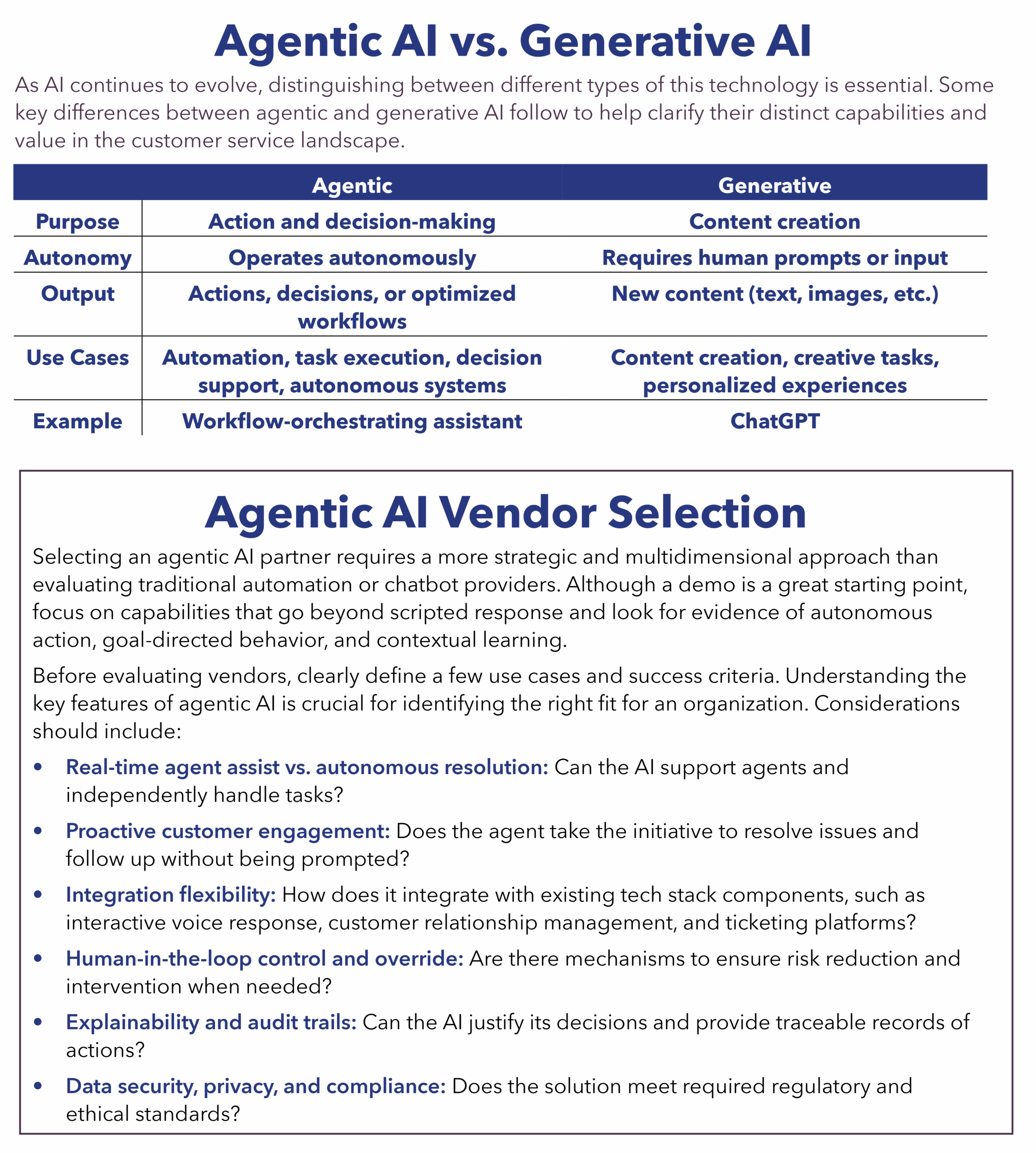
Article Links
- https://hbr.org/2025/05/agentic-ai-is-already-changing-the-workforce
- https://www.ibm.com/think/topics/agentic-ai-vs-generative-ai
- https://www.gartner.com/en/newsroom/press-releases/2025-03-05-gartner-predicts-agentic-ai-will-autonomously-resolve-80-percent-of-common-customer-service-issues-without-human-intervention-by-20290