
in this issue

How Back-Office Operations Contribute to Customer Experience Improvements
Back-office functions are often invisible but critical to CX success. Learn how to bridge silos, elevate operational voices, and turn behind-the-scenes work into a driver of satisfaction, loyalty, and growth.
by Execs In The Know
One of the biggest obstacles to delivering seamless end-to-end customer experience (CX) is the persistence of organizational silos where departments are isolated from shared information and goals. This is common due to traditional function-based organizational structures.
Execs In The Know recognizes this challenge and addresses it in a recent report, titled CX Without Silos: Bridging Front- and Back-Office Operations to Elevate CX, in partnership with NiCE. The report draws on a 35-question survey of nearly 50 CX leaders and reveals a growing disconnect: while back-office operations play a crucial role in CX, they often lack visibility in executive decision-making.1
By examining the pain points, operational realities, and emerging opportunities within the back office, the report provides a more comprehensive understanding of how these functions impact the broader customer journey. This article advances that conversation, focusing on how back-office operations shape CX and ways these silos can be broken down to deliver better experiences and unlock value across the organization.
The Challenge Landscape
Of the many key research findings, one insight revealed a paradox that highlights an untapped opportunity. Despite 63% of CX leaders rating back-office performance as “Good” or “Very Good,” nearly half report that investment in these operations is low. This disconnect reveals a critical blind spot: back-office functions are delivering value but remain underfunded and underprioritized. This limits their potential positive impact on the end-to-end CX as well as having a ripple effect on the employee experience, particularly for frontline staff.
A second important insight relates to an organizational blind spot: only 20% of CX leaders believe their C-Suite understands back-office operations. This finding may suggest a gap between executive decision-making and the operational realities that shape customer and employee outcomes. Such a disconnect can lead to strategies that appear effective on paper but are impractical or unsustainable in practice. On a positive note, this learning identifies a leadership opportunity: bridging the gap between the boardroom and back-office could unlock transformative improvements in both customer and employee experience.
The study also revealed a potential hidden impact on CX. Frontline teams typically are held accountable for customer satisfaction (CSAT) scores (whether good or not so good), but back-office functions like claims processing, billing, and order fulfillment often have an outsized impact on whether scores rise or fall. Back-office functions play a critical role in the end-to-end customer journey, and these teams should have a thorough understanding of their impact and visibility into pain points, solutions, and overall measurement scores.
In addition to knowledge and visibility, the research uncovered a measurement gap for back-office teams. Unlike front-office scorecards that focus on the efficiency and effectiveness of customer interactions, back-office key performance indicators (KPIs) monitor the operational health of the department. These scorecards generally are focused on measuring internal efficiency, productivity, quality, and accuracy. Without unified and standardized KPIs, the value of back-office operations to CX is challenging to prove, leaving leaders struggling to secure budget and visibility.

The Success Path
The report reveals a powerful opportunity for CX leaders: bridge the longstanding divide between frontline and back-office operations. What may appear as persistent challenges are actually solvable friction points waiting for intentional action. The study poses a critical question: How can leaders enhance cross-functional alignment, inform more informed investment decisions, and achieve better outcomes for both employees and customers? CX leadership should reimagine operational collaboration, elevate the visibility of back-office contributions, and unlock a more unified end-to-end experience.
Like many solutions, this transformation starts with education and awareness. Helping the C-Suite and back-office peer leaders understand the strategic role of operations in delivering seamless CX is job one. Back-office work must be reframed — not just as support tasks, but as drivers of revenue, retention, and satisfaction. This reframing is a crucial step in sparking a change in mindset.
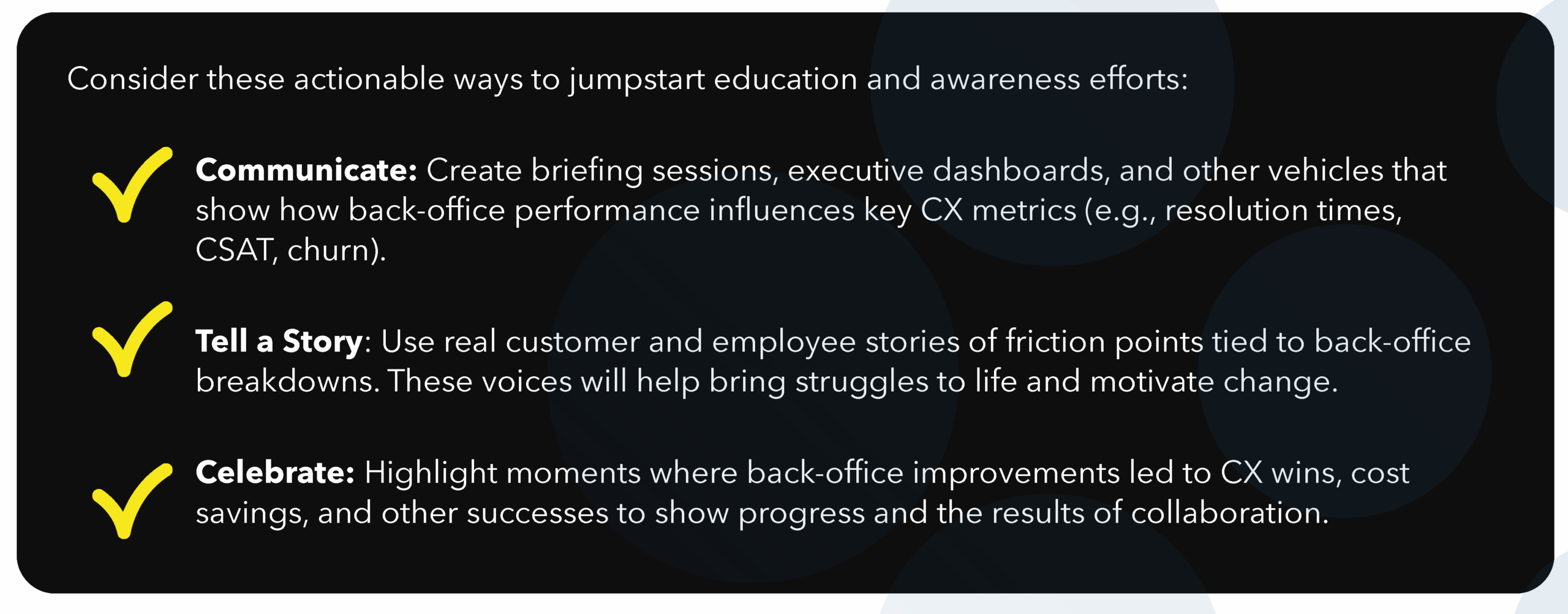
Once that mindset shift occurs, leaders can begin to see back-office excellence as a source of competitive advantage. Operational efficiency directly influences customer loyalty; billing accuracy, claims processing, account adjustments, and fulfillment speed all shape whether a customer’s experience feels effortless or frustrating. Elevating awareness also opens the door to investment in tools, training, and process redesign that improve customer and employee experiences. As awareness of the back office’s critical role in shaping customer and employee experiences increases, it’s equally important to ensure their voices are actively included in CX strategy development.
Elevating back-office voices in CX strategy is crucial for setting clear expectations and achieving the desired outcomes. Creating more cross-functional visibility and collaboration enables back-office teams not only to stay informed about CX priorities but also to contribute to them in meaningful ways. When these teams are engaged early and often, their insights can help identify process gaps, improve handoffs, and accelerate problem resolution, ultimately driving better outcomes for both customers and employees.
Some actions to elevate back-office voices in CX strategy include:
- Involve: Back-office leaders bring deep operational insight into the systems, workflows, and processes that directly shape customer outcomes, but typically behind the scenes. To ensure experience transformation efforts are grounded in operational reality, CX leaders should actively involve these peers early in the process by seeking their input, surfacing pain points, and co-designing solutions.
- Empower: Create structured channels for back-office teams to share insights, raise red flags, and contribute improvement ideas. Go beyond collection: establish a closed-loop feedback process that acknowledges contributions, follows up on actions taken, and fosters collaboration. This builds confidence in the new operating model and strengthens trust between teams.
- Govern: Form CX governance councils or “CX Without Silos” task forces that include cross-functional representation — not just from customer-facing teams, but from all departments that impact the customer experience, directly and indirectly. This shared ownership model ensures better alignment, faster decision-making, and a unified approach to delivering the end-to-end experience.
As back-office functions become more integrated into CX strategy development, they should also play an active role in defining the metrics that connect their work to broader business outcomes. When frontline and back-office leaders collaborate around shared CX metrics, silos give way to joint accountability. The conversation shifts from “keeping the lights on” to “fueling growth,” taking advantage of all parties at the strategy table. This alignment empowers organizations to innovate, break down bottlenecks, and deliver seamless customer journeys while reducing internal friction for employees.
Translating operational metrics into a language the C-Suite cares about is essential. Instead of presenting isolated process data, frame it in terms of outcomes leaders prioritize: efficiency, scalability, CSAT, and return on investment (ROI). By aligning operational insights with strategic business drivers, back-office efforts become visible not just as support activities but as key enablers of growth and competitive advantage.
Another critical step is building a compelling case around CX-focused metrics, such as CSAT, Net Promoter Score (NPS), effort, and retention. When operational improvements can be tied to rising CX scores, they become far more persuasive as strategic investments rather than tactical tweaks.

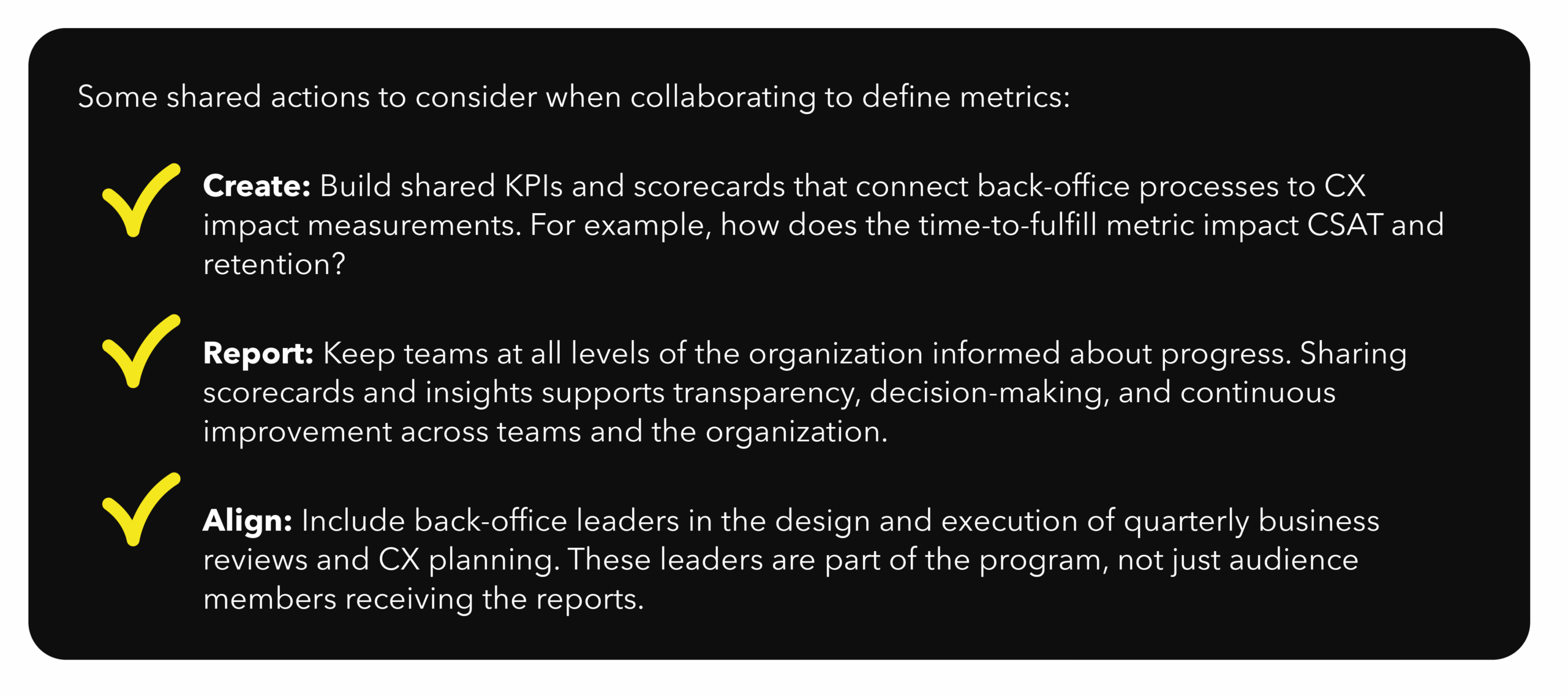
Increasing collaboration and reporting on improvements and opportunities is an excellent precursor to advocating for investment and modernization for back-office systems. Many brands struggle with outdated systems; in fact, 47% of CX leaders indicate the current level of investment in their back-office operations are either “Low” or “Very Low” compared to 17% who indicate “High” or “Very High.” 2 When senior leadership understands the stakes, they are more likely to approve investments in technology that improve back-office performance.
To tell a convincing story of how investment can improve CX, leaders should consider these actions:
- Document: Build a business case that quantifies how underinvestment in the back-office degrades CX. This may result from slow resolution, increased handle time, or creating new frustrations for customers and employees.
- Highlight: Make sure the business case shows how modernizing back-office systems improves KPIs and delivers an ROI. Consider the positive impact on both customers and employees. Chances are that agent experience, employee retention, CX consistency, and other internal metrics will also improve dramatically as a result of the investment.
- Update: Keep track of how KPIs and operations evolve, so the story remains fresh and up-to-date. A monthly or quarterly refresh of the data and results will help communicate the impact of investing (or not) in critical behind-the-scenes systems.
As considerations are made for what tools to invest in to increase collaboration, efficiency, and performance, artificial intelligence (AI) should top the list. Leaders repeatedly identify AI implementation and automation as an area for growth. According to Gartner, “by 2028, 33% of enterprise software applications will include agentic AI, up from less than one percent in 2024, enabling 15% of day-to-day work decisions to be made autonomously.”3
Organizations can greatly benefit from AI-driven systems that link departments to break down silos and power seamless collaboration. AI is a unifier; it can connect data, workflows, and insights and help orchestrate end-to-end processes, improving the customer and employee experience. These improvements may include lowering resolution time, reducing manual tasks, cutting costs, and/or replacing some back-office roles.
An actionable approach for using AI in back-office operations include:
- Identify: When introducing or expanding AI capabilities, organizations should select the most impactful use cases and align their technology selection and goals accordingly. For example, agentic AI can orchestrate and monitor handoffs between teams, enabling end-to-end visibility and accountability.
- Partner: CX and back-office leaders should work closely with IT business partners and outside firms (if needed) to understand the requirements for compatibility with existing systems.
- Protect: Leaders should also address governance, risk, and compliance. Key questions about AI explainability, data access, and handling must be surfaced and addressed as plans are made for selection and deployment.
 A More Collaborative Future
One of the most common challenges CX leaders face is working across siloed organizations to improve the end-to-end experience for customers and employees. Breaking down these silos to deliver better experiences and unlock value across the organization is no small feat. In addition, leaders often face low or no investment in seemingly invisible functions, such as back-office operations. They may be unsure about how to approach senior leadership for budget allocation.
Leaders have a variety of options to increase back-office contributions to the customer and employee experience. One starting point is managing up using education and awareness campaigns to help executives and peer leaders recognize the back office as a strategic lever, not just a support function. Equally important is elevating back-office voices in CX strategy discussions, ensuring that the people closest to operational processes have a significant influence in shaping the customer journey.
Another critical step is collaboration around metrics. By working closely with back-office peers to identify and define the measures that matter, leaders can better capture the impact of operations on end-to-end CX. This clarity not only strengthens cross-functional alignment but also provides a compelling case for investment and modernization, demonstrating how back-office performance impacts CSAT, NPS, loyalty and, ultimately, revenue.
Finally, leaders should prioritize AI integration in the back office. While education and metrics set the stage, the adoption of AI-powered solutions offers the most transformative opportunity. When implemented thoughtfully, AI doesn’t just streamline processes; it empowers employees, reduces errors, and creates more consistent and proactive experiences for customers.
Ultimately, reframing the back office is about reimagining its role in the enterprise value chain.
With the proper visibility, governance, and cross-functional collaboration, back-office operations can evolve from hidden cost centers into powerful engines of satisfaction, loyalty, and long-term growth.
| In luxury retail, precision and consistency are everything. How do you ensure that back-office functions like fulfillment or returns align with the elevated brand experience customers expect from Michael Kors?
“At Michael Kors, we recognize that every customer interaction, whether customer-facing or behind the scenes, must reflect the brand’s commitment to luxury, quality, and care. Our back-office operations play a pivotal role in delivering a seamless and elevated experience, especially in areas like warranty support, which directly impact customer trust and satisfaction. Historically, our warranty process was multi-layered, convoluted, and time-intensive, often leading to customer frustration. Recognizing this, we partnered closely with our back-office support team to reimagine the entire journey. Today, our process is streamlined, responsive, and customer-centric:
By integrating our back-office functions into the broader CX strategy, we’ve not only enhanced operational efficiency but also elevated the emotional experience of our customers. Every touchpoint—from claim submission to resolution—now reflects the care, attention to detail, and consistency that define the Michael Kors brand.” — Ebrahim Hyder, Vice President, Customer Service, Michael Kors |
Article Links