
in this issue

AI Can’t Fix Bad Knowledge: How Governance Shapes Customer Service
Knowledge governance is essential for AI to deliver consistent, accurate, and compliant CX.
by Sarah Jeanneault, VP Marketing at ProcedureFlow
| Artificial intelligence is redefining the contact center, promising better service, lower costs, and more productive employees. One obstacle consistently undermines these benefits: the quality of the knowledge AI relies on. Without knowledge governance, AI amplifies errors, spreads inconsistency, and increases compliance risks. For AI investments to succeed, organizations need to establish foundational elements like a knowledge governance strategy1 to ensure information is accurate, up-to-date, and scalable. |
 The AI Hype Meets the Knowledge Gap
Generative AI has captured the attention of customer experience leaders worldwide. Chatbots, intelligent assistants, and real-time coaching tools are being deployed at unprecedented speed. But beneath the excitement lies a harsh reality: AI is only as effective as the foundation it’s built on.
When knowledge is outdated, fragmented, or siloed, AI does not solve problems; it magnifies them. Agents and customers receive conflicting answers, compliance lapses occur, and trust erodes. The gap between expectations and reality is already visible by CMS Wire:2 while “extensive” use of AI in CX nearly tripled in the past year (from 11% to 32%), 16% of leaders now report AI has little to no impact on customer experience, up sharply from four percent a year ago. This makes it clear that poor inputs inevitably produce poor outputs, regardless of technological sophistication.
A Veritas report3 underscores this point, revealing that 45% of leaders say poor data management prevents them from leveraging emerging technologies like generative AI. Organizations that underestimate this risk often find that AI projects fall short of expectations, delivering operational headaches rather than transformative improvements.
The Foundation of Governance
Knowledge governance provides the structure AI requires.4 It is a deliberate framework that ensures information is accurate, compliant, and aligned with organizational objectives. At its core, governance means that there is established responsibility for content creation and maintenance, review processes are defined, and standards are set for accuracy, accessibility, and accountability.
This structure matters because organizations consistently rank siloed systems (28%), fragmented data (26%, and governance gaps (26% among their top CX challenges. Without governance, critical knowledge quickly becomes outdated, such as:
• Policy updates (e.g., healthcare or financial regulations).
• Product and service details (pricing changes, new eligibility rules, technical specifications).
• Customer-facing processes (escalation paths, onboarding steps, troubleshooting guides).
Governance builds confidence among agents who rely on accurate knowledge in real-time, supports leaders in mitigating compliance risks, and assures customers that they receive consistent, trustworthy information. It also reduces hidden costs associated with rework, escalations, and turnover. No surprise, then, that 25% of organizations now list “digital governance and content quality” as a top investment priority.
 The Risks of Poor Knowledge
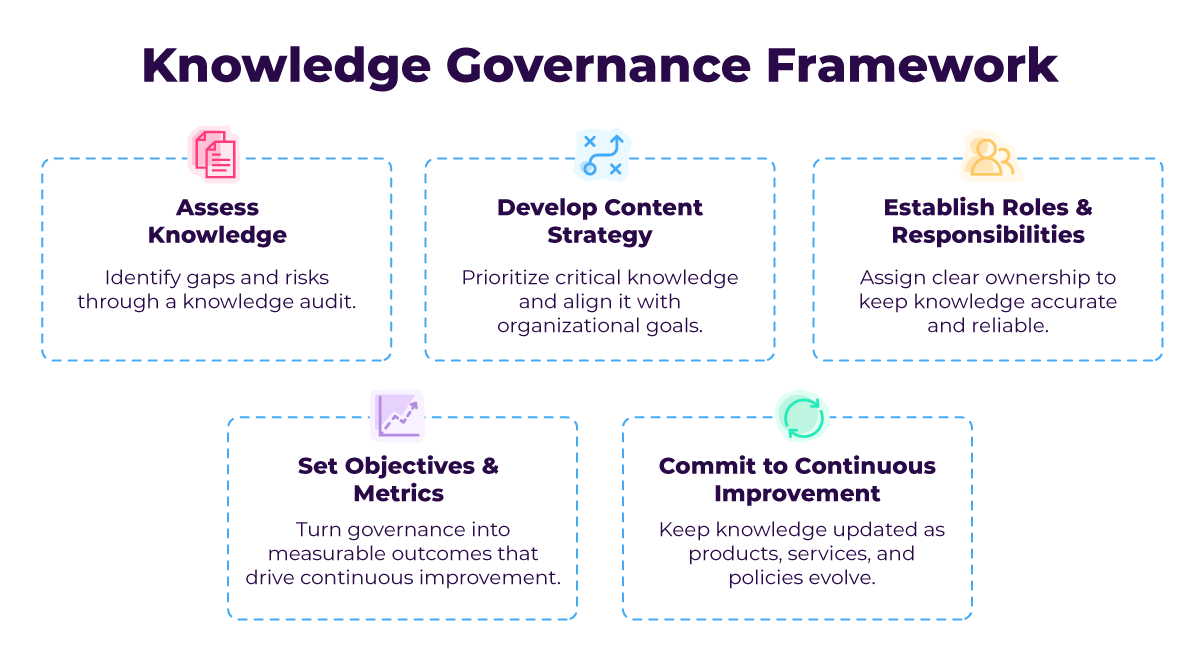
The absence of governance carries tangible consequences. Knowledge becomes scattered across multiple systems, expert insights go uncaptured, and outdated processes persist unchecked. This issue is only set to intensify as by 2030, 61 million baby boomers will exit the workforce, risking a massive loss of expertise and widening skill gaps.
The financial stakes are significant. Gartner5 estimates that poor data quality costs organizations an average of $12.9 million annually. Compounding the problem, MIT reports that 95% of organizations are seeing zero return on their $40 billion investments in generative AI, and Veritas finds that nearly 77% of corporate knowledge is redundant, obsolete, or trivial—precisely the type of unreliable information that causes AI systems to generate errors.
CX leaders also recognize the risks: 49% cite data privacy, 42% cybersecurity, and 31% IP protection as their top concerns when deploying generative AI. The result is more than just wasted spend; it decreases agent confidence and erodes customer trust. Agents struggle to navigate conflicting information, which fuels burnout and, ultimately, poor customer satisfaction and loyalty.
Knowledge and the Human Factor
The human element of knowledge is critical to both employee experience and customer outcomes. Ninety percent of CX leaders agree that employee digital experience directly impacts customer experience. When agents lack governed, reliable information, they face the leading causes of frustration: outdated policies, unclear processes, or conflicting answers across systems.
CX leaders know exactly what employees need:
• Collaboration tools (39%)
• Easy access to customer data (36%)
• Easy access to product/service info (34%)
AI can handle routine inquiries, but the nuances of empathy, judgment, and complex problem-solving remain uniquely human. Governed knowledge ensures employees are equipped with reliable information so they can focus on higher-value interactions.
With confidence in their tools, employees deliver more accurate, empathetic service, reducing turnover and increasing customer satisfaction—turning AI into a true complement6 rather than a competitor.
A Framework for Governance
Effective knowledge governance is not a one-time initiative but an ongoing discipline that requires careful planning, continuous monitoring, and adaptation. Organizations that succeed in implementing a framework follow a deliberate path that ensures both human agents and AI have access to accurate, timely, and actionable knowledge.
1. Assess the current state of knowledge. Conduct a knowledge audit to pinpoint gaps, redundancies, and outdated information across systems and repositories.
- Outdated content examples: expired promotions, obsolete troubleshooting steps, discontinued product manuals, or escalation paths tied to retired roles.
- Critical knowledge at risk: compliance rules, billing procedures, claims handling, onboarding checklists, or scripts used during customer interactions.
2. Develop a content strategy aligned with organizational goals. Define which types of knowledge are critical, how content should be structured, and who maintains it.
- Customer-facing knowledge: Product features, pricing structures, and self-service articles.
- Operational knowledge: Call handling protocols, escalation procedures, process flows for onboarding or billing.
- Regulatory knowledge: Healthcare policies, financial reporting requirements, or security and data-handling procedures.
3. Establish clear roles and responsibilities. Assign ownership for content creation, updates, and approvals. For instance, product teams should maintain feature documentation, compliance teams oversee policy updates, and operations leaders ensure processes are accurate. Without ownership, outdated or conflicting knowledge lingers and erodes trust.
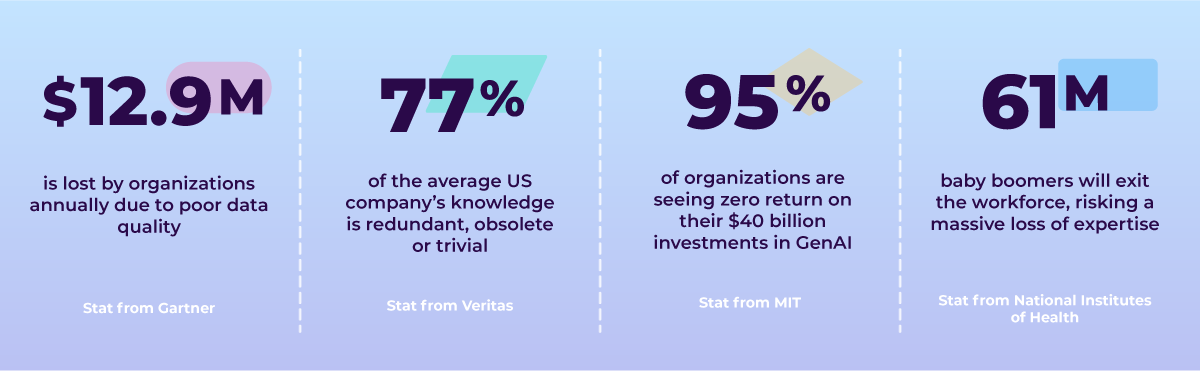
4. Set objectives and performance metrics. Translate governance into measurable outcomes. Common goals include:
- Reducing escalations caused by inaccurate information
- Improving first-contact resolution rates
- Increasing employee confidence in knowledge systems
- Ensuring regular review cycles (e.g., every 90 days for regulated content)
5. Commit to continuous improvement. Knowledge must evolve alongside the business. As products, services, or policies change, updates must flow quickly into customer-facing and internal knowledge. For example, retail teams must refresh seasonal return policies, insurers must reflect new eligibility criteria, and utilities must update outage protocols.
By following this structured approach, organizations ensure that both AI and human agents always have access to the most reliable version of critical knowledge.
 Preparing for the Future of CX
The question for contact centers is no longer whether to adopt AI, but whether they are ready foundationally and strategically to ensure it is successful. AI cannot create accuracy where none exists; it only amplifies the quality of the information it consumes.
Knowledge governance provides the foundation for AI to deliver on its promise. It ensures accuracy, reduces risk, and gives employees the confidence to perform at their best. By prioritizing governance today, organizations move beyond hype and build a sustainable, AI-enabled future for customer experience.
Technology alone will not guarantee success. Organizations that treat knowledge as an afterthought risk undermining the very tools they hope will deliver value. Those that put governance at the center achieve lasting improvements: faster onboarding, higher customer satisfaction, stronger compliance, and better agent performance.
By embedding governance into their AI strategy, organizations can scale technology responsibly. As AI capabilities advance, both people and systems stay aligned, delivering consistent, high-quality customer service at every interaction.
|
|


Article Links
2. https://www2.cmswire.com/cp-smg-dcx-report-cx.html
5. https://www.gartner.com/en/data-analytics/topics/data-quality