in this issue

Leading with Clarity in the Age of Distraction
A former NFL quarterback and current Senior Director at one of the nation’s largest churches (18 campuses, 60,000 attendees, 400 employees) shows how to train focus under pressure and build systems where frontline teams thrive.
by Execs In The Know
The modern workplace runs on pings and pop-ups. Every hour brings another dashboard, another alert, another demand for attention. Information has never been more abundant, or more exhausting. But, what if the defining skill of leadership today isn’t absorbing more data, but filtering it? What if the real edge lies in discernment: the ability to separate the trivial many from the vital few?
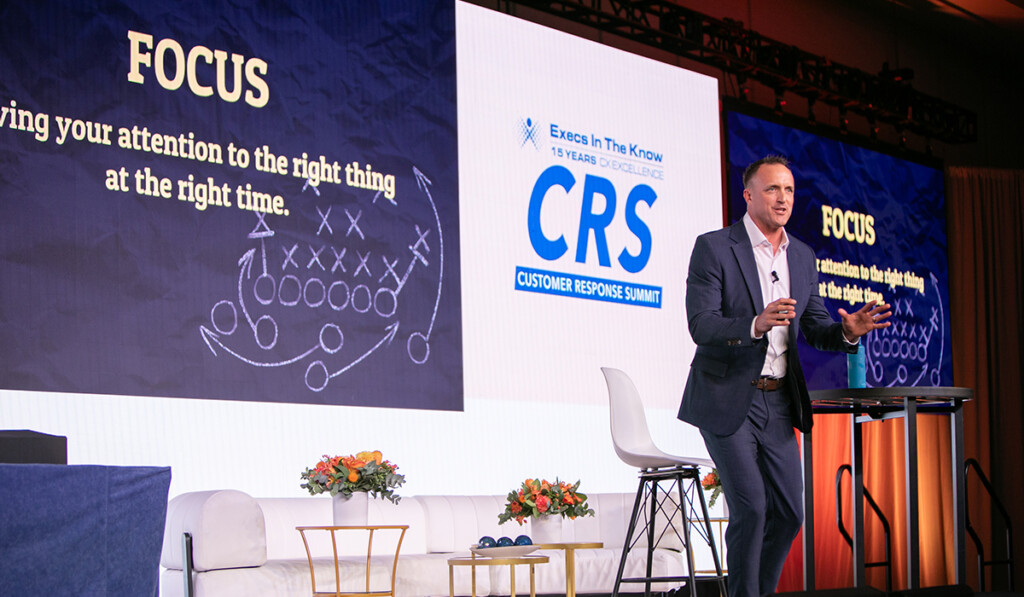
That is the question Travis Brown pressed onstage at the Customer Response Summit (CRS) in San Diego in September. Brown is not a conventional business thinker. A former NFL quarterback, he built his career in environments where clarity under pressure was not optional, but a matter of survival. Today, his work is rooted in the same conviction: clarity doesn’t materialize on its own. It is chosen, practiced, and protected.
The lesson for executives is as uncomfortable as it is liberating. In a world addicted to more — more dashboards, more key performance indicators (KPIs), more meetings — clarity demands subtraction. What are you willing to mute so your team can hear what matters? Where are you willing to trade breadth for depth, noise for signal, speed for steadiness?
The ability to rise above the noise, name what matters, and act with conviction has become the defining edge. Read on to learn how to simplify the noise, anchor to purpose, and build teams that focus on what truly matters.
How to Design for Clarity
The hardest part of modern leadership isn’t finding answers; it’s choosing attention. In an economy that monetizes our every glance, the leaders who win aren’t the loudest or the busiest; they’re the clearest. The best leaders don’t chase more; they choose better discipline inputs and curate the voices they trust. And they decide, in advance, what deserves their and their team’s limited focus.
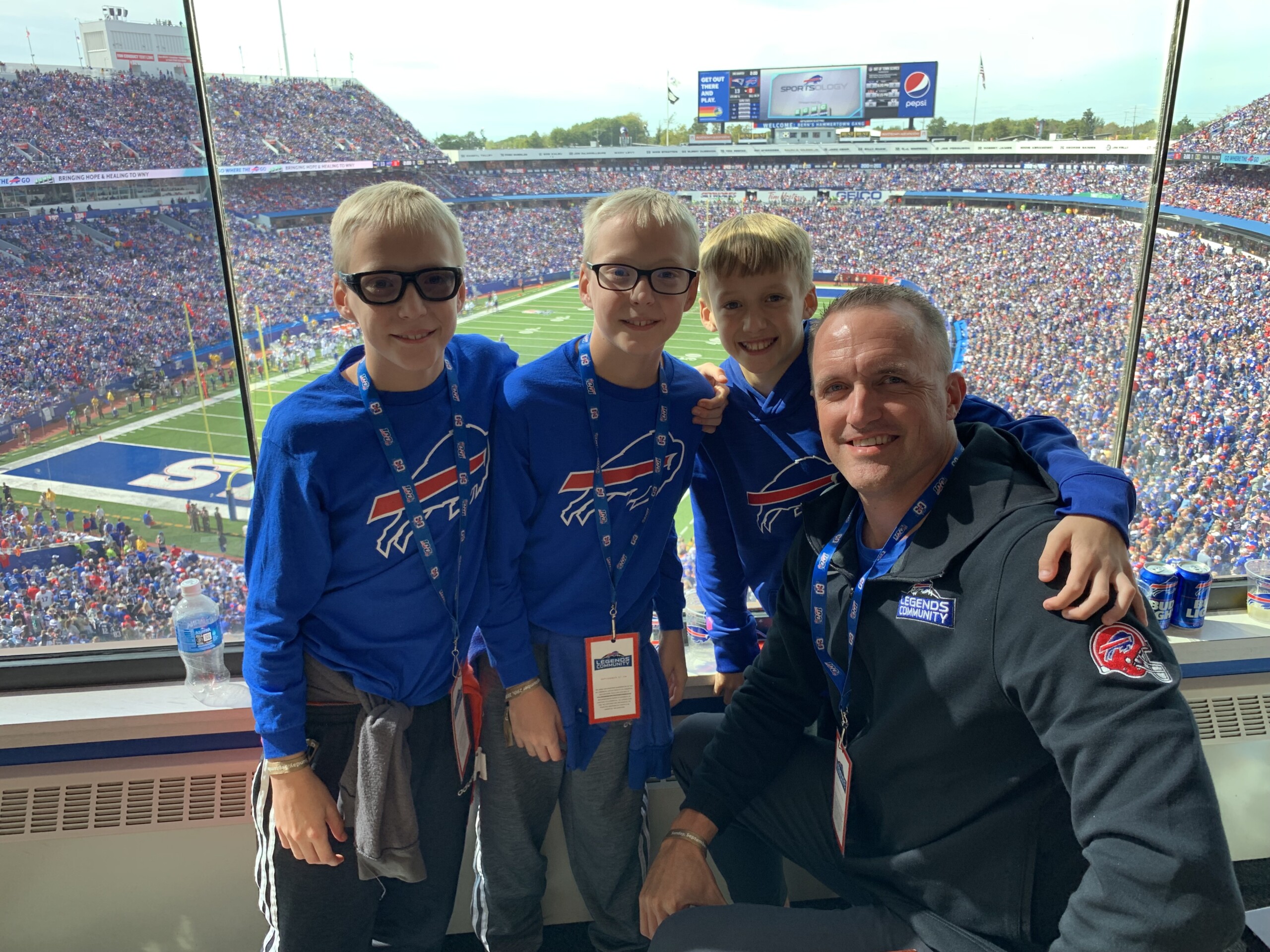
Brown has learned that discipline is essential under bright lights and in high-stakes situations. An All-American quarterback at Northern Arizona who went on to spend six seasons in the NFL (Eagles, Seahawks, Bills, Colts), Brown understands what pressure does to human performance and how to design for clarity when the clock is running and the margin is thin.
 Today, as Senior Director of Campus Teams at Christ’s Church of the Valley (CCV) in the Phoenix area, he oversees 18 campuses, a weekly attendance of roughly 60,000, and approximately 400 employees. His core conviction is simple and relentlessly practical: focus can be trained.
“Playing college and professional football placed me in environments that demanded my full attention while bombarding me with distractions. I learned how to lock in on the task at hand and cut through the noise, not just for myself but for the entire team. That discipline has carried into my leadership today — focus on what truly matters in the moment,” Brown explains.
What, exactly, is focus? It’s giving your attention to the right thing, at the right time. During his keynote, Brown noted that the average person now consumes the equivalent of 74 gigabytes of information a day (roughly 16 full-length films), up from 34 GB in 2009. We consume more information in one day than someone from the 15th century consumed in their entire lifetime.
At work, the average employee context-switches around 1,200 times a day, leaking about 40 minutes of productivity every day into the cracks. Distraction isn’t a character flaw; it’s a system. Leaders who don’t counter-design for it will spend their careers reacting.
The countermeasure isn’t more willpower or apps. It’s your starting posture: begin centered so you can absorb the noise and lead steadily.
Start Centered, Lead Steadily
Brown’s reputation for steadiness didn’t emerge from theory. Early in his post-NFL life, he and his wife welcomed twins born at 27 weeks, weighing just over one and two pounds each. Their neonatal intensive care unit (NICU) stay stretched to 72 days. At the time, he had three children under six at home, had just retired due to injuries, and the economy was in a state of collapse.

That season of life, he says, forced him to “rightsize” everything. Urgency clarified what endures; noise fell away. “When doctors tell you your son may only live another hour, all the other noise — markets, possessions, distractions — fades quickly. The twins are 17 now and thriving, but that perspective has never left me.”
It’s why, to this day, he starts his mornings in silence, reading, reflecting, journaling, before he ever opens a screen. Rituals don’t make leaders rigid; they make them ready.
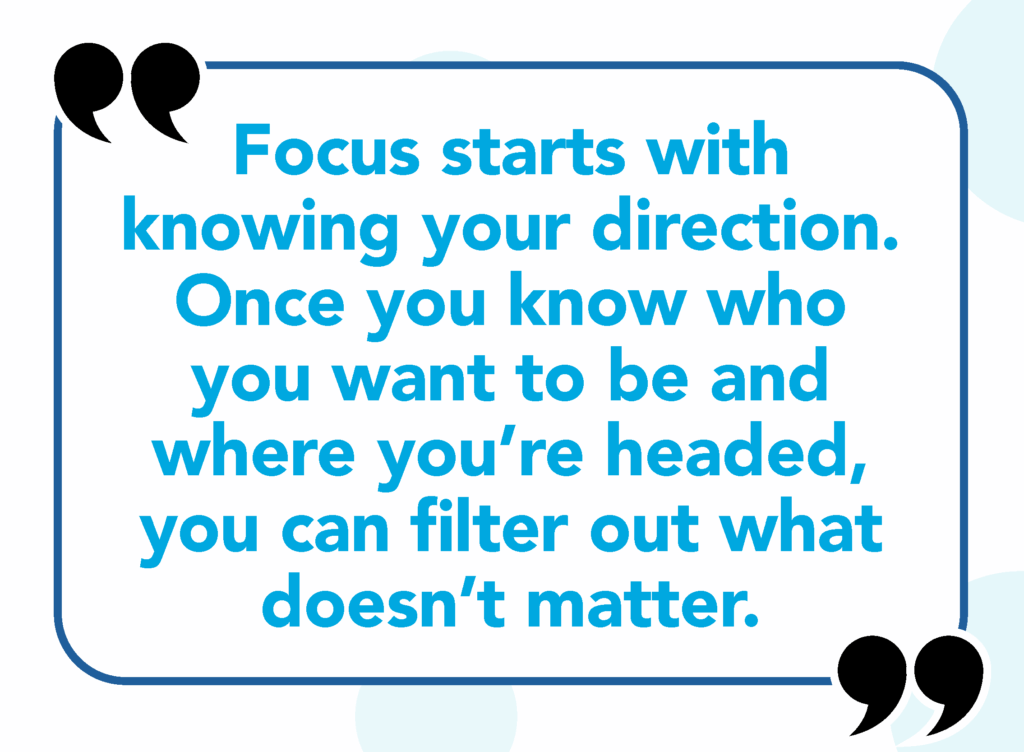
“Focus starts with knowing your direction,” explains Brown. “Once you know who you want to be and where you’re headed, you can filter out what doesn’t matter. That’s why my mornings are sacred. I don’t need my phone or computer. Distractions don’t get to set the agenda. By blocking what doesn’t matter in that moment, I start the day centered and focused. When leaders take care of themselves, they’re better in every other area of life. The ministry has shown me what truly matters in high-pressure moments. Sitting with families in tragedy or crisis strips away everything nonessential. Perspective is clearer when you’ve seen what doesn’t last.”
And when change is constant, Brown anchors his teams in a phrase that cuts through the angst of new tools, new structures, and new expectations, saying, “We’re married to the mission, but only dating the methods.”
It’s a position of conviction without rigidity, exactly the temperament customer experience (CX) organizations need as technology accelerates and customers’ expectations rise. “At CCV, everything is constantly shifting — growth, expansion, change. Our mission remains unchanged, but our methods often evolve. If you cling too tightly to methods, change will frustrate you. Stay anchored in mission.”
Discipline Your Inputs
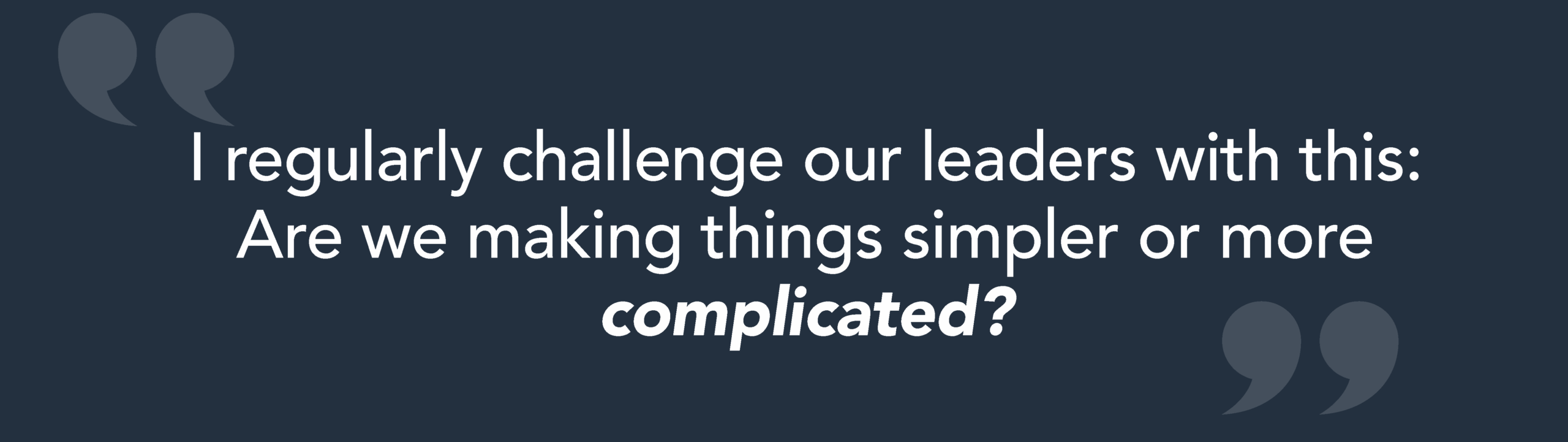
Brown asked a tricky question to our audience at CRS: “Is the information I’m giving or consuming actually beneficial?” In CX, we take pride in our instrumentation, dashboards, and alerts. “I regularly challenge our leaders with this: Are we making things simpler or more complicated?” he says. Tools should reduce cognitive load for the frontline, not increase it. If a new system adds steps without adding clarity, it’s noise, no matter how clever the feature list.
That same scrutiny applies at the personal level. Cleaning up inputs isn’t an existential audit; it’s a habit that should be adopted. Brown’s advice: start with the obvious workarounds and zombie reports — the ones no one can explain, but everyone still receives.
“Simple wins create space for what truly matters,” he notes. Focus grows where clutter shrinks. “Technology promises efficiency but often creates noise. Leaders need to ask: Does this tool simplify or complicate the process? Does it serve our people, or does it serve itself? If it adds clutter instead of clarity, it’s not worth it,” Brown adds.
Clarity for the Frontline
Frontline contact center agents face constant distractions while trying to stay present with customers. Clarity helps them cut through that noise so they can focus on the real goal of solving the customer’s problem. When agents know what matters most in a call, they can stay calm, make quicker decisions, and avoid getting lost in endless alerts or competing priorities.
Clear direction also builds confidence. Agents who understand which metrics truly drive customer satisfaction can utilize artificial intelligence (AI) tools and data as support, rather than distractions. That focus keeps conversations human, improves service quality, and reduces burnout — benefits that ripple across the entire customer experience team.
The key question leaders must ask is: Does the information I’m giving my team help us accomplish our mission?
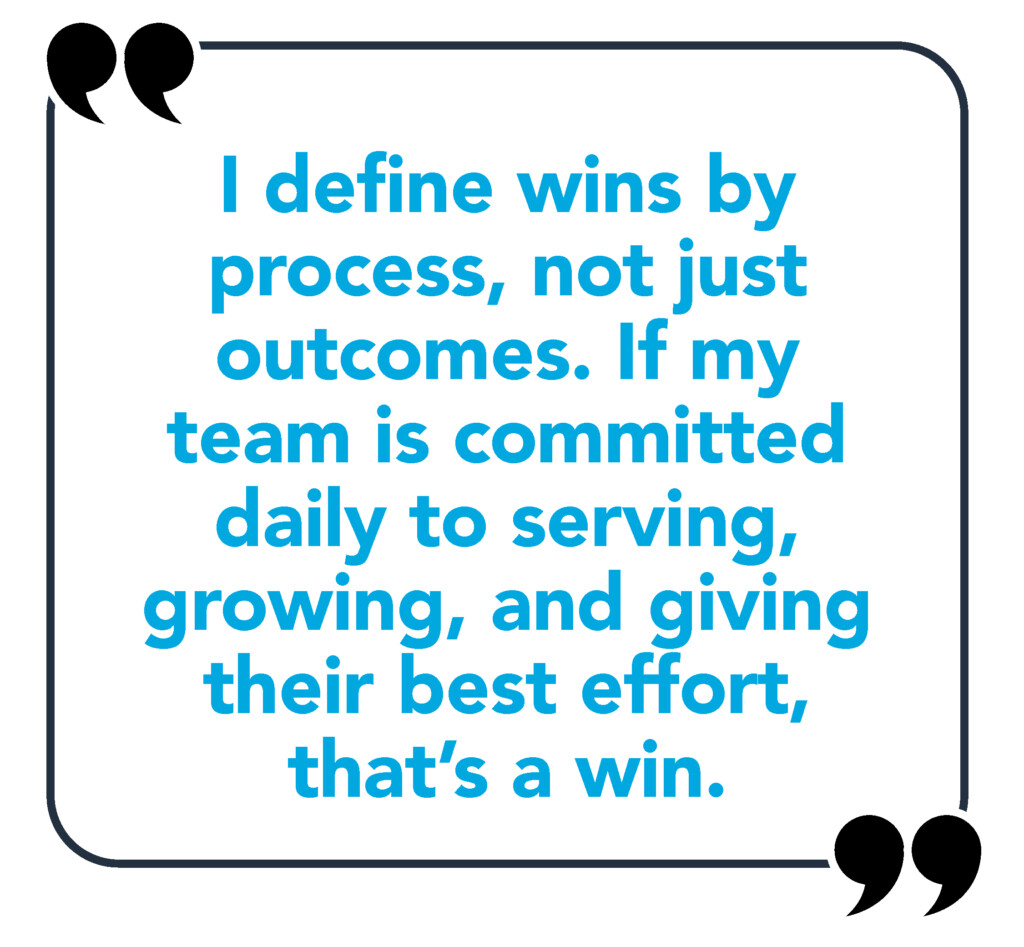
“If frontline teams are bogged down with endless alerts, dashboards, and updates, they won’t serve customers well,” Brown explains. “Growth naturally brings more systems, but we have to fight for simplicity. I regularly challenge our leaders with this question: Are we making things simpler or more complicated? Our frontline teams need us to keep things simple. With 18 campuses, we pilot new tools in smaller contexts first. We gather feedback from the people who actually use them to ensure they empower rather than overwhelm. Rollouts should build confidence, not confusion.”
Learning from Setbacks
Failure has a way of shaking us out of autopilot. When the usual methods don’t work, we’re pushed to reimagine, test new ideas, and try solutions that might not fit neatly into the box. That discomfort often becomes the spark that leads to real breakthroughs. In this sense, setbacks aren’t just obstacles; they’re raw material for creativity and innovation.
Start treating failure as fuel, not a dead end. Instead of labeling mistakes as defeats, use them as springboards to explore fresh approaches and experiment with bold ideas. Build a culture where calculated risks are encouraged and missteps are recognized as part of the creative process. When both wins and losses are valued, your team will see each step — forward or sideways — as movement toward discovery and progress.
“I once drove my father-in-law’s diesel truck and accidentally filled it with regular gas. A quarter mile later, the truck broke down on the side of the road. The lesson? Details matter. One small misstep can lead to significant problems. I also learned my father-in-law is very forgiving!” says Brown.
Curate the Right Voices
Information is one thing; influence is another. In a world of constant commentary, Brown urges leaders to curate the voices that actually help you see. He asks two questions: Are the voices I’m listening to beneficial? And have they been where I am — or where I want to go?
The loudest voice is often that of the customer; the wisest voice is often that of a peer or mentor who has carried similar weight. Great leaders don’t pretend to know everything. Great leaders don’t always have all the correct answers; they ask the right questions.
Importantly, Brown flips the mirror: what does your team hear when they hear your voice? Do your words lower the temperature, clarify the next move, and reinforce standards? Or do they add static to an already noisy system? In pressure moments, teams need steadiness, not volume.
Choose Your Altitude (On Purpose)
One of Brown’s most useful operating models is what he calls leadership altitude. Some days demand the balcony; others require the trenches. The point isn’t to pick one; it’s to know your current altitude and communicate accordingly.
“Every day I shift leadership altitude,” he says. “One moment I’m looking one to three years ahead; the next I’m down in the weeds on an operational challenge. Both perspectives are important, and they inform each other. My football background reminds me of this. On the field, I needed a coach in the box, seeing the game from a higher altitude with a broader perspective. I could only see what was right in front of me, while he could see the whole field. Both views were critical, but they required clear communication. The same is true in leadership: altitude only helps if we communicate clearly about what we see.”
Altitude mistakes are costly: too much time spent low, and the business drifts; too much time spent high, and you miss real-world friction. Brown suggests designing your calendar to match the altitude you intend, strategic blocks protected from tactical interruptions, and tactical windows where you’re intentionally present with frontline realities. In meetings, label the altitude: are we here to decide strategy, or to solve execution? Mixed altitudes make for muddled outcomes.
“The best leaders anticipate when they’ll need to operate at different altitudes and build their schedule around that. You can’t plan every frontline detail, but you can protect time to think strategically and set your headspace. One practical shift: ask questions. Leaders often stay in decision-making mode, but slowing down to ask clarifying questions helps ensure decisions are rooted in understanding,” Brown adds.
In the AI Era, EQ is the Edge
Brown is enthusiastic about technology, including automation, analytics, and AI, which removes toil and elevates experiences. But he is blunt about the differentiator: “With all the conversation around AI, the differentiator will actually be emotional intelligence (EQ). Systems can be trained, but empathy can’t be automated.” Leaders who read the room, manage themselves effectively, and connect across diverse contexts will outpace those who merely deploy tools.
 Operationally, EQ shows up in choices that never make a product roadmap: when a bot hands off before frustration peaks; how a frontline leader acknowledges emotion before quoting policy; which metric gets deprioritized so a human can stay with a customer two minutes longer. It’s the tone of a make-good, the cadence of an apology, the judgment to do the unscalable thing at the exact right time. AI gives us time back; EQ determines where that time delivers trust.
Teams with high EQ convert tense moments into loyalty, surface richer insights from verbatim feedback, and design journeys that prioritize dignity. Leaders can hardwire it: hire for curiosity, coach with live call reviews that name emotions, reward outcomes that balance efficiency with care, and give playbooks that script principles, not people. In other words: “AI is less than EQ when the work is human,” says Brown.
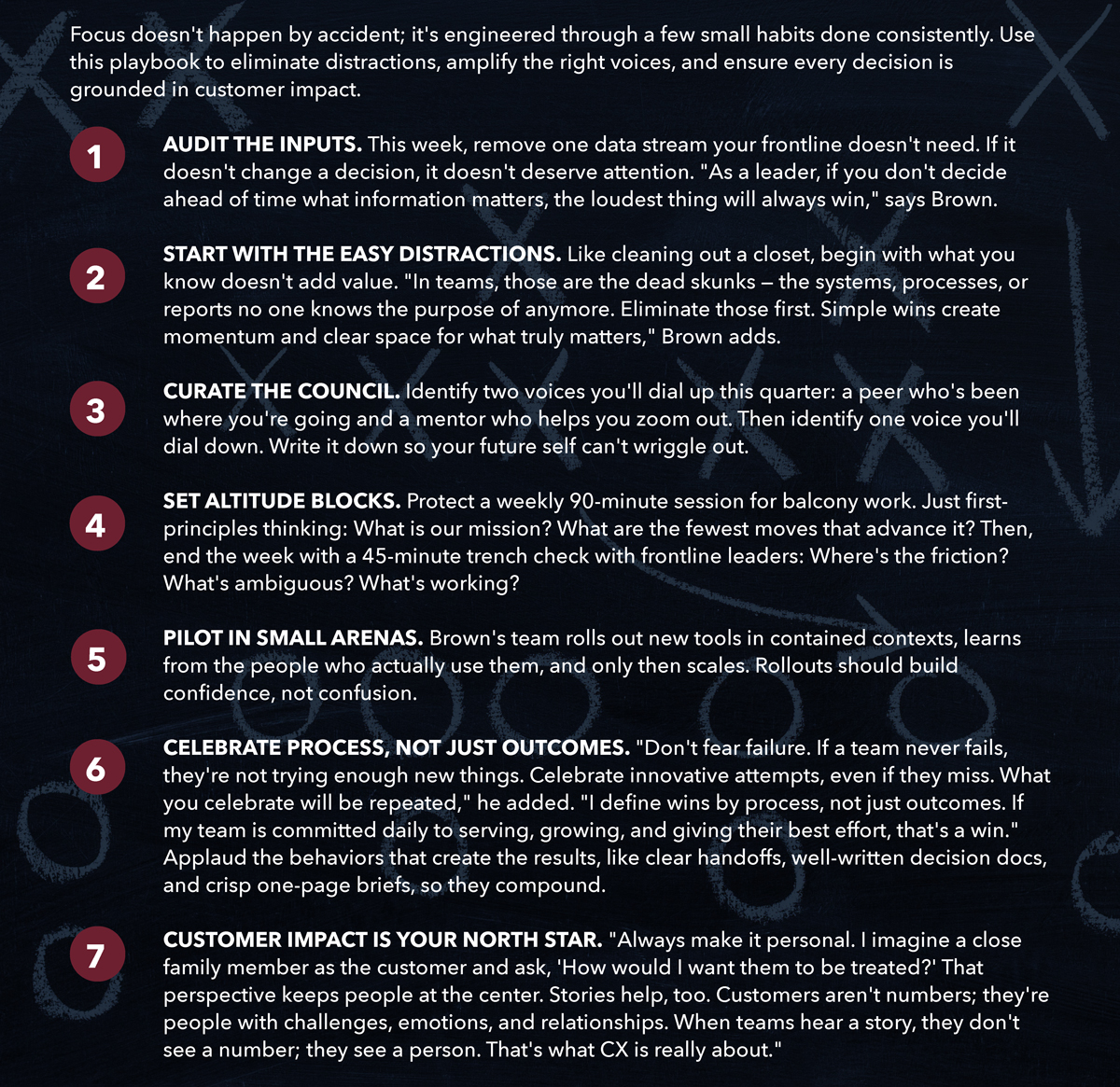
A Practical Playbook
 Are You Leading with Clarity?
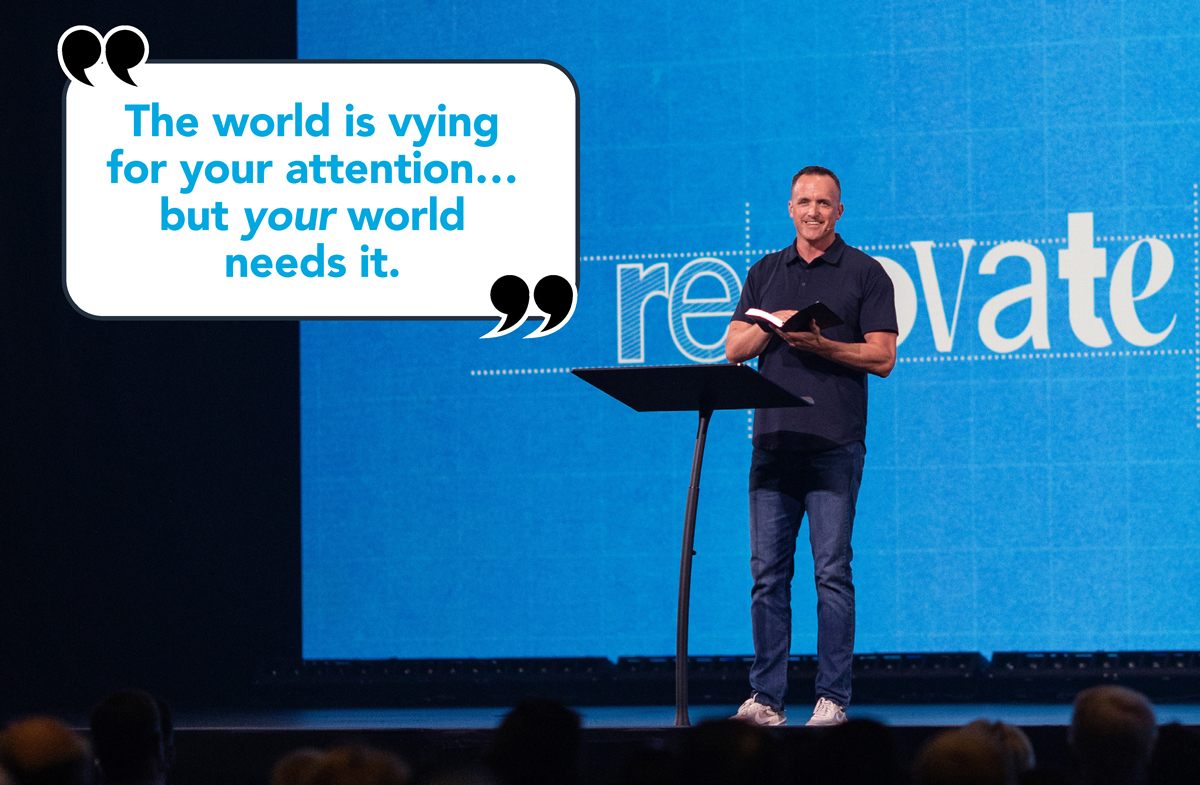
The attention economy isn’t going away. “The world is vying for your attention … but your world needs it,” he urged during his keynote. In the end, clarity is less a lightning bolt and more a rhythm you train into the day. It’s the huddle before the snap: choose your altitude, call the play, and trust the reps you’ve put in.
The leaders who steady a room aren’t louder; they’re anchored. They start centered so they can lead steadily. They’re married to the mission and only dating the methods, which means change doesn’t shake them; it serves them. They curate the few wise voices that sharpen perspective, strip away the dashboards that don’t change decisions, and roll out tools in small arenas so confidence grows before complexity does. When pressure spikes, they lower the temperature, name what matters, and give their teams the rare gift of focus: the right thing, at the right time.
So, what does this look like in practice? Protect one balcony block to think from first principles. Walk the trenches and ask what’s frictional or kill a zombie report. Pilot the smallest version of the next idea or coach for focus, just as quarterbacks practice under pressure, on speed, and on repeat, so that the response becomes instinctual.
And when the choice is between speed and humanity, let EQ lead; that’s where trust is built and loyalty compounds. The world will continue to vie for your attention. Give it, intentionally, to the work and people that last, and watch clarity turn into a competitive advantage. Give your attention to the right thing, at the right time.