
in this issue

How CX Efficiency is a Win-Win for Customers and Employees
Five Key Priorities for Improving Customer Satisfaction and Lowering Cost-to-Serve
by Claire Beatty, Senior Director, Thought Leadership, Genesys
Seventy percent of consumers worldwide say a company is only as good as its service. This means there’s no time for complacency in customer experience. Businesses need to move at the speed of the customer by keeping pace with the latest strategies, technologies and trends. At the same time, CX leaders are looking closely at cost-to-serve, expecting a clear return of investment on transformation initiatives.
A focus on efficiency is typically the path taken to reduce cost-to-serve. And yet, an efficiency drive that focuses purely on cost metrics is likely to leave customer and employee experiences lacking. At a time when loyalty is more critical than ever before, organizations need a better approach.
When efficiency is customer- and employee-centric, it creates a crucial win-win that businesses need to remain competitive. Efficient experiences can also be highly empathetic, allowing customers and employees to achieve their goals, all while cutting a company’s service costs.
The key to customer- and employee-centric efficiency is the strategic use of CX technology. Today’s technologies enable organizations to streamline processes in myriad ways. For example, AI can predict intent, which helps increase first-contact resolution. Chatbots can handle and triage requests, reducing agent-assisted interactions. Advanced analytics tools can provide the insights needed to contextually personalize interactions, shortening time-to-resolution.
Focus on time-to-resolution
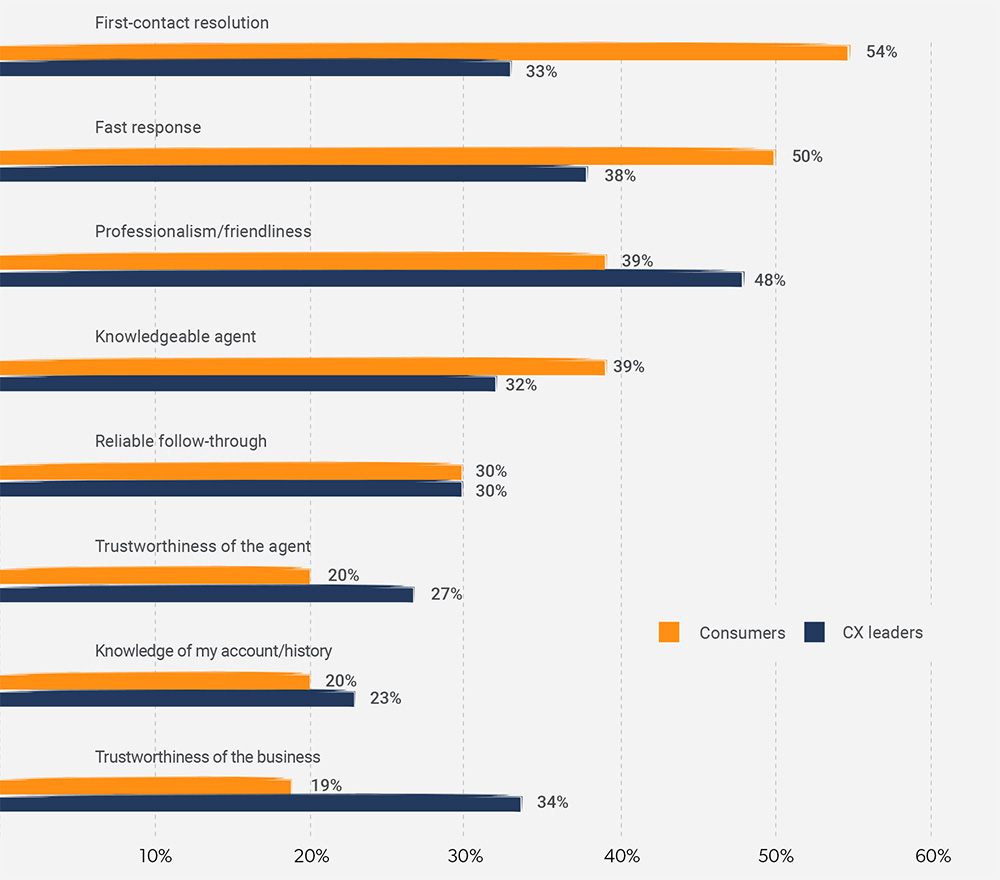
It may seem counter-intuitive, but customers want efficiency — that’s being heard, understood and having their issue resolved completely. In fact, a recent global survey found more than half of consumers globally say their greatest priority in a service interaction is a first-contact resolution.
Business leaders, however, say they are most focused on agent professionalism, friendliness and providing a fast response, when interacting with customers. Just 41% of leaders say their company is very effective in achieving a first-contact resolution. There is an efficiency gap to close.
The first step toward closing that gap is understanding what is driving repeat interactions. Why are customers being directed across channels and how can those root causes be addressed?
Consumers and CX leaders: Which is these do you/does your company value the most in a customer service interaction?
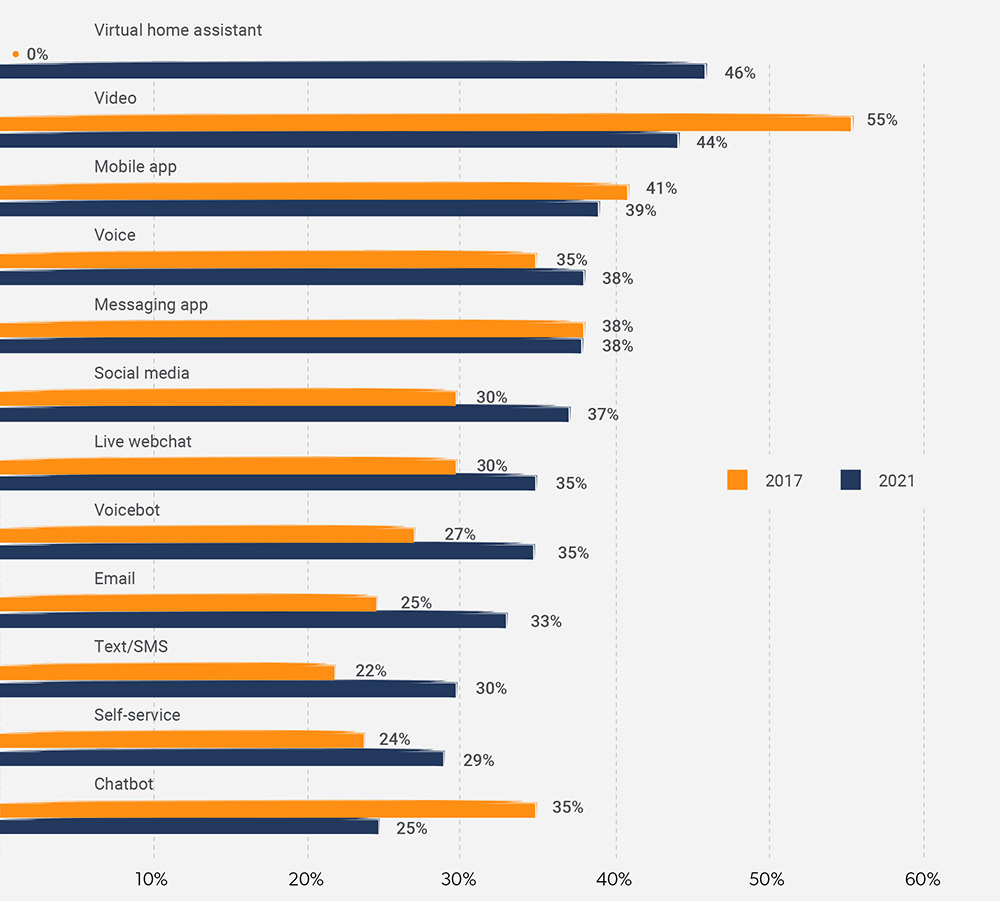
Consumers: Rate your overall satisfaction with each of the methods you use to interact with customer service (% selecting “highly effective”)
A leading strategy for businesses to improve efficiency is to increase self-service. Genesys customers are generally working towards upwards of 50% of customer interactions to be successfully managed by self-service channels. When these channels work best, they use AI to provide contextually relevant information and interactions, are built for purpose and well-integrated with agent-assisted channels.
Banish bad bots
More than a third of consumers say they have used a chatbot within the past year. But just a quarter are highly satisfied with those experiences. In fact, satisfaction with chatbots has declined in the recent years.
How can businesses banish those bad bots? It’s time to bring in AI. Instead of just serving as an interactive FAQ, chatbots should recognize known customers and use on-site behavior data to understand intent and personalize interactions. A shift from “How may I help you?” to “I see you got an error on the previous page. Would you like assistance with that?” creates a more efficient and engaging interaction. About one-third of surveyed business leaders use AI to power conversational chatbots, and 37% say they plan to do so in the coming year. Similarly, AI-powered voicebots can use customer profile and intent data to streamline, triage or complete interactions.

Let technology do the hard work
Many CX employees are compensated and coached on being efficient. A survey of more than 1,000 US contact center agents found 56% consider their greatest strength4 to be efficiency, speed and adherence. On the flip side, just 7% said their greatest strength was quality, listening and empathy.
Which of the following employee metrics have seen the most substantial improvements since your organisation’s implementation of AI? (%)
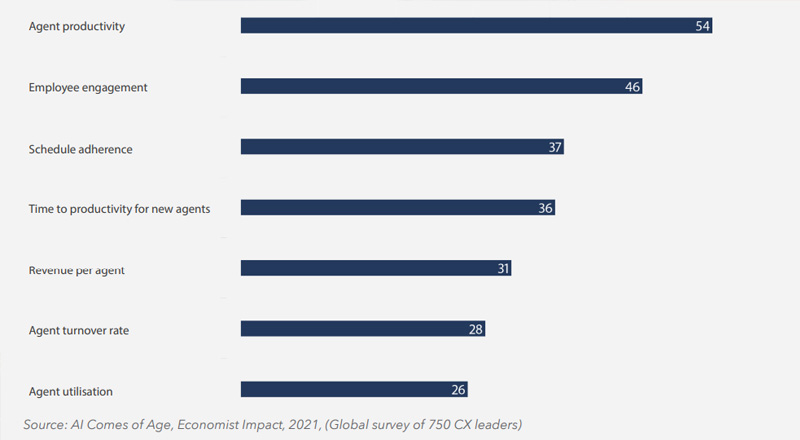
To give employees more time to focus on the listening and understanding part of their job, technology can bring the efficiency. Some of those capabilities include automating routine manual processes and administration to reduce employee stress, using AI to identify coaching and training opportunities, monitoring sentiment in real time to allow agents to course-correct and adding gamification to deliver results against desired metrics in a fun and engaging way.
The result of a better working environment? A stronger employee value proposition that reduces hiring and onboarding costs, boosts engagement and productivity, and ultimately makes customers happier. Since retaining customers is far more cost-effective than acquiring new ones, these efficiencies translate into real savings.
Get to grips with data
Modern CX technology generates a wealth of data that businesses can use to unlock efficiency and improve experiences. This starts with knowing who your customer is and predicting why they might be interacting with your business. We call the technologies that support these capabilities the “Systems of Listening.” They use AI to develop a deep understanding of customers to include their preferences, web activity and conversation history, allowing for real-time engagement and personalization.
However, many businesses are still experiencing challenges around data siloes and information blind spots. Almost half of surveyed business leaders say their agents need to look up customer identification information during voice or digital interactions, rather than having it readily available. And only one-quarter conduct identity stitching (linking identifiers such as cookies and social media handles) to build a more complete picture of their customers.
CASE STUDY: Company Nurse
Company Nurse specializes in workplace injury management. It has registered nurses available 24/7 to triage workplace injuries and get workers’ compensation claims off to an ideal start.
With Millennials and Generation Z entering the workplace and organizations becoming more distributed, Company Nurse needed to ensure that injured workers could connect via multiple channels. But its existing on-premises system was expensive to maintain and manage. Additionally, there was no real-time visibility into contact center operations or effective way to organize data into configurable reports and measurable KPIs.
Company Nurse implemented Genesys Cloud CX™ for phone and email in a matter of weeks, and took a phased approach for channels like SMS, social media and web chat (including click-to-dial functionality), along with proactive func-tions like outbound dialing and push notifications.
Since migrating to cloud, Company Nurse has improved its metrics across the board:
- 269% ROI with 4.8-month payback
- $50,000 saved annually with reduced overflow calls
- 20% increase in call volume without adding agents
- 21% decrease in agent idle time
- 11-13% decrease in average handle time
- 10-point rise in adherence levels, from low 80s to mid-90s
“Genesys Cloud CX is a beauti-ful, reliable tool that creates a positive experience for both our agents and our customers,” said Henry Svendblad, Chief Technol-ogy Officer at Company Nurse. “There aren’t too many instanc-es where you can have a positive impact on every stakeholder in the process. With Genesys Cloud CX, we do.”
Efficiency leads to myriad business benefits
Faster and more complete customer interactions increase loyalty, engagement and retention – both of customers and employees. And that’s why being efficient is really at the heart of being empathetic. If you put yourself in the shoes of the customer, you want to complete your sale or service request as quickly and conveniently as possible. Being known and heard is the most efficient and rewarding response. As an employee, you want to succeed every day – meet your goals with high-quality work and pleasant, productive interactions. That’s why for businesses, efficiency is a win-win-win.

Claire Beatty |
About the Author:Claire leads Thought Leadership for Genesys, writing about innovation across the customer journey, digital transformation, AI and the future of work. She previously held editorial roles at MIT Technology Review and the Economist Intelligence Unit.
Learn more at Genesys.com |