An Early Look: Corporate Trends and Insights
By: Execs In The Know and COPC
Since 2012, Execs In The Know has partnered with COPC, Inc. to compile the hottest, industry trends, year-over-year insights, and advanced data in the form of the Customer Experience Management Benchmark (CXMB) Series.
With three different installments –Corporate Edition, Consumer Edition, and Vertical Insights – nowhere else will you find this level of actionable industry insights and trends all in one place.
We are pleased to give you a sneak peek into our upcoming release of the Corporate Edition – scheduled for full release in March at our Customer Response Summit Event in Hollywood, Florida.
This year, we introduced several new questions in the Staffing and Technology sections.
In the Staffing section we added a question on the utilization of “Gig Agents,” and another that examines the deployment of “universal agents” — that is, agents capable of handling a wide variety of issue types.
In the Technology section we added questions aimed at understanding the corporate objectives of artificial intelligence (AI) deployment, along with follow-up results for many of the AI-related questions introduced last year.
We’ve also added a special section devoted to comparing results from the 2019 CXMB Series Consumer Edition (released in September 2019) and the latest Corporate Edition results. By comparing the Consumer Edition and the Corporate Edition results, the CXMB Series provides readers with a unique and powerful set of insights.
Get your sneak peek now, and if you want to get the first look at the full version – attend our Customer Response Summit.
SHIFTING INDUSTRY FOCUS |
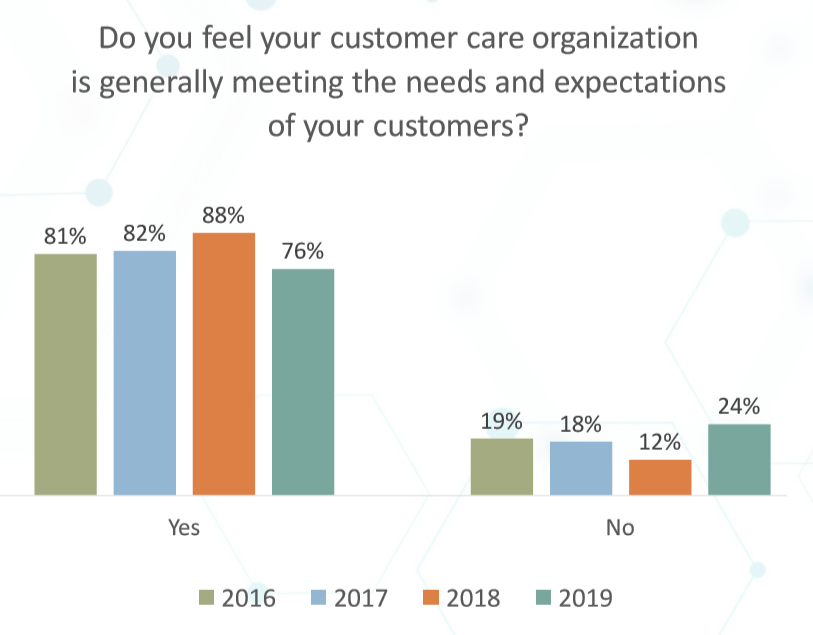
| Since 2014, CXMB Series Corporate Edition survey participants have been asked the question at right. At only 76%, the result from the 2019 survey is the lowest affirmative response ever seen in the data. This result could be due to the constant change within industry (and among consumer expectations), leaving many brands feeling like they are constantly trying to catch up to the world’s CX innovators, particularly when it comes to technology. |
|
|
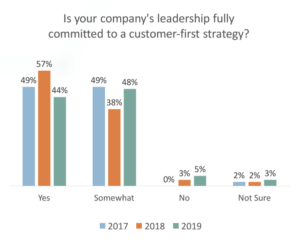
Like the self-assessment results above, survey respondents were less enthusiastic than in years past regarding their leaderships’ commitment to a customer first-strategy. Only 44% of respondents indicated their leadership was committed to a customer-first strategy (the lowest result on record), while 5% of survey participants responded with a firm, “No.” If brands are serious about improving the customer experience, deployment of a customer-first strategy is a must, and the most logical place to start. |
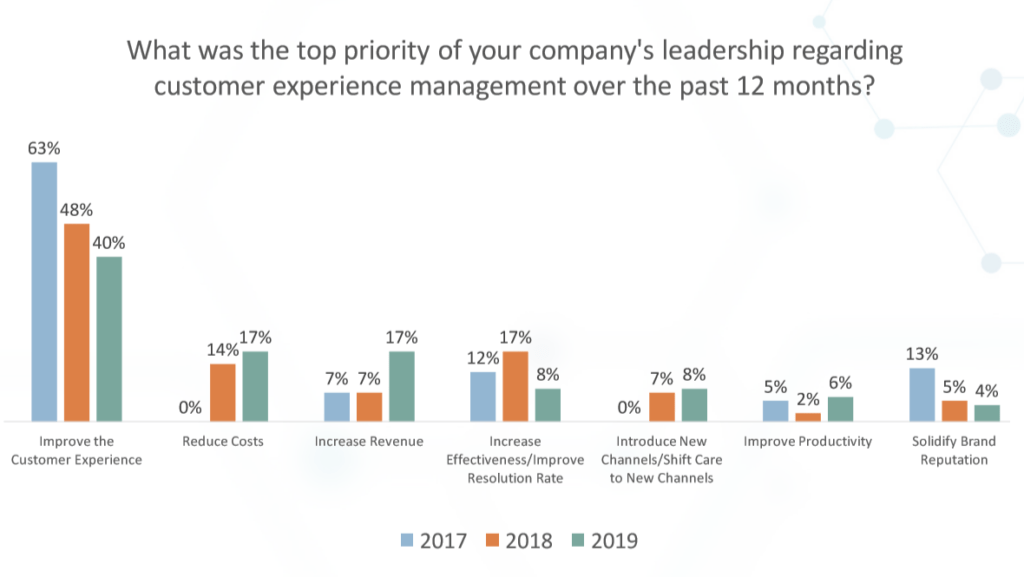
| While on the surface the decline of brands indicating customer experience as a top priority is a concern, further study is required to understand what may be driving the decline. Are companies moving away from CX to focus on financial productivity? Or is this indicative of a mature market looking to realize the financial benefits of the advanced CX technology they have implemented to drive improved CX. | ![]() |
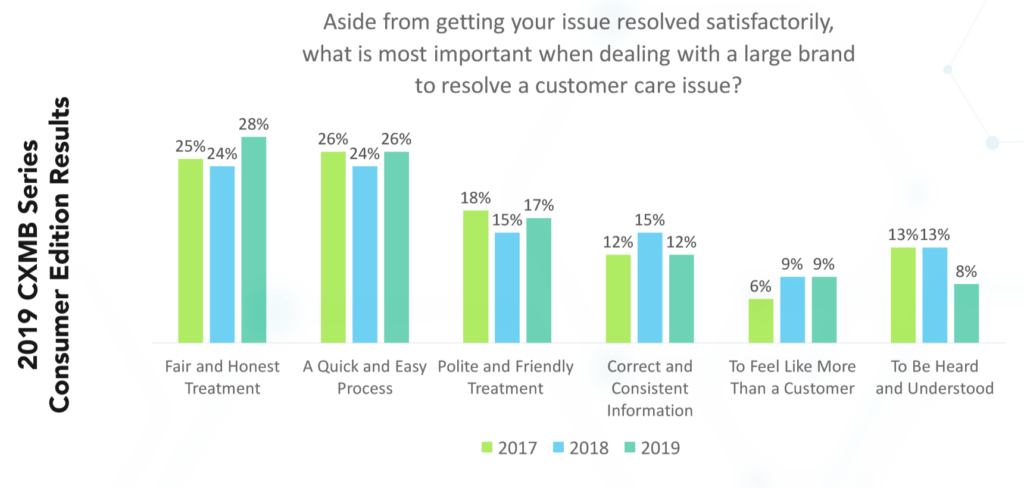
UNDERSTANDING WHAT IS MOST IMPORTANTWhen asked what’s most important to their customers, roughly half of corporate survey respondents continue to point to “A Quick and Easy Process.” In fact, in the minds of corporate survey respondents, little else comes close to this response, with only 24% indicating “Correct and Consistent Information,” and the balance distributed among the other responses. But when consumers were asked a similar question (below), results reveal a somewhat different perspective.
|
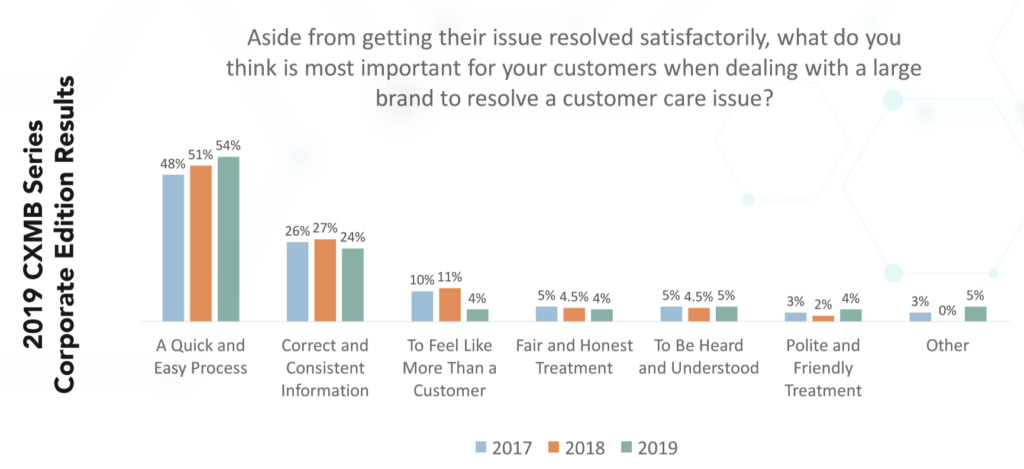
| While consumers do value “A Quick and Easy Process” for resolving customer care issues, this aspect is matched by consumers’ desire for “Fair and Honest Treatment.” This divergence presets brands with two distinct opportunities: 1) to seek an understanding of what “Fair and Honest Treatment” means to consumers ; and 2) to assess whether or not their CX program is delivering the “Fair and Honest Treatment” consumers find so important.
|
![]() |
The Rise of Multimodal Customer Experience: Are We Moving Too Fast?Omnichannel was promised as the solution to a fragmented customer journey. While it delivered in many ways a new paradigm is taking shape, one defined by multimodal experiences powered by AI, automation, and real-time context. Customers can now move fluidly between voice, chat, video, and digital channels, often without a visible transition. For some, this represents the ideal journey. For others, it can feel as though the human element of customer care is slipping away. As organizations race to innovate, many are unintentionally creating gaps, not just between channels, but between themselves and key segments of their customer base. With varying levels of digital fluency and generational differences, and varying expectations, a one-size-fits-all approach to CX no longer scales. So, the question becomes: In our pursuit of the future, are we leaving parts of our customer base behind? In this candid and forward-looking discussion, CX leaders will explore:
|
CX Livewire: Consumer Voices, Real-Time ReactionsCustomer expectations are constantly evolving, and understanding how consumers perceive service, support channels, and emerging technologies is critical for shaping effective CX strategies. In this fast-paced and interactive session, panelists will explore key insights from Execs In The Know’s latest research findings, capturing the perspectives and expectations of CX leaders and consumers. Throughout the discussion, panelists will react to both the research findings and live polling of the CRS audience, creating a dynamic comparison between what consumers say they want and how organizations are currently approaching service delivery. These real-time insights will allow attendees to benchmark their own thinking against the room, while panelists share practical perspectives from inside their organizations on how they interpret, and respond to, shifting consumer expectations. Expect candid reactions, engaging audience participation, and thought-provoking contrasts between consumer sentiment and operational reality. This high-energy session is designed to spark conversation, challenge assumptions, and highlight where CX leaders may need to adapt in order to meet the evolving demands of their customers. |
Agent-Facing AI for CX: Through the Eyes of the AgentFor decades, contact center agents have been expected to act as human search engines navigating complex knowledge bases, policy documents, and fragmented systems to find the right answer for customers. But the emergence of agent-facing AI is beginning to shift that paradigm. Instead of simply retrieving information, modern AI tools can now interpret context, surface relevant guidance, and recommend next-best actions in real time. This panel will explore how CX leaders are deploying AI to transform the agent role, and what this experience is like from the agent’s perspective. Panelists will discuss how tools such as AI copilots, real-time knowledge synthesis, contextual assistance, automated summarization, and predictive assistance are helping agents navigate complex conversations more effectively while reducing cognitive load. At the same time, organizations must carefully balance automation with human judgment, ensuring agents remain empowered decision-makers. Panelists will also address the operational and cultural challenges of introducing AI into the agent workflow including trust, training, governance, and change management. Attendees will hear practical insights (and hopefully firsthand feedback from agents) on what’s working, what’s not, and how agent-facing AI can simultaneously improve efficiency, enhance employee experience, and deliver better outcomes for customers. |
The Next Gen CX Business Plan: Preparing for the Next 3–5 YearsFor years, organizations have piloted AI-powered support, automation, proactive service models, and intelligent self-service. Now, the industry is reaching an inflection point: what happens when these capabilities mature into the standard operating model? The question for leaders is no longer if these technologies work, but how to architect a business plan that thrives once they are fully integrated. Moving from pilot to scale requires a fundamental shift in how we lead. It demands a roadmap for workforce evolution, a commitment to data integrity, and a new definition of “success” that balances efficiency with the human connection customer still crave. What does workforce strategy look like when AI handles a significant portion of interactions? How do roles evolve? What investments must be made now in data quality, governance, and systems integration to support intelligent, proactive service? How is success measured? How do organizations deliver the trust, clarity, and the confidence that define Customer Assurance? In this discussion, CX leaders will explore:
|
Customer Assurance: A Leadership Decision, Not a DepartmentCustomer Assurance is not a department or a checklist. It is the confidence customers feel when they know a company will show up with clarity, competence, and care. It is built through leadership decisions that shape how the organization communicates, operates, and responds when something matters most. In an era defined by automation, AI, and no-reply emails, customers are tired of simply being processed. They are asking deeper questions: Do I feel safe doing business with you? Do I trust this experience? Do I believe this company will take care of me when it counts? True assurance is what turns a transaction into trust. It requires more than strong service design. It takes leadership alignment, clear decision-making, and systems that make confidence possible at every stage of the customer journey. That includes how expectations are set, how issues are owned, how employees are empowered, and how technology is used to support rather than distance the customer relationship. In this discussion, CX leaders will explore:
|