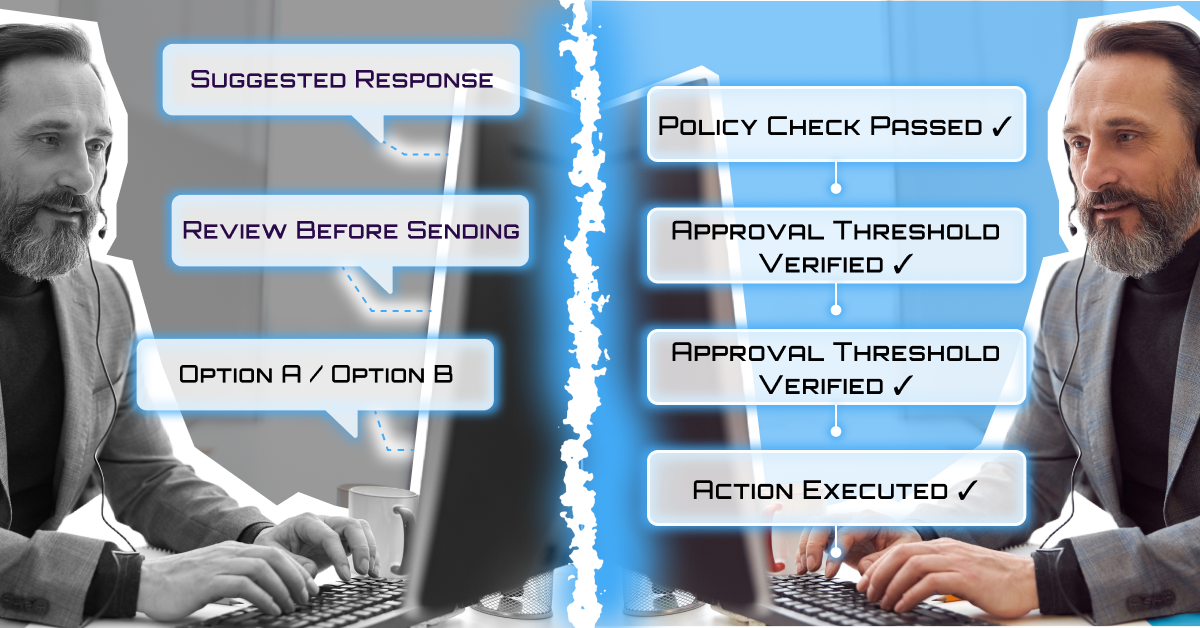
The conversation about AI in customer experience has fundamentally changed. Six months ago, CX leaders debated whether to implement chatbots. Today, they’re navigating a reality where AI systems don’t just respond. They act! They route cases, authorize refunds, and escalate issues without human intervention.
As Derek Bell, VP of Product at Procedureflow, recently observed: ‘AI is being asked to operate, not just assist, but most organizations are still running document-based knowledge systems.’ This disconnect is creating what I call the execution gap, and it’s where many AI initiatives are stalling.
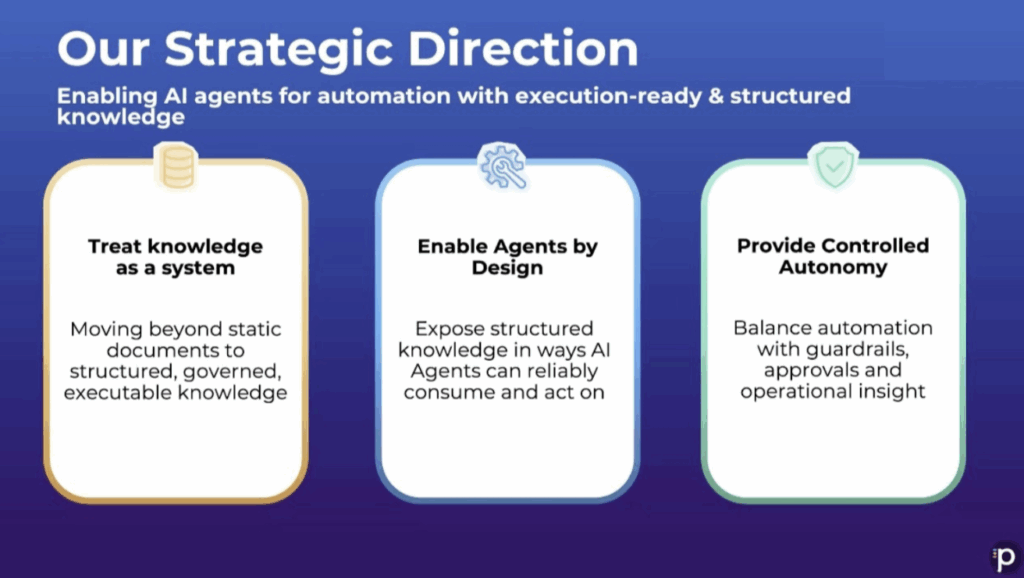
Procedureflow’s three-pillar approach: treating knowledge as a system, enabling agents by design, and providing controlled autonomy.
The Evolution: From Responder to Actor
Stage 1: AI as Responder (Chatbots) – Answer questions, deflect tickets, surface knowledge articles. Reactive and limited in scope.
Stage 2: AI as Assistant (Copilots) – Sit alongside agents, suggesting responses and pulling information. Humans make final decisions.
Stage 3: AI as Actor (Agentic Systems) – Execute tasks autonomously processing returns, updating accounts, coordinating across departments. They don’t just recommend; they do.
Most organizations manage all three stages simultaneously. A chatbot handles initial contact; a copilot assists escalations, and agentic workflows trigger in the background. According to McKinsey’s State of AI research, 23% of organizations are already scaling AI agents, yet operational governance remains the primary barrier to broader deployment.
The Hidden Gap: Intelligence Without Structure
Here’s the paradox: As AI becomes more capable, the need for operational clarity intensifies. A chatbot can mask knowledge gaps. A copilot can surface options without committing. But an agentic system that processes a refund incorrectly creates compliance risk, erodes trust, and violates policy.
As Derek Bell puts it: ‘AI doesn’t fail because it lacks intelligence; it fails because it isn’t connected to structured, executable knowledge.’
Consider a customer contacting support for a defective product outside the return window. An agentic system needs to know: Does this customer qualify for an exception? What is the approval threshold? Who gets notified? Which system gets updated first? Without structured decision logic, AI either freezes or acts on incomplete information.
What Makes Agentic AI Different
- Decision Authority vs. Decision Support – Copilots suggest. Agents decide. AI must operate within clear governance frameworks defining approval of thresholds, escalation triggers, and exception handling.
- Cross-System Orchestration – Agentic systems coordinate actions across multiple platforms. A simple ‘update my subscription’ might require changes in billing, CRM, fulfillment, and communication systems in a specific sequence.
- Accountability in Ambiguity – Humans handle edge cases through judgment. Agentic AI requires explicit rules for ambiguity. Organizations that haven’t defined these boundaries find their AI either over-escalates or under-escalates.
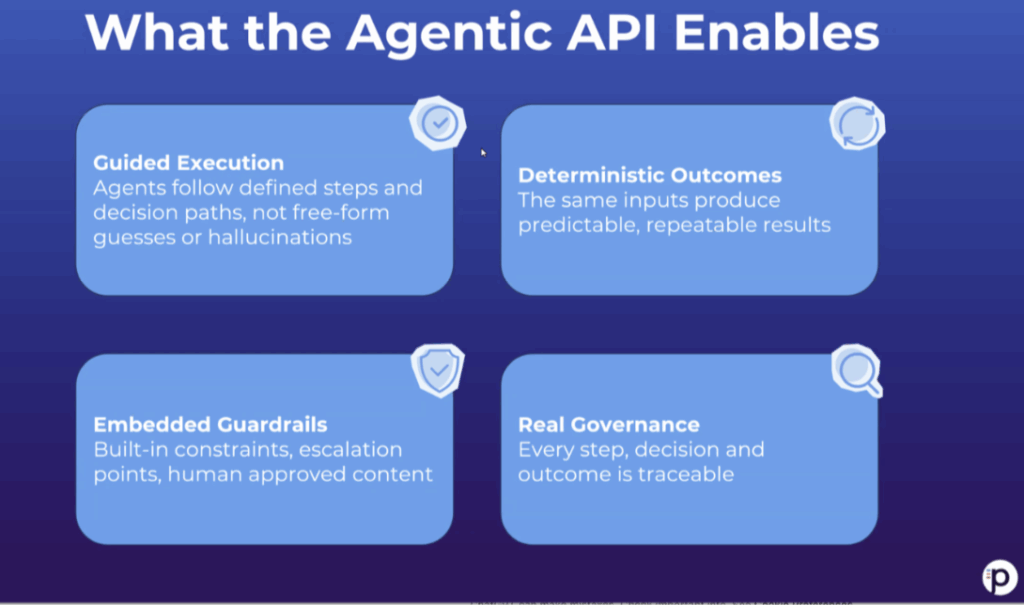
Four critical capabilities: guided execution following defined paths, deterministic outcomes for predictability, embedded guardrails for safety, and real governance for traceability.
Building the Foundation: From Knowledge Chaos to Operational Clarity
Leading organizations approaching agentic AI start with knowledge architecture, asking:
- Where does our operational knowledge live? For most companies, it’s fragmented across SharePoint, Slack, email threads, and tribal knowledge. Agentic AI requires centralized, structured, and version-controlled operational knowledge.
- How do we translate expertise into executable logic? The best agents make dozens of micro-decisions per interaction. Enabling AI to replicate this requires breaking down judgment into decision trees and conditional workflows. Organizations succeeding here treat processes as living systems, not static documents.
(Learn more about transforming process workflows.)
- How do we maintain consistency across channels? When policy changes, does it update everywhere AI needs it? Organizations with mature operational structures build single sources of truth that all systems including AI reference.
- How do we govern what AI can do? Define confidence thresholds (‘If certainty is below 85%, escalate’), impact boundaries (‘No AI decision exceeds $500’), and audit requirements.
A Framework for Leaders: The Four Pillars of AI-Ready Operations
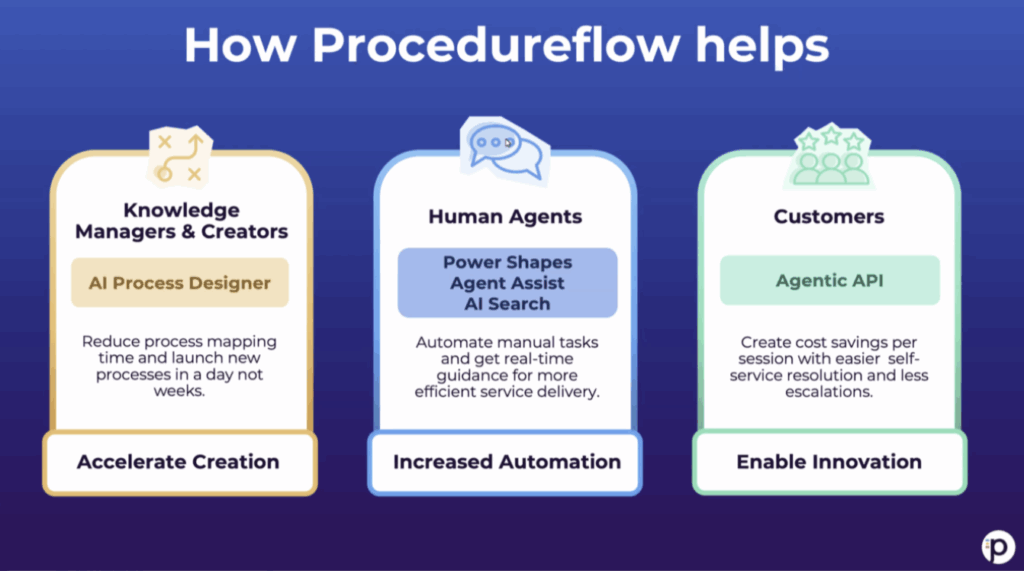
Procedureflow serves three audiences: Knowledge Managers accelerate creation, Human Agents get increased automation, and Customers benefit through agentic APIs.
Pillar 1: Structured Decision Logic
Move from ‘here’s what we usually do’ to ‘here’s exactly what to do when X, Y, or Z occurs.’ Document decision trees, define variables, and codify exception handling.
Pillar 2: Governed Knowledge Systems
Establish a single source of truth for policies and procedures. Implement version control so changes propagate systematically. Create ownership accountability.
Pillar 3: Workflow Visibility
Map how work actually moves through your organization. Identify hand-offs, dependencies, and bottlenecks. Make implicit steps explicit. The most sophisticated deployments expose workflows through structured APIs that AI systems can query in real-time. Procedureflow’s Agentic API exemplifies this, enabling AI agents to follow defined steps while maintaining full traceability.
Pillar 4: Continuous Feedback Loops
Build mechanisms to capture when AI decisions work and when they don’t. Create review processes where edge cases inform knowledge updates.
The Leadership Imperative: Designing for Human-AI Collaboration
The goal isn’t to remove humans from customer experience, it’s to position them where they add most value. Agentic AI should handle routine execution, freeing humans to manage complexity, build relationships, and solve novel problems.
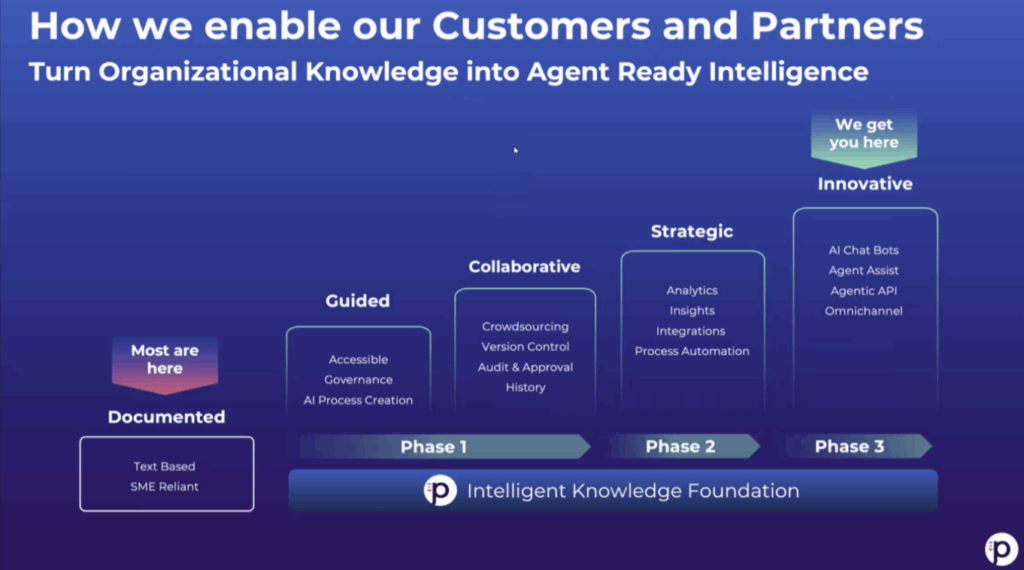
The maturity journey: Organizations progress from documented (text-based, SME reliant) through guided, collaborative, and strategic phases to innovative (AI chat bots, agent assist, agentic API).
This requires leaders to rethink workforce development. As AI takes on transactional work, the human role shifts toward judgment, empathy, and strategic intervention. Training must evolve from ‘how to process a return’ to ‘when AI guidance may not serve this customer’s best interest.
Transparency with customers is equally critical. Organizations leading in AI deployment are upfront about when AI is acting and how customers can request human review.
Starting Points: Where to Begin
Audit your knowledge infrastructure. Where are operational policies and decision rules documented? How easily could an AI system access them?
Map one end-to-end journey. Choose a common request password reset, return processing and document every decision point, system touch, and hand-off.
Define AI governance principles. What decisions should always involve humans? What are your risk tolerances? Establishing these boundaries prevents reactive policy making.
The Opportunity Ahead
The companies that will lead aren’t those with the most advanced AI they’re those with the operational clarity to deploy it safely and effectively.
The shift from copilot to agent requires building organizations where intelligence, automation, and human judgment work in concert. Where customers receive faster, more personalized service without sacrificing accuracy. Where frontline teams feel empowered rather than replaced.
Consider what becomes possible: A health insurance company automating complex eligibility determinations across 50 states while ensuring every decision follows current regulations. A financial services firm enabling 24/7 account servicing while maintaining audit trails. A utility provider orchestrating multi-system processes without workflow fragility.
These aren’t hypothetical. Organizations building on structured knowledge foundations are already achieving them. The early results from companies deploying governed agentic systems show dramatic improvements because when AI follows the right process, it works better, not just faster.
The question isn’t whether agentic AI will reshape customer experience it already is. The question is whether your organization will lead this transformation or react to it.
by Sarah Jeanneault, Procedureflow
About the Author
Sarah Jeanneault is VP of Marketing at Procedureflow
Sarah brings over 20+ years of experience leading growth-focused strategies and building customer-centric ecosystems that drive revenue, strengthen engagement, and increase long-term value. She has guided teams across startups and enterprises to achieve multi-million-dollar growth. Outside of work, Sarah enjoys skiing, biking, trail running, gardening, and baking sourdough bread.
About Procedureflow
Procedureflow simplifies knowledge management by turning complex processes into visual guides that are easy to navigate, while ensuring they remain accurate, collaborative, and compliant. Our visual and strategic approach to managing standard operating procedures helps organizations deliver trusted knowledge that scales and drives operational efficiencies. Clearly guided processes combined with task automation help employees quickly grasp critical details and execute requests with confidence. Create a unified knowledge source that anyone can navigate and count on to deliver exceptional service. Discover more at www.procedureflow.com.
Related Resources:
- Process Workflow Automation Guide – Practical approaches to transforming static processes into executable workflows
- Procedureflow Product Overview – Explore how leading organizations are building AI-ready operational systems





























































































































 TELUS Digital
 ibex delivers innovative BPO, smart digital marketing, online acquisition technology, and end-to-end customer engagement solutions to help companies acquire, engage and retain customers. ibex leverages its diverse global team and industry-leading technology, including its AI-powered ibex Wave iX solutions suite, to drive superior CX for top brands across retail, e-commerce, healthcare, fintech, utilities and logistics.





















 Trista Miller