
in this issue

Learn how leading brands are turning CX outsourcing into a loyalty-driving strategy through strategic partnerships, human-centered design, and AI-powered support.
by Execs In The Know
Outsourcing in customer experience (CX) is undergoing a quiet but powerful transformation. Once viewed largely as a cost-reduction lever or a reactive support model, outsourcing is emerging as a strategic growth enabler, particularly when it comes to customer loyalty. The narrative is shifting from transactional to transformational, from offloading volume to building value.
In an era where customer expectations are rising and CX teams are being asked to do more with less, outsourcing is an opportunity to build trust, deepen relationships, and deliver the kind of seamless service that keeps customers coming back.
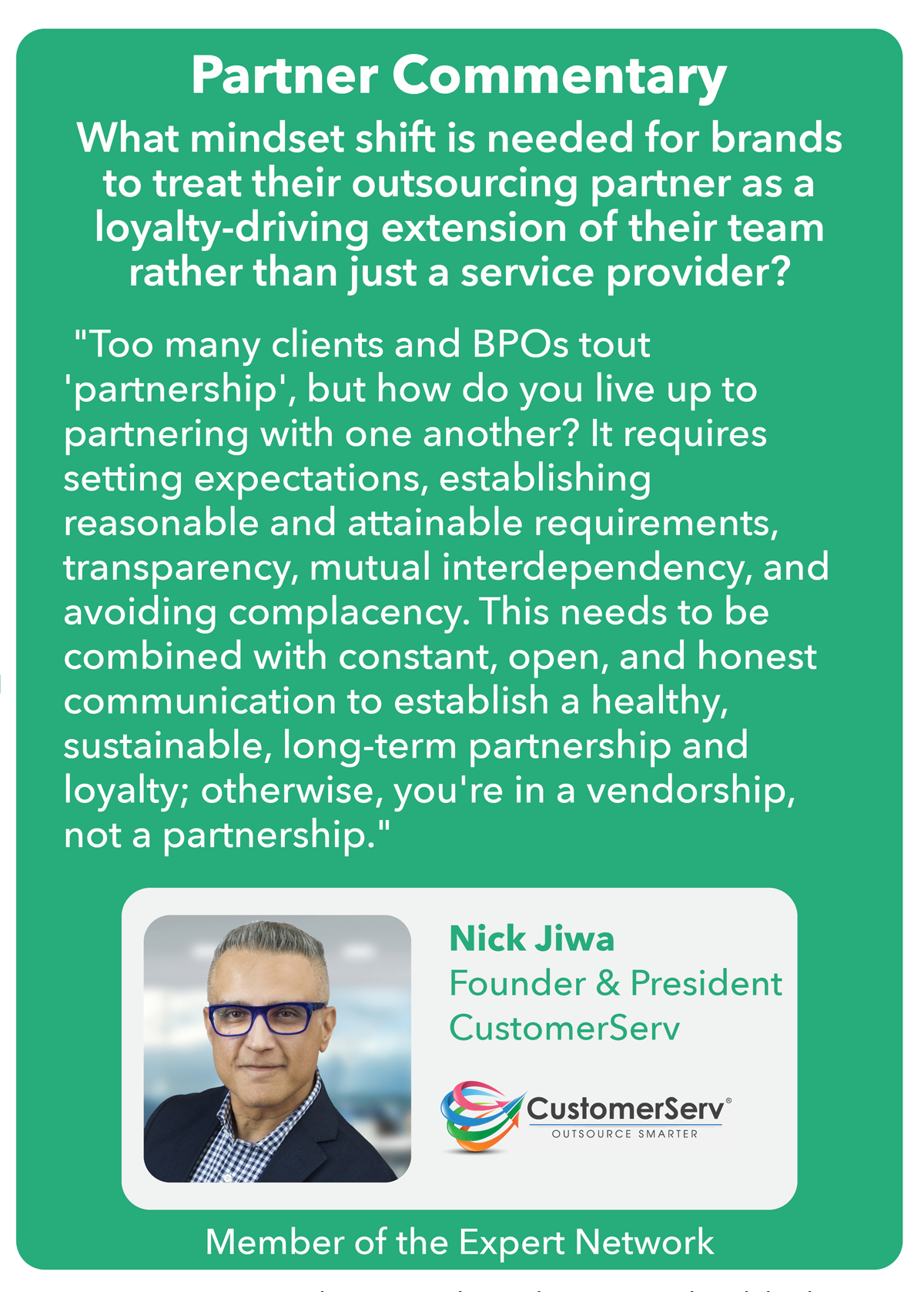 But this transformation raises a few important questions:
- What does a loyalty-driven outsourcing strategy look like?
- How can brands ensure their BPO (business process outsourcing) partners are delivering on more than just service level agreements (SLAs)?
- As generative and agentic artificial intelligence (AI) rewrite the rules of support, what role will human-centered outsourcing play in the loyalty equation?
Let’s explore the forces driving this shift and what CX leaders should focus on next.
The Case for Loyalty-Driven CX Outsourcing
Loyalty isn’t earned through one moment. It’s the result of many moments consistently delivered, thoughtfully designed, and deeply human. According to McKinsey, 71 percent of customers expect personalized interactions, and 76 percent get frustrated when this doesn’t happen.1 Loyalty hinges on delivering high-quality, emotionally intelligent support that meets customers in the moment, something frontline BPO agents are uniquely positioned to do.
Here’s why that matters.
Today’s outsourced customer care is often the front door to the brand, not a back-office function. It’s where first impressions are formed, trust is built (or broken), and loyalty is either earned or eroded. In many industries, it’s the most frequent and personal point of contact between companies and customers.
When executed with intention, outsourced CX becomes more than just a support function. It becomes a loyalty engine. When mismanaged, it becomes a churn risk, and the stakes are high. According to recent data cited by Harvard Business School Online, a modest 5 percent increase in customer retention can boost profitability by as much as 75 percent.2 This a striking reminder of how powerful every customer interaction can be.
The takeaway is clear: your BPO partners aren’t just resolving tickets, they’re shaping customer perception in real-time. When they’re embedded in your mission, equipped with context, and empowered to act as true brand extensions, they’re not just handling volume, they’re driving value. In a business landscape where retention is the new growth, strategic outsourcing is about customer connection.
The Timeliness of the CX Outsourcing Shift
Several forces are converging to make this transformation urgent and inevitable.
1. Economic Pressure Meets Rising Expectations
The dual mandate of reducing costs while increasing customer satisfaction is nothing new. But in today’s economic environment, the pressure is more acute.
Sustaining high service quality during financially challenging times isn’t just a nice-to-have. It’s a competitive advantage. According to a report by Harvard Business Review, 88 percent of business leaders agree that customer engagement significantly impacts the bottom line, especially when brands maintain consistency and reliability in their service experience.3 Even amid budget constraints, brands that continue to deliver strong customer support foster trust, strengthen loyalty, and reduce the likelihood of churn. Cutting costs at the expense of service can erode long-term customer value, while investing in the experience, even modestly, can yield lasting returns.
CX leaders are being asked to reimagine operating models that can flex with demand, scale quality, and deliver personalized, human-centric care without ballooning budgets. Outsourcing, when done right, becomes a lever not of cost-cutting, but of value creation.
 2. AI Is Redefining the Role of Humans
The rise of AI, particularly agentic and generative models, is automating a significant portion of routine support. Gartner predicts that by 2029, 80 percent of common customer service inquiries will be resolved by AI without human intervention.4
That doesn’t eliminate the need for BPO agents; it elevates it. As AI handles easy tasks, the complexity and emotional nuances of customer interactions will increase. Outsourcing partners will be responsible for the hardest, most high-impact moments. That demands a new kind of agent: one with empathy, critical thinking, product fluency, and brand alignment.
3. The Human Connection Is a Differentiator
In a world where automation is the norm, genuine human interaction becomes a competitive edge. A recent PwC Customer Loyalty Survey found that 59 percent of consumers say a single bad experience would cause them to switch brands but 73 percent say a single excellent human interaction can restore trust after a problem.5
The opportunity for loyalty is not just in resolving issues but in how those issues are handled. That means equipping BPO partners to act with context, care, and brand voice.
Timely Challenges Facing CX Leaders
This moment isn’t without friction. Many CX leaders are facing the following dilemmas when it comes to outsourcing and loyalty.
- Can we trust our partners to represent the brand like our internal teams do?
- How do we ensure consistent quality when BPO teams are spread across the globe?
- How do we balance efficiency and empathy, especially with increasing AI integration?
- What does success look like beyond average handle time (AHT) or cost per contact (CPC)?
- How do we elevate the agent experience to deliver a better customer experience?
These are not just operational questions; they’re strategic ones. And they require rethinking the entire relationship between brand and partner.
Rethinking BPO Relationships
Here’s what separates loyalty-driven outsourcing models from legacy ones.
Metrics like customer satisfaction score (CSAT), net promoter score (NPS), and AHT are necessary, but they’re no longer sufficient on their own. Leaders are increasingly layering in loyalty-focused key performance indicators (KPIs) like:
- First Contact Resolution (FCR)
- Customer Effort Score (CES)
- Sentiment analysis
- Retention post-service
- Agent satisfaction and turnover
Embedded Training and Brand Fluency
Outsourced agents need more than scripts. They need immersion in your brand story, customer personas, tone of voice, and escalation philosophy. Regular alignment, shadowing internal teams, and co-created training sessions are becoming best practices.
Employee Experience Focus
A growing body of research shows that frontline agent engagement directly correlates with customer loyalty. Outsourced teams must be included in engagement initiatives, feedback loops, and career development pathways.
Strategic Co-Creation
The best BPO relationships are co-created. Quarterly business reviews should include innovation sessions, voice of the customer data reviews, and forward-looking planning. Brands are beginning to treat BPOs as strategic advisors in the CX journey.
 The Role of AI in Human-First Outsourcing Models
AI is enabling better human-led support when used wisely. Agentic AI, which operates autonomously with goal-directed behavior, is increasingly being paired with BPO teams. Tasks like post-call summaries, refund eligibility checks, and even sentiment prediction are being handled by AI to free up human agents for high-empathy, high-impact work.
This shift calls for new operating models:
- AI Assist: AI surfaces relevant data to agents in real-time.
- AI Lead + Human Review: AI completes a task and humans verify.
- AI Complete: AI handles low-risk cases; humans focus on relationship-building.
BPOs who embrace hybrid models are already seeing increased performance and agent satisfaction. In Cisco’s 2025 global survey of nearly 8,000 decision-makers, 68 percent predicted that agentic AI would handle customer support interactions by 2028, while 89 percent emphasized that human connection must remain integrated alongside AI to deliver optimal results.6
At the Customer Response Summit in 2024, Amanda Wiltshire-Craine, former Senior Vice President of Global Customer Services at PayPal, shared how her team is reimagining the support experience through a proactive, loyalty-first lens.7 Rather than viewing contact volume as something to reduce, they reframed every interaction as a symptom of a larger customer need, a “defect in the experience” worth resolving at the root.
By equipping BPO teams with unified data, generative AI workflows, and clearer visibility into customer journeys, PayPal shifted its service model from reactive resolution to strategic prevention. “Generative AI enables scale,” Amanda noted, “but only when it’s humanized.” That belief now underpins the brand’s outsourcing approach, where empowered agents, consistent coaching, and outcome-based KPIs work together to drive trust, retention, and long-term loyalty.
A Loyalty-First CX Outsourcing Roadmap
BPOs adopting a loyalty-first CX outsourcing roadmap should integrate CX into their operating model, aligning structure, processes, and governance with end-to-end customer journeys. McKinsey found that companies that reorganize around CX, often leveraging outsourced or hybrid delivery models, achieve a 20 percent lift in customer satisfaction, 15 percent higher conversion, 30 percent lower cost-to-serve, and 30 percent better employee engagement.8
If you’re a CX leader rethinking your outsourcing strategy, here’s a loyalty-first framework to consider:
1. Define the “Why”
Align internally on the purpose of outsourcing. Is it to scale personalization? To extend hours of service? To offer multilingual support? Ground the partnership in shared goals beyond cost savings.
2. Choose Partners Strategically
Vet your partners not just on volume-handling capacity, but on their ability to demonstrate:
- Culture fit
- Agent empowerment practices
- Tech agility (especially with AI)
- Track record in driving CX outcomes
 3. Redesign KPIs
Layer loyalty-linked metrics into performance reviews. Reward problem prevention, not just resolution. Build feedback loops that include customer and agent sentiment.
4. Invest in Agent Enablement
Extend your brand training and customer data access to outsourced agents. Invite them to internal town halls or customer journey mapping sessions to build belonging.
5. Pilot and Scale Intentionally
Start with a strategic use case, co-design the experience, and evaluate rigorously. Look at customer behavior over time, not just satisfaction scores in the moment.
Loyalty Is Earned
Loyalty is built where customers meet agents, where emotion meets resolution, and where expectations meet experience. CX outsourcing has evolved. It’s about delivering value. Brands that invest in strategic partnerships rooted in shared purpose, AI transformation, and human-first design won’t just retain customers — they’ll earn their lasting loyalty.
What’s Next for CX Outsourcing
As the line between technology and humanity continues to blur, the future of CX outsourcing won’t be defined by who answers the call but by how intelligently, empathetically, and consistently that interaction delivers value. Outsourcing will no longer be a reactive function or operational expense.
It will be a growth lever that blends AI precision with human intuition, unlocking a more adaptive, connected, and loyalty-driven customer experience. The next frontier for CX leaders? Co-creating ecosystems where BPOs, bots, and brand values work in lockstep to turn service into a strategic differentiator.
This is exactly the conversation we’ll be having at our upcoming CX Outsourcing Briefing on August 7. This one-day executive gathering is designed for leaders who are rethinking the role of outsourcing in a rapidly evolving landscape. Hosted at American Airlines headquarters, this event brings together senior CX executives for honest dialogue on modern partnership models, AI integration, and loyalty-first strategies that drive meaningful results. If you’re ready to move beyond transactional outsourcing toward something more strategic, more human, and more future-ready, learn more and join us.
Article Links
https://www.mckinsey.com/capabilities/operations/our-insights/where-is-customer-care-in-2024
https://online.hbs.edu/blog/post/how-to-retain-customers?
https://www.pwc.com/us/en/industries/consumer-markets/library/brand-loyalty.html
https://execsintheknow.com/how-paypal-is-redefining-service-delivery/