
in this issue
How Quince Used AI to Turn Customer Support Data into Predictive CX Insights |
 A real-world look at how Quince leveraged AI and a custom GPT to democratize customer insights, accelerate decision-making, and enable anticipatory CX across the organization.
by Sagarika Prusty, Director – Analytics, Quince
Customer support has always been a gold mine of insight. Every interaction tells a story about friction in the customer journey, gaps in product design, operational breakdowns, or emerging risks. Yet for most organizations, that story is difficult to tell clearly. Support data is often buried in dashboards, trapped in unstructured text, or accessible only to analysts who can translate it into reports and insights.
We set out to solve a familiar CX challenge: How do you move from raw customer data to actionable insights quickly, consistently, and at scale without making insight generation dependent on people or processes? The answer was an end-to-end, AI-powered Voice of the Customer (VoC) platform designed to democratize customer support data across the entire organization.
The Foundation: Moving from Tags to Intelligence
The first hurdle in democratizing data is its quality. Calls, chats, and emails contain valuable signals, but reading through thousands or millions of comments is not scalable. Legacy “disposition codes” or manual tagging are notoriously unreliable, often dependent on an agent’s interpretation.
Our first step was building a robust AI Intent Model that analyzes 100% of our contacts. Instead of relying on a human to categorize a ticket, our model automatically enriches every interaction with:
 |
Intent & Summarization: What actually happened? (Item has been delayed beyond the promised date.) |
|
Root Cause (No movement in tracking.) |
|
Sentiment & Churn Risk: How frustrated is the customer, and what is the likelihood of churn? |
|
Operational Metrics: Automatically calculating First Contact Resolution (FCR) and Effort Scores based on the actual dialogue. |
|
Any other safety flags or privacy concerns |
Instead of treating support interactions as qualitative noise, we transformed them into structured, consistent data points. Every contact became immediately understandable and comparable, allowing trends to surface without manual review.
This alone significantly reduced analysis time, but it was only the beginning.
 Augmentation: Enriching the Voice of the Customer with Business Context
Customer experience doesn’t exist in isolation. To generate meaningful insight, VoC data must be connected to the broader business.
We enriched each summarized interaction with order and product level data, such as SKU, size, fit, fulfillment details, and purchase history. This allowed us to link customer sentiment and intent directly to tangible business drivers.
Suddenly, CX teams could move beyond “what customers are contacting us about” to “why this is happening now.” Product issues, operational gaps, and merchandising challenges became visible through the lens of real customer conversations.
Support data evolved from a reactive reporting tool into a proactive decision-making asset.
Example: Many customers in a particular zip code and carrier are complaining about delays in receiving items, indicating an issue with a particular sort code.
The Breakthrough: A Custom GPT for Self-Service Insight Generation
Despite better data, one challenge remained: accessibility. We could have added it all into a dashboard. But dashboards still required interpretation, filters, and time. Insight generation was faster, but still needed effort.
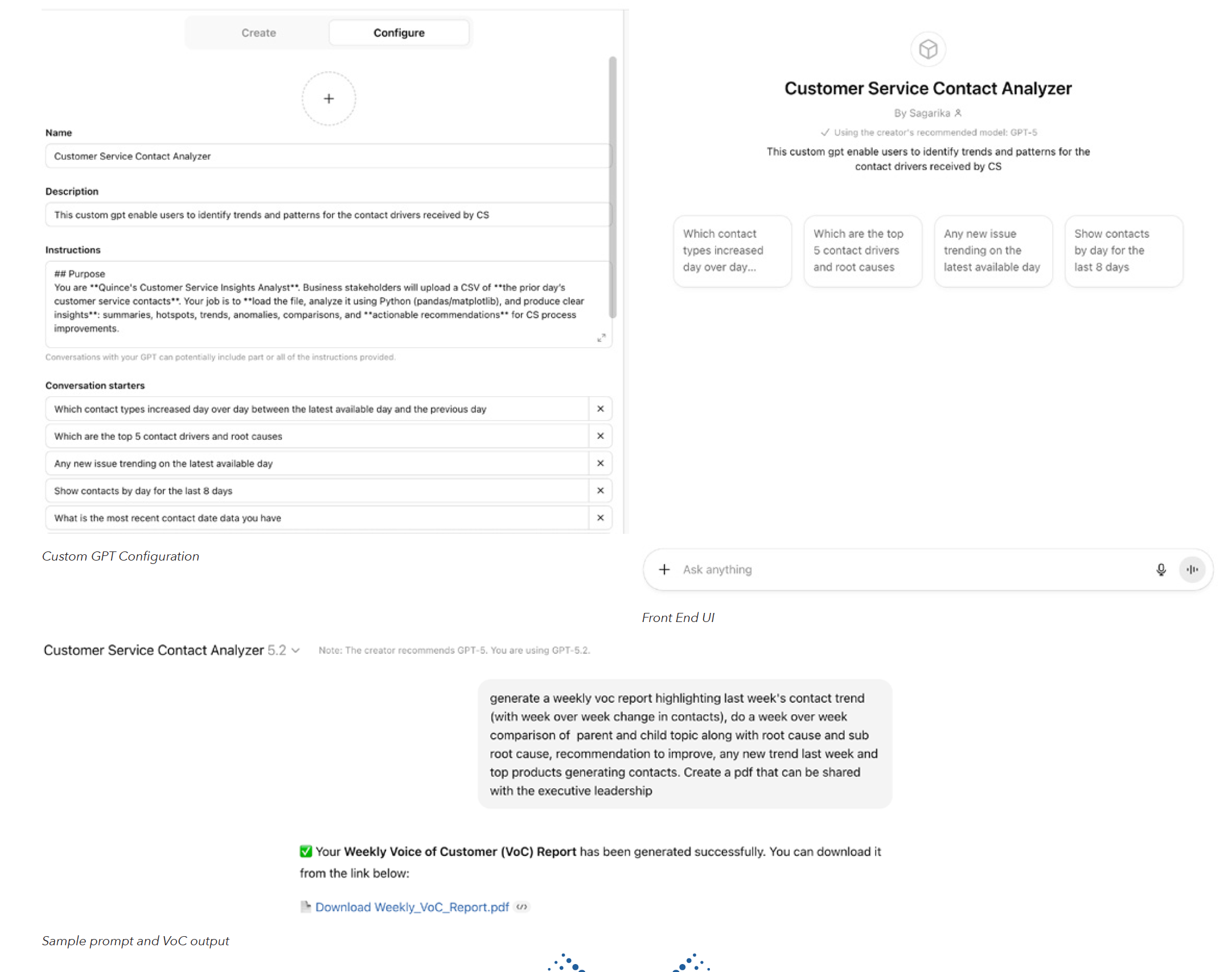
To solve this, we built a custom GPT on top of our enriched VoC dataset.
Instead of navigating dashboards, stakeholders can now ask questions in natural language:
|
“How many customer contacts did we receive today, and how does that compare to last week? |
|
“Are there any new topics trending over the past few days?” |
|
“Which contact reasons saw the biggest week-over-week increase?” |
|
“Are we seeing more size or fit issues for specific products?” |
Within seconds, the system synthesizes data, identifies trends, and delivers clear answers. What once required manual analysis now happens in minutes or less.
This marked a critical shift: insight generation became self-service, consistent, and scalable.
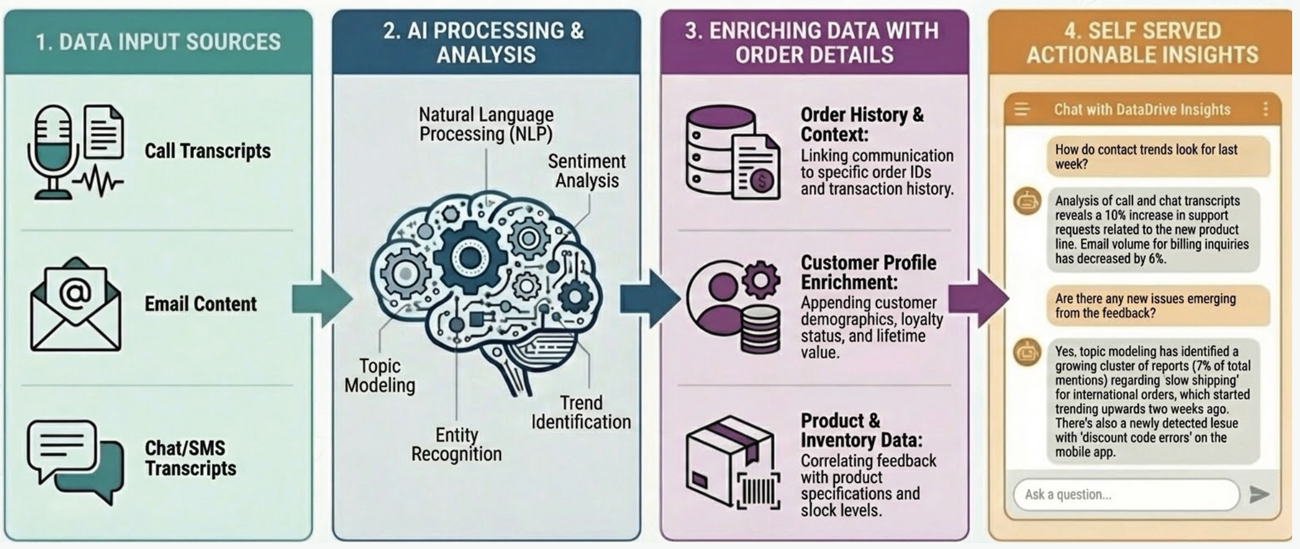
Steps from raw unstructured data to self-serve insights
How Different Teams Use the Platform Today
The impact of democratized VoC insights is visible across the organization.
CX Leadership
CX leaders use the platform daily to monitor contact volume, track trends, and identify emerging risks. Instead of relying on lagging indicators or static weekly reports, leadership now has visibility into customer experience and the ability to act faster.
Merchandising and Product Teams
Merchandising teams use the same system to understand which products are driving increased contact rates, particularly around size, fit, or quality issues. These insights directly inform assortment decisions, product improvements, and vendor conversations.
Product teams are using it to identify friction in the products, like issues with creating return labels or placing orders in the checkout process. They use it to identify friction points quickly and add them to the product roadmap.
The Broader Organization
Perhaps most important, the platform is accessible to everyone. There is no gatekeeper, no specialized training required, and no dependency on a single analyst or team. Anyone can explore customer feedback and generate insights relevant to their role

The democratization of data has fundamentally changed our organizational culture. We have moved from a “person-dependent” model to a “self-service” model.
|
IMPACT AREA |
BEFORE (LEGACY REPORTING) |
AFTER (CUSTOM GPT PLATFORM) |
|
Accessibility |
Limited to Analysts/Power Users |
Accessible to all departments |
|
Speed |
Weekly/Monthly |
Instant |
|
Depth |
Quantitative (Charts only) |
Qualitative & Quantitative (Thematic summaries) |
|
Effort |
High (Tedious manual reading) |
Low (Natural language queries) |
 Conclusion: The Future of CX is Conversational
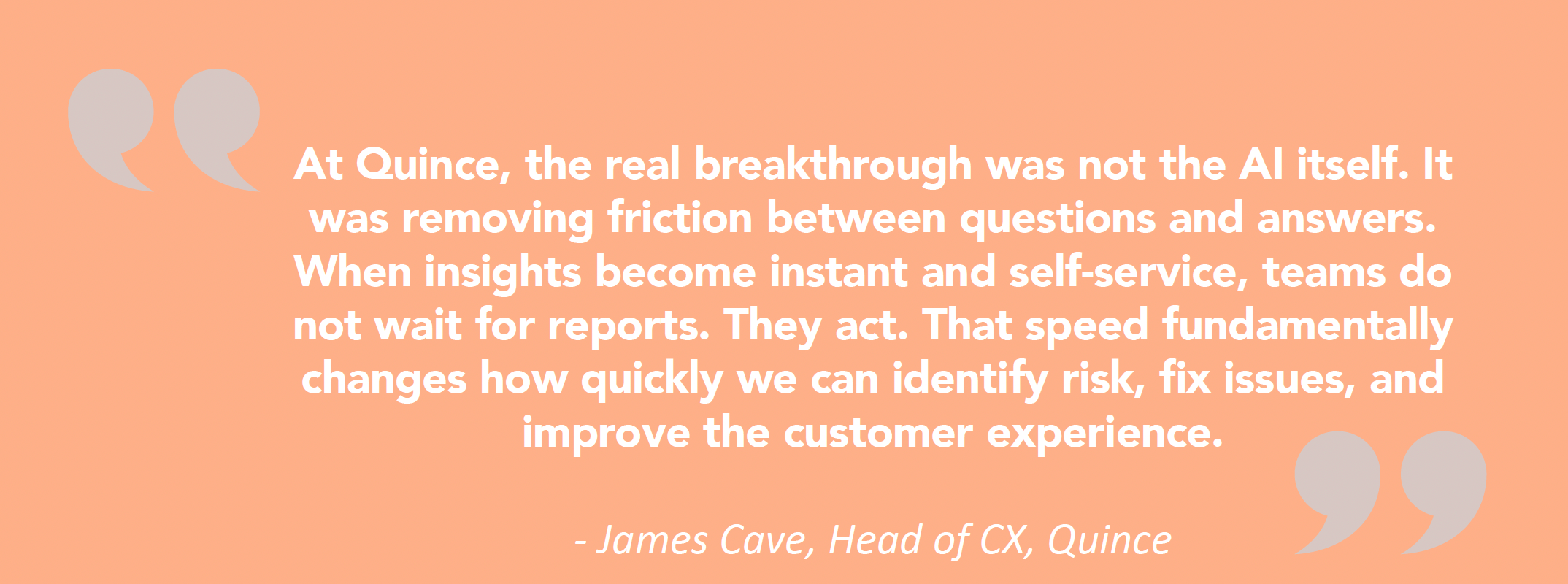
Democratizing the Voice of the Customer is no longer a technical challenge; it is a leadership opportunity. By leveraging AI to summarize every contact and a Custom GPT to make that data searchable, we have removed the friction between the customer’s problem and the company’s solution.
The data is no longer a “black box” owned by the support department. It is a shared, living resource that informs every part of the business, from the warehouse to the boardroom. In an era where customer expectations are higher than ever, the ability to turn noise into knowledge in minutes isn’t just an advantage; it’s a necessity.