
The contact center is no longer a back-office utility; it has become a strategic engine shaping loyalty, trust, and lifetime value. As customer expectations evolve and digital channels mature, brands are seeking new ways to deliver seamless, accurate, emotionally intelligent service without sacrificing efficiency or personalization.
Agentic artificial intelligence (AI) represents a defining moment for customer experience (CX) transformation. Unlike traditional automation or FAQ-driven bots, agentic systems can understand intent, initiate and complete multi-step tasks, learn from outcomes, and support both human agents and customers in real time. Done well, agentic AI becomes an orchestration layer rather than a gatekeeper, giving frontline teams more time, clarity, and emotional bandwidth to focus on high-value engagements.
But as this technology accelerates, one core tension has become visible: customer adoption is rising rapidly, and trust is not keeping pace.
AI Adoption Is Growing — Trust Is Not
Across consumer segments, more people are using AI for everyday interactions, from billing disputes and troubleshooting to scheduling, subscription management, account changes, and proactive alerts. Younger demographics are especially comfortable using AI as a first-touch resolution tool, and many report positive experiences when systems are intuitive, fast, and accurate.
Yet our latest research report, Ethics, Adoption, and Opinion: Consumer Perspectives on AI for CX, developed in partnership with Microsoft, reveals a paradox every CX leader needs to understand.
Consumer perception of companies that expand AI usage has shifted more negatively since 2023, even as adoption has grown. Consumers are demonstrating apparent willingness to engage with AI, but they are also becoming more critical, more discerning, and more vocal about where AI succeeds and where it falls short.
Three patterns now define consumer confidence:
- Ease of use
- Accuracy and comprehension
- Access to a human when needed
If AI is clear, fast, contextual, and correct, trust builds quickly. If it misunderstands intent, over-routes, forces repetitive clarification, or blocks escalation, trust erodes almost instantly.
The research is conclusive: customers are not resistant to AI. They are resistant to feeling misunderstood, constrained, or unsupported.
Performance Expectations Have Changed
The modern consumer no longer evaluates AI by novelty or interface sophistication. They assess it by outcome:
- Did it resolve the issue correctly on the first attempt?
- Did it reduce friction rather than add it?
- Did it feel transparent, respectful, and human-aware?
- Could they reach a live agent without a battle?
Agentic AI is uniquely positioned to meet these expectations because it enables complex, end-to-end orchestration without requiring the customer to navigate menus, repeat information, or wait for callbacks. The breakthrough is not automation; it is continuity, intelligence, and context.
But one insight stands above the rest: Accuracy and comprehension are now the baseline for trust.
Customers are not rejecting AI. They are rejecting bad AI that creates friction or uncertainty.
If the system cannot reliably understand intent, interpret nuance, or distinguish between routine and high-risk scenarios, the overall experience will feel unstable, even if the interface is polished.
Consumer Concerns Have Expanded Beyond CX
In 2023, most AI concerns centered on traditional CX frustrations:
- Lack of accuracy
- Poor escalation paths
- Scripted or robotic tone
- Dead-ends or data repetition
- Excessive containment
In 2025, concerns have expanded. Consumers now raise broader questions about:
- Data ethics and privacy
- Transparency in how systems learn
- Fairness, safety, and information accuracy
- Job displacement and societal impact
- Automated decision-making beyond customer care
77% of consumers say understanding a company’s AI ethics is extremely or very important.
Trust in AI is no longer a single-channel sentiment. It is a holistic reflection of how AI shows up in life, at work, in media, and in society. CX leaders suddenly find themselves shaping not only service interactions, but consumer perception of AI as a whole.
That is a powerful responsibility and a pivotal opportunity.
Human + AI: A Balanced Design Philosophy
The most forward-looking CX organizations are no longer pursuing automation as a replacement strategy. They are building orchestration models where agentic AI handles complexity, repetition, and structured tasks, while humans focus on emotional connection, judgment, and exception handling.
Examples of where agentic AI excels:
- Authentication and verification
- Form completion and policy exploration
- Billing adjustments or subscription changes
- Claims intake and scheduling
- Complex information retrieval
- Routine troubleshooting or process navigation
Examples of where human connection is irreplaceable:
- Moments of emotion, well-being, or vulnerability
- Multi-party decisions with financial or personal impact
- Situations where empathy, reassurance, or nuance matter
- Escalations where accuracy alone is insufficient
- Long-term loyalty building
AI should assist, not replace agents. When consumers know that help is available without friction, their willingness to use AI grows dramatically. Agentic systems build trust not by being perfect, but by being clear, capable, honest, and safely hand-off ready.
Responsible Adoption: A Leadership Framework
Responsible AI adoption is rapidly becoming a leadership imperative. As organizations introduce agentic capabilities, they must think not just about performance, but about:
- Confidence thresholds
- Model improvement and governance
- Transparency in intent and escalation
- Data lineage and ethical learning
- Human enablement and emotional well-being
The most effective organizations are developing internal criteria to answer two essential questions:
- Should this interaction be automated?
- Under what conditions, escalation paths, and quality controls?
This alignment transforms AI deployment from a technology decision into a trust and experience discipline.
A New Playbook for the Modern Contact Center
Agentic AI invites leaders to rethink service not as a queue, but as a dynamic engagement ecosystem. Contact centers that embrace this model are discovering:
- Deeper loyalty driven by reduced effort and increased accuracy
- Higher agent satisfaction as cognitive load decreases
- Faster knowledge cycles and lower error rates
- Greater ability to prevent, not just resolve, issues
- More relationship-building conversations and value creation
- Clearer insight into behavioral patterns, needs, and sentiment
The contact center becomes a growth engine, not just a cost center. When automation handles complexity and humans focus on connection, both the business and the customer experience gain a strategic advantage.
Download the New Research
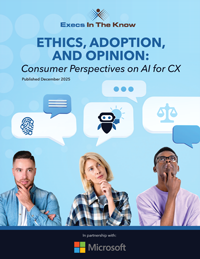 Our brand-new research volume, developed in partnership with Microsoft: Ethics, Adoption, and Opinion: Consumer Perspectives on AI for CX, reveals groundbreaking consumer data and insight that CX leaders need to understand, including:
- Generational comfort gaps that shape channel preference, AI adoption patterns, and willingness to self-serve
- Consumer concerns are expanding beyond CX, into ethics, data transparency, fairness, and workplace implications
- Higher performance expectations, where AI must be not just fast but intelligent, accurate, and friction-free
- Trust levers that matter most: accuracy, comprehension, transparency, and the right balance between AI and humans
This research explores the widening trust gap, why it matters, and how CX organizations can design AI-powered experiences that feel reliable, respectful, and customer-centric.
You can download the full report here.
Experience the Research Live in Dallas — January 29, 2026
Be among the first to experience these insights in person, ask questions, and explore how other CX leaders are designing responsible, trust-centric AI.
We’re bringing our newest CX findings to Dallas, featuring:
- Exclusive analysis from our latest research
- Real-world implications for AI adoption
- Moderated, executive-level discussion led by Execs In The Know’s President & Co-Founder Chad McDaniel
Where: Dallas, TX, at the Microsoft Innovation Hub
When: Thursday, January 29, 2026
Seats are limited. Register today.






























































































































 TELUS Digital
 ibex delivers innovative BPO, smart digital marketing, online acquisition technology, and end-to-end customer engagement solutions to help companies acquire, engage and retain customers. ibex leverages its diverse global team and industry-leading technology, including its AI-powered ibex Wave iX solutions suite, to drive superior CX for top brands across retail, e-commerce, healthcare, fintech, utilities and logistics.























 Trista Miller