
Artificial intelligence (AI)-enabled CX is evolving daily. At the Execs In The Know Customer Response Summit (CRS) in San Diego, the technology took center stage. As summarized in this blog post based on input from over 100 TP clients, execution lags its potential based on readiness, technological limits, and the challenge of getting customers on board.
As we look forward to the 2026 Customer Response Summit in Amelia Island and Scottsdale, what can organizations expect and what should they prioritize? TP believes that the next phase is orchestration – providing intelligence and outcomes to brands and customer interactions by connecting and coordinating AI, humans, operations, and industry expertise.
Orchestration solves the problem of AI pilots that don’t deliver. According to a 2025 MIT report, 95% of enterprise GenAI pilots fail to move from testing to production with measurable impact. Similarly, Gartner research notes that most organizations remain stuck in the pilot phase, focusing more on internal productivity tweaks than on customer experience innovation.
The challenge is the complex, real-world workflows of large enterprises. AI alone lacks the context, memory, and adaptability to create lasting value. It is important to move beyond implementing tools and toward a model of orchestrated intelligence. This approach recognizes the impact that comes from harmonizing advanced technology with your most valuable asset — your people and their deep industry expertise. It’s about creating a single, adaptive system where human empathy and AI-driven efficiency work together.
The three components of orchestrated intelligence – outlined below – are people, technology, and domain expertise:
- No matter how advanced AI becomes, it cannot replicate human empathy, nuanced judgment, or creative problem-solving. Your people are your most valuable asset, and an orchestrated system empowers these experts with AI, enabling them to handle complex, emotional interactions that build trust and loyalty.
- Technology provides the scale, speed, and consistency needed for modern business operations. This includes everything from a secure cloud infrastructure to sophisticated AI models and automation platforms.
- Every industry has its own unique language, regulations, and customer expectations. An AI tool that works for retail may fail in insurance. Tailoring AI solutions to industry-specific use cases (from account opening in banking to Revenue Cycle Management in Healthcare) ensures that the technology is not only powerful but also relevant and compliant.
When these three components are orchestrated effectively, the whole becomes far greater than the sum of its parts. You create a system where AI handles repetitive tasks, freeing up human experts to focus on high-value work, all guided by deep industry knowledge.
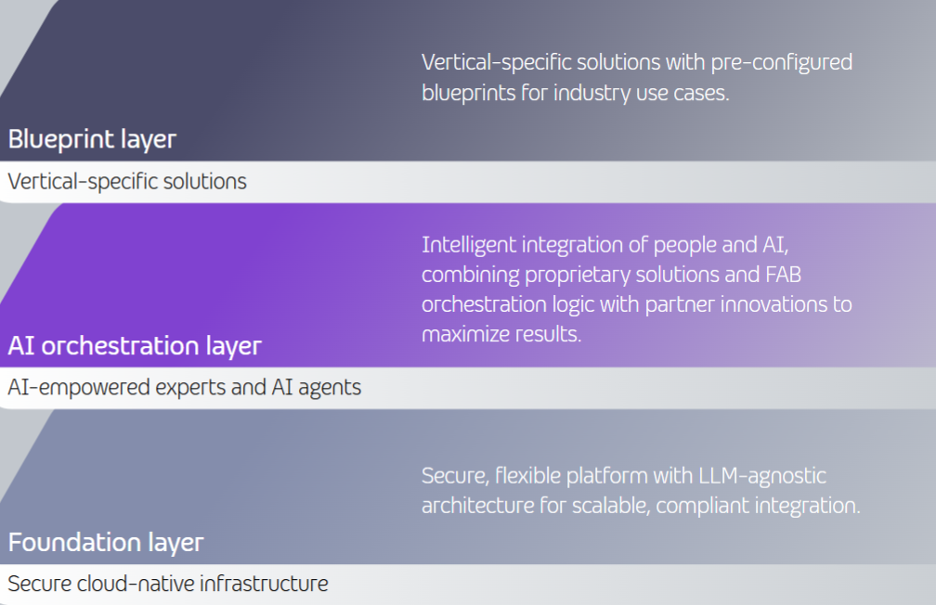
Think about them as three layers of a cake:
- The top layer is where vertical-specific solutions with pre-configured blueprints come together to solve specific industry use cases.
- The middle layer is where your AI-empowered experts and AI agents live – the intelligent integration of people and AI that combines proprietary solutions and orchestration logic to maximize results.
- The bottom layer is the secure, flexible cloud-native platform with LLM-agnostic architecture for scalable, compliant integration.
The 3 Layers of the Orchestrated Intelligence
Orchestrated Intelligence In Action
To understand orchestrated intelligence, consider the example of a major US bank that was facing pressure to improve operational efficiency in its customer service centers while enhancing the customer experience. It needed to reduce interaction times without sacrificing quality or customer satisfaction.
TP worked with the bank to both empower agents and optimize workflows, including:
- Providing agents with real-time solution suggestions and access to information, reducing research time
- Using AI to create realistic training scenarios, accelerating agent onboarding, and improving their ability to handle complex queries
- Leveraging data analytics to create targeted campaigns that improve customer engagement
The results demonstrated the power of augmenting, not replacing, human expertise:
- 20% increase in efficiency
- 15% reduction in interaction time
- +6-point increase in Net Promoter Score
It is a path that moves away from a narrow focus on technology and toward a holistic vision of orchestrated intelligence. It recognizes that true transformation happens at the intersection of people, process, and technology, all guided by deep domain expertise.
The theme of the February Customer Response Summit is “CX Without Compromise: Setting the Standard for a New Era of Care.” Orchestrated intelligence is the magic that makes that happen.
Guest post written by Mike Lytle, Chief Delivery Officer, Americas at TP
About TP
TP is a global leader in digital business services, which consistently seeks to blend the best of advanced technology with human empathy to deliver enhanced customer care that is simpler, faster, and safer. To learn more about AI-enabled CX, visit tp.com