As CX leaders, the Execs In The Know community is intimately familiar with how exceptional service drives loyalty, retention, and long-term business value. At TP, our goal is to communicate that to Boards, CEOs, and CFOs: Articulating a financial case for investment and translating the benefits of customer care into metrics that resonate.
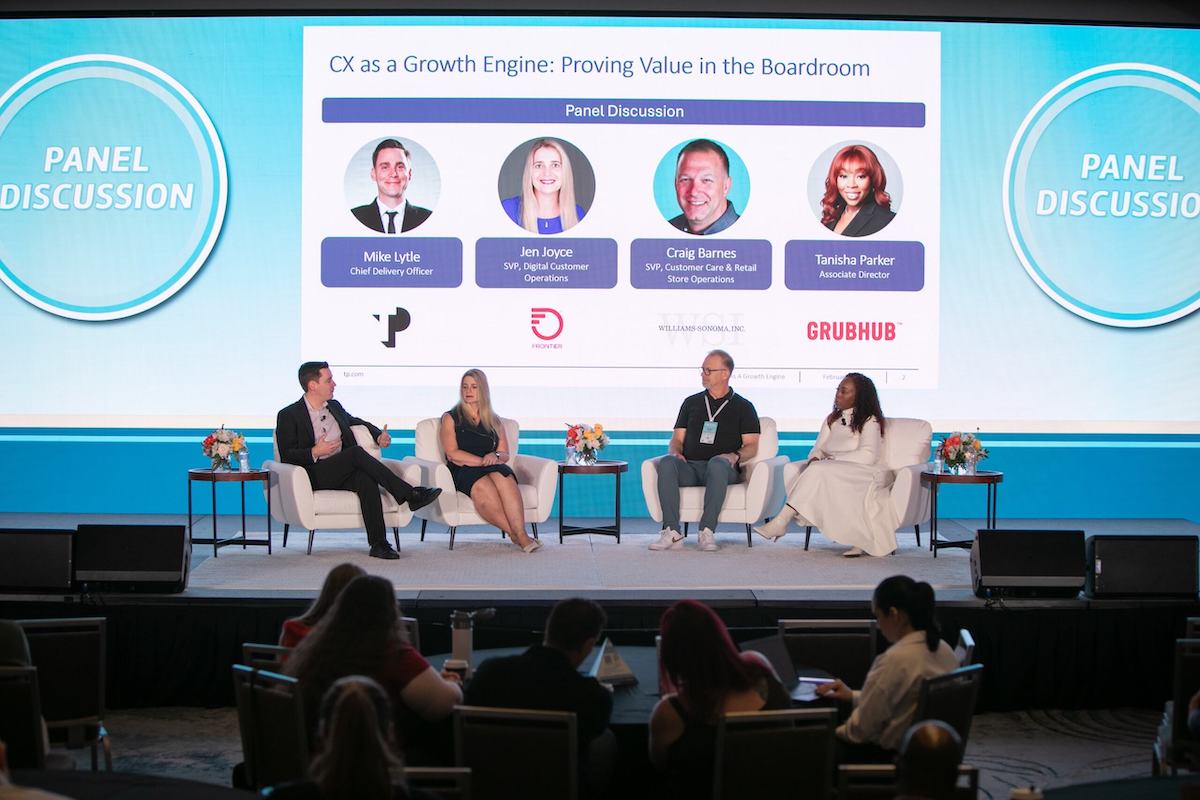
At the Customer Response Summit in Amelia Island, I shared the stage with three other experts to understand their strategies for tying customer care excellence to revenue growth, reduced churn, and operational efficiency.
I was joined by Jen Joyce, Senior Vice President of Digital Customer Operations at Frontier Communications; Craig Barnes, Senior Vice President of Customer Care at Retail Store Operations at Williams-Sonoma; and Tanisha Parker, Associate Director at Grubhub.
The conversation centered on three pillars – each laid out here as a playbook to help you plan, measure, and communicate:
- Reframing the contact center as a value creator
- Securing executive and board buy-in
- CX as a revenue system
From Cost Center to Value Creator
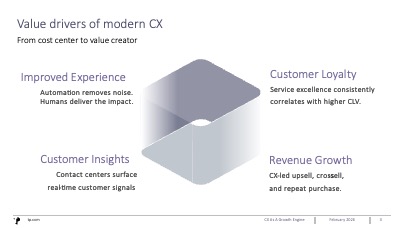
Execs In the Know members are in various stages of shifting the narrative around contact centers from cost center to value creator. The panel offered four recommendations:
- The first is that customer trust and growth is earned, not won. AI alone does not do that. AI + humans does. We agreed on the guiding principle: “Automate the noise, humanize the moments that matter.” AI is ideal for high volume, low emotion, and predictable interactions. Humans, however, have empathy and understanding when the stakes are higher – emotionally and financially. While automation removes noise, humans deliver the impact.
- Second, the contact center is the best source of customer insights. Because it sits at the real-time intersection of customer experience, behavior, and feedback, contact centers are uniquely able to identify what customers are thinking. By turning our rich data into actionable information, we can help organizations spot trends immediately and respond faster.
- Third, service excellence consistently correlates with higher Customer Loyalty. In practical terms, if a client reaches out for technical support, and we solve that quickly and effectively, chances increase that the customer will not churn and, instead, will become an advocate.
- This dovetails with the fourth key of modern CX: Revenue growth. We are on the front-lines of upsell, cross-sell, and repeat purchases. Our speed, efficiency, and effectiveness directly impact brand, product, and service resonance. The best growth strategies are centered on customer experience.
Securing executive and board buy-in
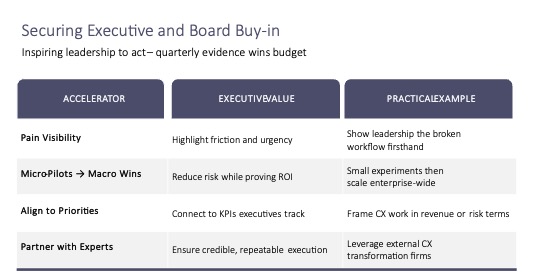
Securing executive buy-in for CX initiatives requires inspiring leadership to act. There are three levers to do this:
- Contact centers experience customer pains daily. Senior management will support transformation initiatives when you highlight that friction, communicate the urgency, and show them first-hand the broken workflows that the customer experience experts overcome in each interaction. This connects them emotionally to the problems we solve.
- Turning micro-pilots into macro wins. This means beginning with small experiments that reduce risk while proving ROI – important metrics for the C-suite. Having this support is required for larger-scale implementations.
- Aligning with executive priorities: This is an exercise in translation – framing CX in terms of revenue and risk. Often, it is effective to work collaboratively across functions to present a unified case to the executive team for how the recommendations will help the organization achieve its strategic goals, faster.
Driving action requires more than sharing anecdotes: Delivering quarterly evidence (grounded in data and storytelling) wins commitment and budget.
CX as a revenue system
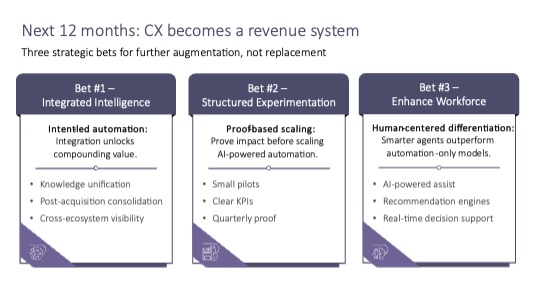
We are confident that delivering on the points in this blog will make CX a revenue system in the next 12 months. Accomplishing this requires that CX leaders make three strategic bets:
- Integrated intelligence and intent-led automation: The most successful contact centers design automation around customer goals rather than keywords, scripts, or rigid workflows. Applying an intent strategy combined by AI creates compounding value. This, in turn, requires data rigor: a) Unifying data from disparate data sources b) Consolidating customer data post-acquisition c) Having a unified, end-to-end view of the customer across systems and operations.
- Structured experimentation and proof-based scaling: Begin with small pilots with clear KPIs backed with quarterly proof. Then, increase the scale. Specifically, around AI, this has been echoed at previous Execs In The Know events: Because AI aspirations are not meeting CX realities – and because most deployments still do not move beyond the pilot phase – it is important to focus on discrete use cases before expanding its scope.
- Enhanced workforce and human-centered differentiation: Smarter customer experts outperform automation-only models. Leverage AI to make them more effective through real-time assistance, recommendation engines, and decision support.
Final Thoughts
The panel concluded with a powerful reminder: “Experience isn’t a cost—it’s the multiplier that grows every part of the business.” By reframing CX as a growth engine and aligning it with organizational priorities, leaders can secure the resources needed to elevate customer experience initiatives and drive long-term business value.
Guest post written by Mike Lytle, Chief Delivery Officer, Americas at TP
TP is a global leader in digital business services, which consistently seeks to blend the best of advanced technology with human empathy to deliver enhanced customer care that is simpler, faster, and safer. For more information, visit tp.com.