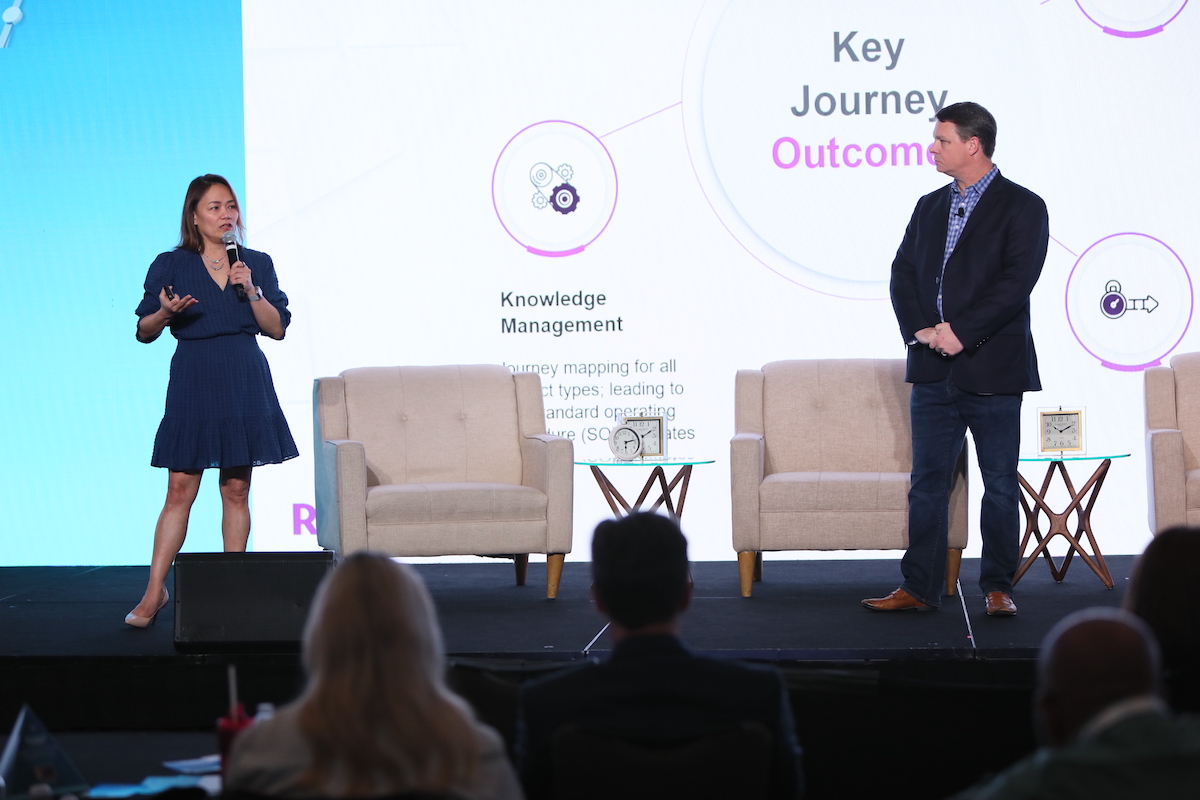
Customer experience (CX) leaders are a demanding audience. Whether they’re seated in a briefing, tuning in to a virtual event, or listening from the audience at Customer Response Summit (CRS), they’ve heard enough presentations to spot a polished pitch masquerading as a real story. They’re looking for true, relevant, and repeatable.
If you’re presenting a CX case study, in any format, here’s what separates the ones that stick from the ones that get forgotten.
Open With a Problem They Recognize
The instinct is to set context: who you are, what you do, how long you’ve been doing it. But you have about 60 seconds to earn the room’s attention, and nothing wastes it faster than a company overview slide. Start with the customer’s situation, the real one. Name the friction, the failure point, the cost that was piling up before your work began. “A national retailer’s frontline agents were spending 40% of every call just locating customer history” puts the audience immediately inside a problem they understand. That’s where you want them.
Specificity is credibility, and the more precisely you can describe the problem, the more confident the audience becomes that you actually solved it.
Make the Stakes Clear Before You Introduce the Solution
Before you explain what you did, explain what was at risk. CX leaders think in terms of retention, loyalty, revenue, and the effort it takes customers to get help. Explicitly connect the problem to those stakes; don’t assume the audience will make the leap.
This is especially important on a main stage or in a large virtual session, where you’re speaking to people in different contexts and with different company sizes. Stakes translate, but technical detail doesn’t always.
Tell the Story of the Work
When you get to the solution, the temptation is to explain how everything works. What CX leaders want to understand is: how did you think about this problem, and how did that thinking lead to something that worked?
Describe the approach: the decisions made, the tradeoffs navigated, and what you tried before you found what worked. This is where your expertise shows. In a live setting, this is also where you can let a little of the real story in, including the moment the team realized they needed to change course, the thing that surprised you, the part that was harder than expected. Authenticity lands in a room, and polished product narratives don’t.
Keep this section tight: two to three minutes in a presentation and two to three paragraphs in a follow-up document. The goal isn’t to be comprehensive; it’s to be convincing.
Lead with Outcomes
Results are the reason anyone is listening to a case study, so treat them accordingly. Vague claims like “improved customer satisfaction,” “reduced friction,” and “drove operational efficiency” land like wallpaper. CX leaders have heard them so many times they’ve stopped registering.
Here’s what resonates:
- A specific metric with a baseline: CSAT moved from 71 to 88 over two quarters
- A business outcome with scale: handle time dropped 22% across 1,200 agents
- A speed-to-value number: fully deployed in six weeks, not the six months originally projected
- A retention signal: the client renewed and expanded the scope within the first year
In a live format, one or two clearly showcased strong numbers will do more work than a slide full of data.
Use Your Customer’s Voice
If your client is in the room or has agreed to be quoted, their words carry more weight than anything you can say. A specific, candid quote (one that captures what the experience actually felt like, not just that they were “pleased with the results”) gives the whole story credibility it can’t manufacture on its own.
The best customer quotes are honest about the starting point: “We didn’t believe it would work this fast” or “Our team pushed back at first, and then they became the biggest advocates.” That kind of candor builds more trust than any metric.
Close by Connecting to the Room
Don’t end with a logo slide or a thank you. End by connecting the story back to the audience’s world. What should they take away? What might look familiar in their own organization? What’s the first question worth asking if this resonates?
CX leaders aren’t shopping for vendors in the room; they’re building mental models of what’s possible. Your job is to give them something concrete to put in that model. The strongest case studies don’t just show what you accomplished for someone else. They make the person listening think: this could work for us.
That’s the moment a case study becomes a conversation, and that’s exactly where you want to be.
Ready to show up where it matters? Connect with Scott Moberly, Vice President, Partner Advocacy, at [email protected] or explore our 2026 Media Kits to find your next opportunity.