
At CRS Scottsdale, our CX Livewire: Consumer Voices, Real-Time Reactions panel put findings from the new 2026 CX Leaders Trends & Insights: Consumer Edition directly in front of CX leaders and then polled the audience on what is actually happening inside their organizations. The conversation focused on four areas: CX influence, AI use cases, customer loyalty, and agent training.
The live polling provided directional insights, and the comparisons were revealing. In some cases, CX organizations appear to be moving in step with consumer expectations. In others, a meaningful gap remains between what customers value and where organizations focus their efforts.
The comparisons build on the conversations at CRS, where leaders from YETI, Mercedes-Benz, Carrier Enterprise, and Cresta examined the Consumer Edition findings alongside audience polling. Read the full CX Livewire session recap for an overview of the discussion, the panelists, and the research behind the conversation.
CX Influence: The Voice Is There — But How Strong Is It?
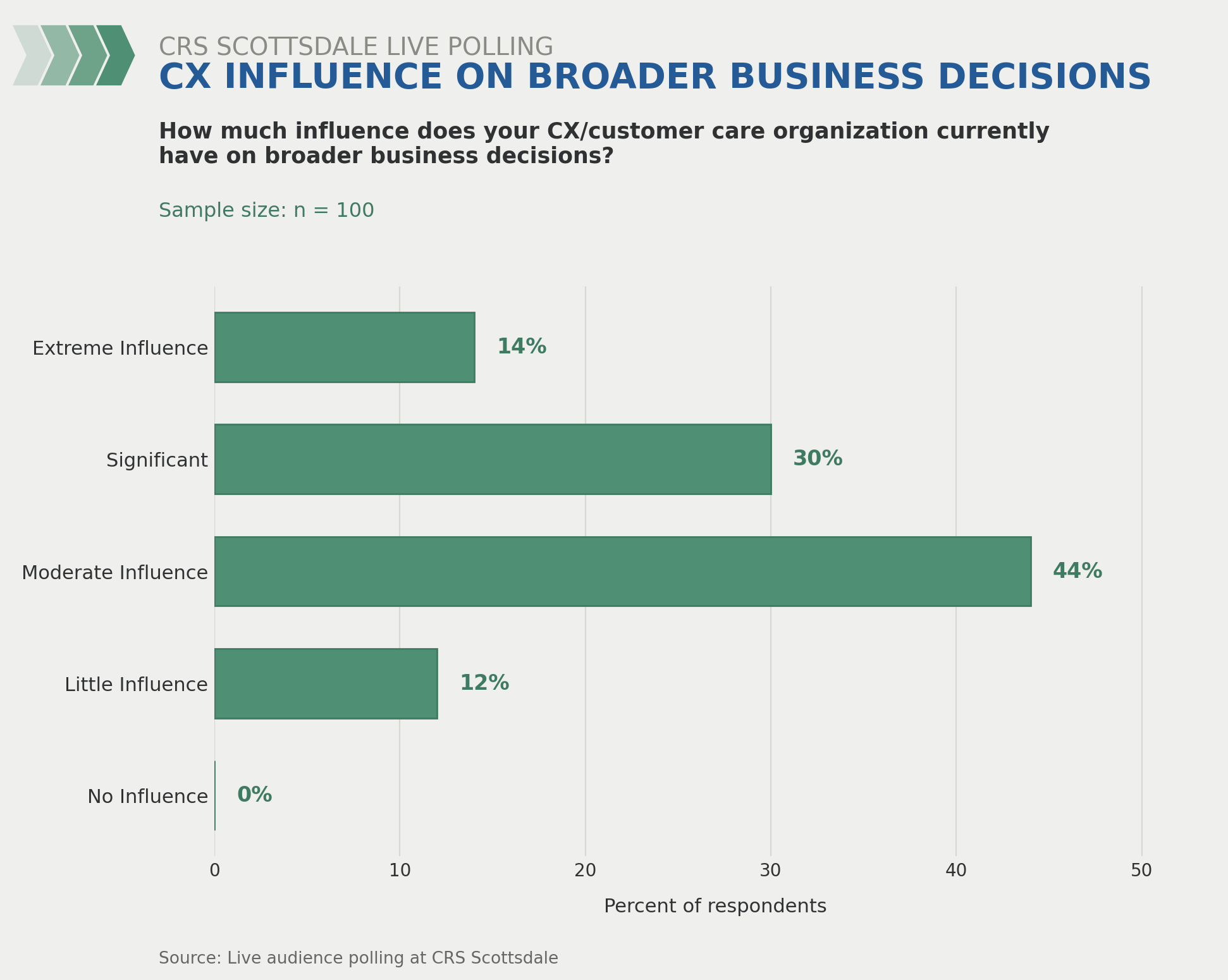
Consumers increasingly expect CX to have a meaningful voice inside the enterprise. In our Consumer Edition research, 90% say it is important for customer care and CX organizations to have influence within a company, while 86% believe CX should have moderate or extreme influence over the organization.
The Scottsdale audience painted a broadly positive — but more nuanced — picture. Eighty-eight percent of respondents said their CX organization currently has at least moderate influence, but only 44% characterized that influence as significant or extreme. Another 12% said CX has little influence.
The takeaway may not be that CX lacks a seat at the table, but that the strength of that seat varies considerably. Closing the gap means moving beyond reporting customer sentiment and using customer insight to influence upstream decisions in product, policy, technology, billing, operations, and strategy. The more directly CX leaders can connect customer friction to commercial and operational outcomes, the stronger that influence becomes.
AI Use Cases: Leaders and Consumers Are Surprisingly Aligned
Here, the comparison was striking.
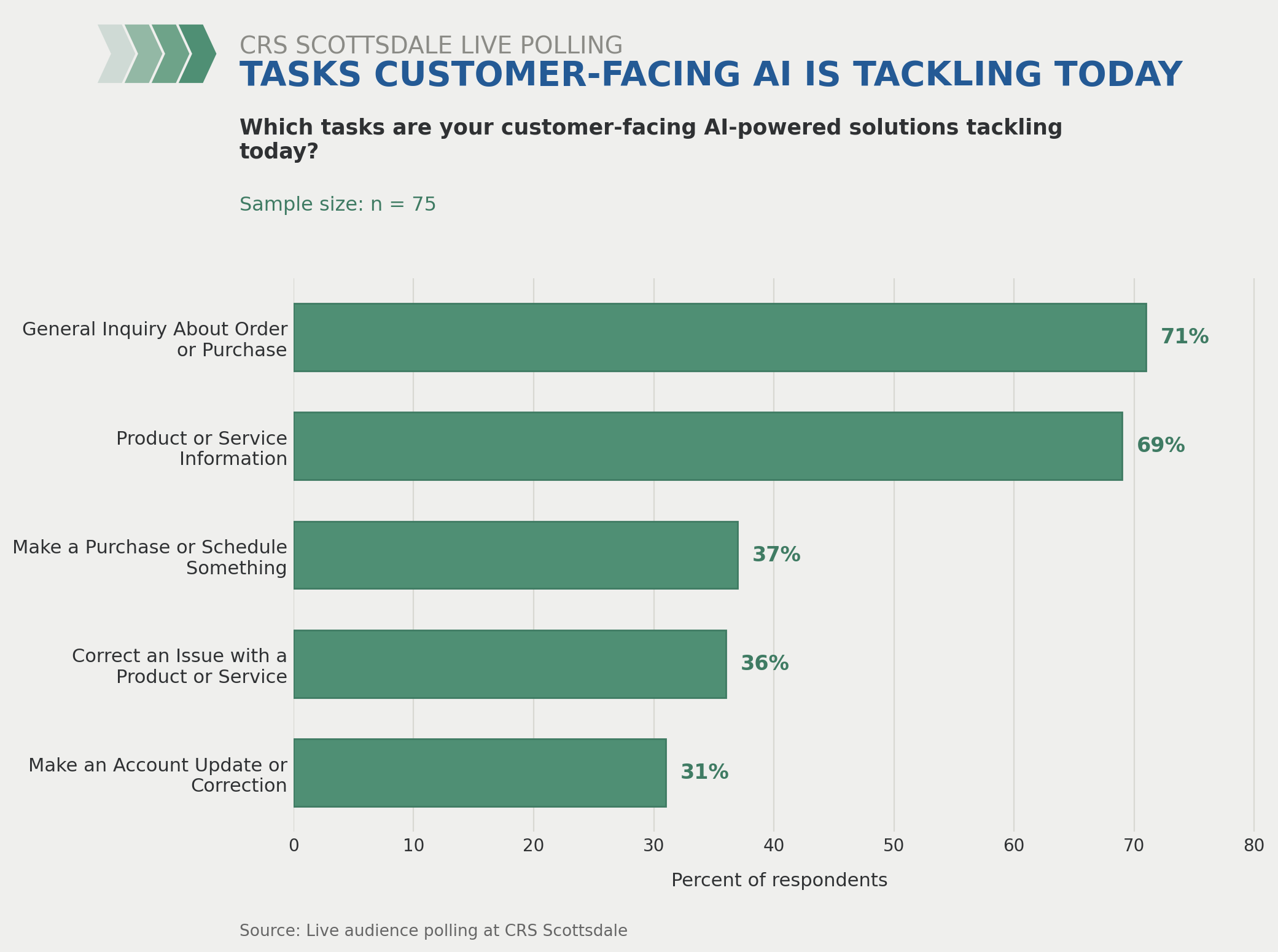
Consumers are most comfortable using AI for general inquiries and product or service information, both at 56%. Comfort drops as tasks become more consequential: 34% are comfortable using AI to correct an issue, 32% for purchasing or scheduling, and 31% for account updates or corrections.
The live audience reported almost the exact same prioritization. 71% are using customer-facing AI for general inquiries and 69% for product information, followed by purchases or scheduling at 37%, issue correction at 36%, and account updates at 31%.
That alignment is encouraging. Organizations appear to be starting where customers are most comfortable and where the risk of failure is typically lower.
The next challenge is disciplined expansion. Rather than asking how many interactions AI can automate, leaders should ask where accuracy, data access, governance, escalation, and customer confidence are strong enough to support greater autonomy. The consumer data suggests there is an appetite for more — but brands need to earn permission through performance.
Loyalty: Customers See the Connection More Clearly Than Brands Can Prove It
This may have been the biggest gap of the session.
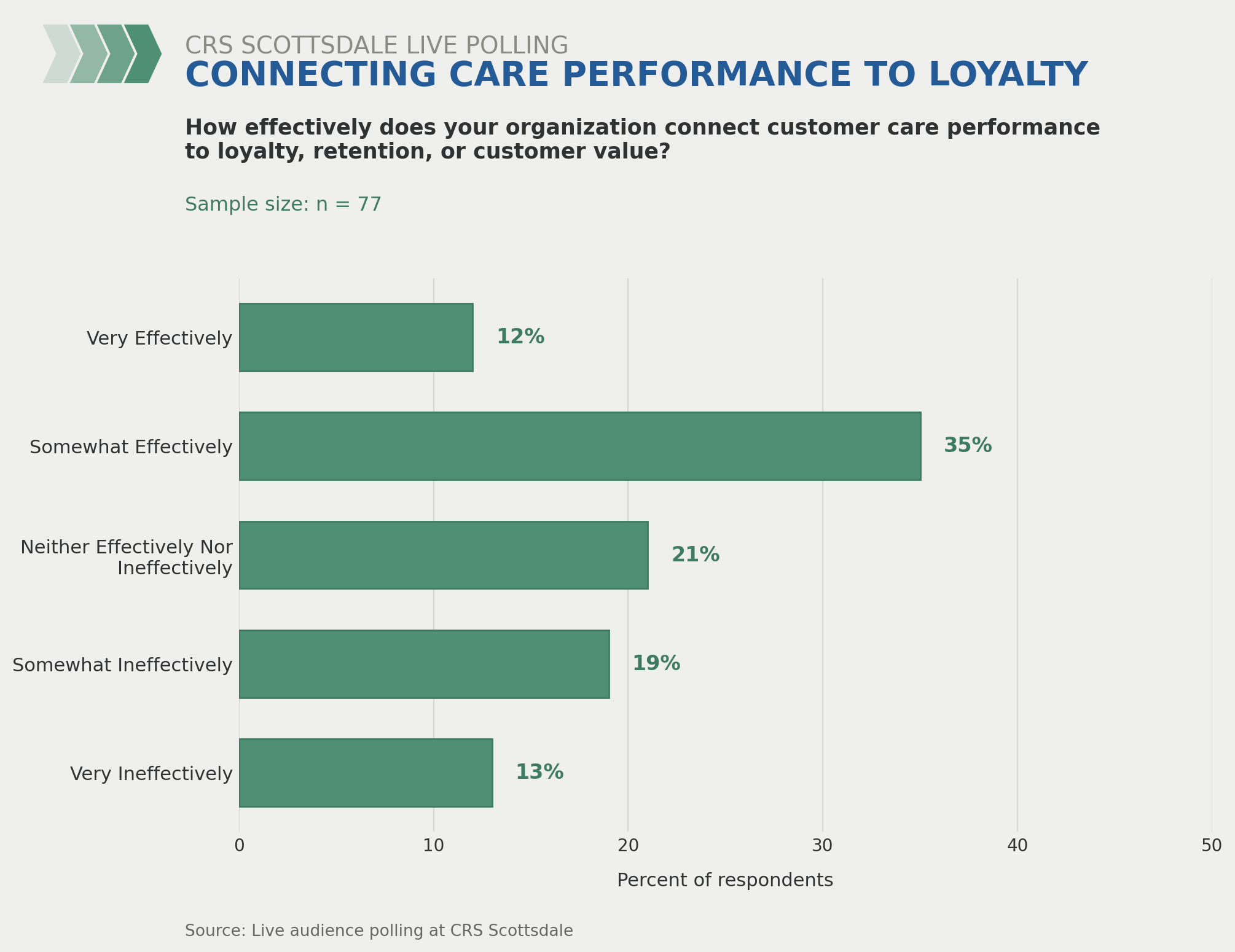
In the consumer research, 90% say a positive customer care experience is likely to increase their loyalty, including 60% who say it is “Very Likely.”
Yet when Scottsdale attendees were asked how effectively their organizations connect customer care performance to loyalty, retention, or customer value, only 47% said very or somewhat effectively. Nearly one-third (32%) said their organizations do so ineffectively.
Although consumers appear convinced of the relationship, many organizations struggle to quantify it.
Closing this gap requires connecting contact-center and experience data with actual customer behavior. Resolution, repeat contact, satisfaction, escalation, and effort become far more powerful when examined alongside retention, churn, purchase frequency, spend, or lifetime value. CX leaders do not necessarily need a perfect attribution model. Instead, they need enough evidence to move the conversation from “we believe great service creates loyalty” to “here is what happens to customer behavior when service succeeds or fails.”
Agent Training: Perhaps the Most Interesting Disconnect
The final poll produced the sharpest divergence.
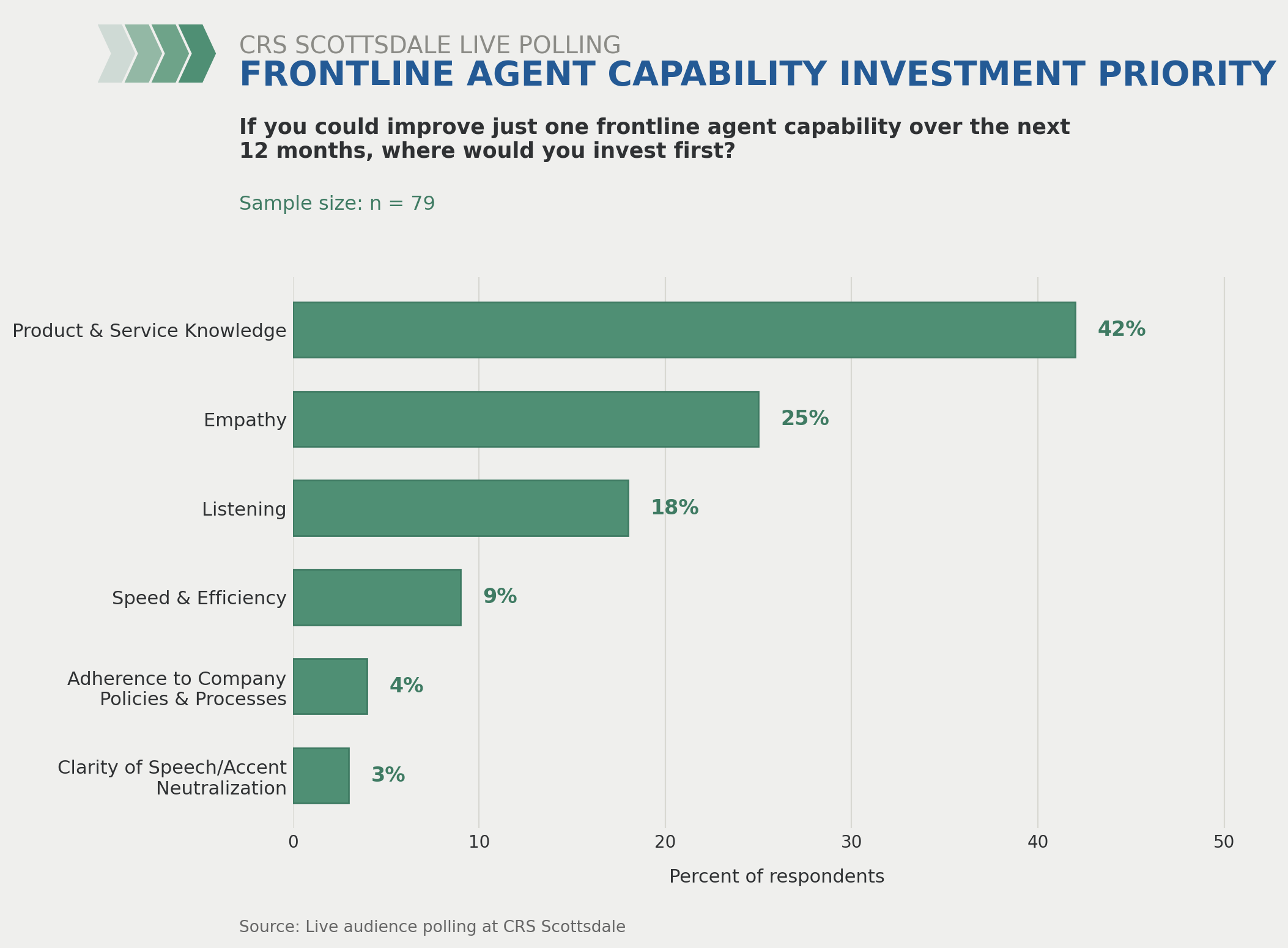
Consumers ranked clarity of speech and communication highest for agent training at 37%, followed by product and service knowledge at 21%, speed and efficiency at 18%, listening at 12%, and empathy at 9%.
CX leaders in Scottsdale had very different priorities. Product and service knowledge led at 42%, followed by empathy at 25% and listening at 18%. Only 3% selected clarity of speech, while 9% chose speed and efficiency.
Neither perspective is necessarily wrong. Leaders understand the operational realities their agents face, while consumers judge the experience from the other side of the interaction. But the contrast suggests training strategies may benefit from a stronger customer-feedback loop.
Product knowledge and empathy matter. Consumers also appear to be saying something more fundamental: help me understand you, understand me, and move the interaction forward efficiently. Training agendas should therefore balance knowledge and empathy with communication clarity, comprehension, efficiency, and the ability to translate expertise into an answer the customer can readily understand.
The Bigger Opportunity: Close the Loop Between What Customers Want and What Organizations Do
Taken together, the four polls tell an encouraging story. CX leaders and consumers are not operating in completely different worlds. AI use-case priorities are remarkably aligned, and most organizations report meaningful CX influence.
But the gaps matter.
Consumers strongly link service to loyalty, with organizations still struggling to prove that link. While leaders prioritize knowledge and empathy for frontline development, consumers place greater emphasis on clear communication and efficient execution.
That’s why comparing these perspectives can be valuable. Consumer research tells us what customers experience and prioritize. Practitioner insight tells us what organizations can do today.
CX leaders’ opportunity lies in the space between the two.
The key takeaway: Listen to both sides, identify the gaps, and use them to decide where the next investment, measurement, or operational change can create the greatest impact.
Check out the full CX Leaders Trends & Insights: Consumer Edition report now.