Agentic AI, including intelligent triaging and routing, end-to-end self-service resolution, and back-office workflow orchestration, is experiencing one of the fastest rollouts customer service and support technology has ever seen. Gartner’s 2026 Technology Trends Report for Customer Service and Support shows 97% of service and support leaders exploring agentic AI in some capacity, as brands, BPOs, and enterprise support teams push AI agents into production looking for faster service, lower costs, and stronger ROI.
AI agents are now answering questions, completing transactions, making decisions, and transferring customers into live queues, but performance management and governance of AI agents in active production haven’t followed at the same pace. In some contact centers, AI agents have replaced live agents completely, handling sensitive customer interactions without training against high-performer behaviors or scoring against quality standards already used across your live teams. AI agent ROI originally promised to enterprises and BPOs looked stronger than they ended up being, with 83% of CFOs reporting that less than half of their AI investments have generated a measurable financial lift and 72% of customer service and support technology purchases last year ending in high or moderate buyer’s regret.
Customer support agent headcount landed the same way, with Goldman Sachs estimating AI agent representative costs at roughly $92 per day against roughly $90 for a human agent, while customer service jobs haven’t disappeared, in fact they’ve grown through restructuring with job postings outperforming the broader job market since August 2025.
Customer service has been treating AI agents as a substitution question, which tasks to pull from live agents and hand to automation for greater capacity and ROI, instead of as a hybrid workforce to manage. Contact centers that replaced live capacity in favor of AI agents have learned the hard way there are hidden costs to removing human reasoning, judgment, empathy, and service recovery from customer interactions and handing them to agentic AI without governance or rigorous performance management systems in place.
Some enterprises have gone as far as scaling their hiring of customer support reps back up after deciding agentic AI wasn’t ready, but the real issue underneath the readiness is the systems to manage AI agent performance alongside live teams weren’t in place before the rollout.
Hybrid workforces are the reality for customer service and support, with AI agents and live agents shaping the same outcomes through different behaviors, failure patterns, and corrective paths. Real ROI from agentic AI workforces comes from pairing the speed and scale AI brings to repeatable service volume with managing your digital and live workforce under the same unified performance management system. Some enterprises and BPOs are reading early misses as failure or a reason to pause, but investment is moving the other way, with AI spending in customer service and support up 38% and 13% of the average service and support budget now going to AI initiatives. The imperative isn’t pausing AI Agent rollout, it’s knowing the root of why AI agents, left ungoverned or managed like just another rep on the roster, turn expected ROI into unexpected costs.
AI Agent Authority Expanded Faster Than AI Agent Management
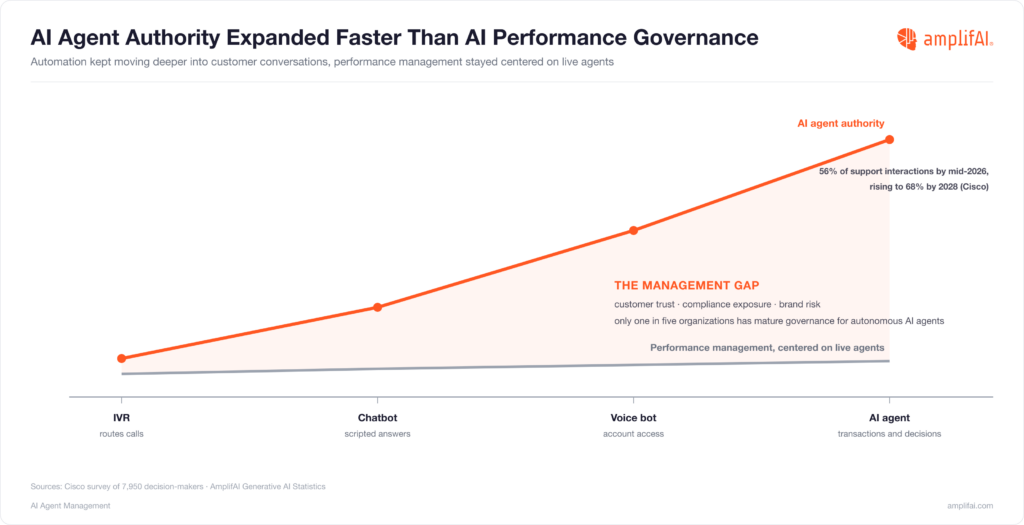
Customer service automation started with IVRs routing calls and chatbots answering scripted questions, expanding into voice bots and AI agents that verify customers, access account data, and transfer complex issues into live queues. Interactions have moved deeper into AI automation while performance management has centered on live agents, with chatbots, voice bots, and AI agents siloed from performance KPIs, coaching, and quality assurance.
With increased AI automation we’ve seen an increase in customer journey data silos, without a unified performance management system connecting the customer conversation, scoring AI agents against quality standards used for your live team, or showing whether automation reduced customer effort or moved unresolved issues farther down the queue.
Agentic AI has taken on interactions once reserved for experienced live agents, including verification, account changes, billing questions, troubleshooting, complaints, and service recovery, expanding AI agent authority faster than its management. For enterprise brands early to the rollout, trial and error resulted in loss of customer trust, compliance exposure, and brand risk.
AI Agent Vendors Score Their Own Performance
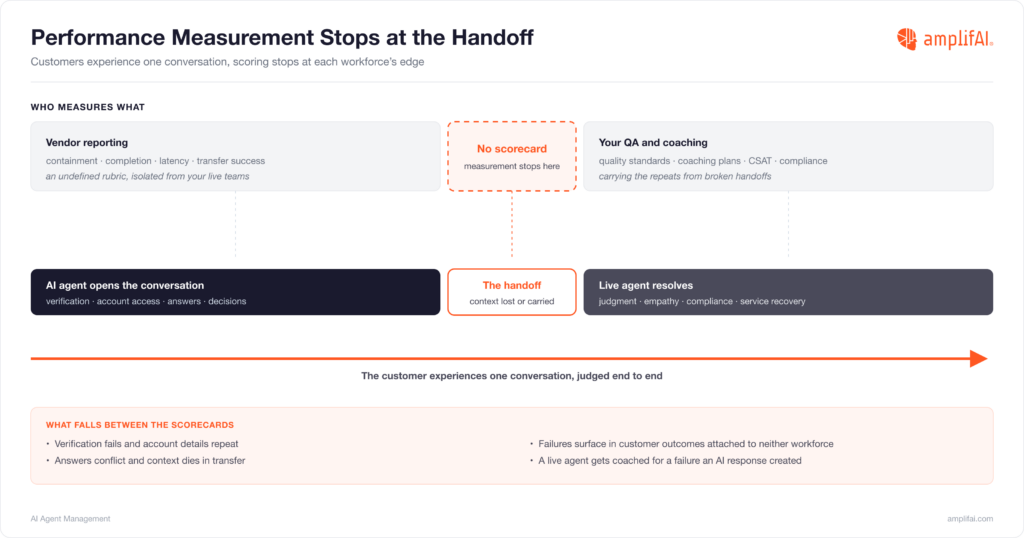
Enterprises and BPOs deploying AI agents in most cases are working through siloed vendors, where defining and managing performance remains disconnected from the rest of the contact center. AI agent vendors define the metrics, keep conversation data inside their reporting, and return containment, completion, latency, and transfer rates, while CSAT, FCR, compliance, and live-agent performance sit inside your QA, survey, and CRM systems.
Siloed performance management scores your workforce two different ways, live agents held to QA reviews, coaching plans, and quality standards, while AI agents currently answer primarily to an undefined rubric isolated from your live teams. Vendor reporting may mark a transfer successful, but if the customer handoff wasn’t tracked, monitored, or managed, your live agents have to carry the repeats, giving an unreliable view of performance or the prescriptive actions to fix it. Was it an AI agent failure, or a failure in live agent coachable behaviors? The AI agent’s action splits from the customer outcome it helped create, the inevitable result of agentic AI scaled without governance and oversight.
Expansion of AI agent deployment has multiplied dashboards and definitions of success, increasing the burden on CX leaders managing multiple versions of performance across one customer conversation.
One Customer Journey Needs One Performance Standard
Your customers experience one conversation, whether an AI agent opens it, a live agent finishes it, or the interaction moves between them. Currently performance measurement of your AI agents stops at the handoff or is loosely patched together, leaving ambiguity in quality and compliance results. When verification fails, account details repeat, answers conflict, or context dies in transfer, failures surface in customer outcomes attached to neither workforce.
Split performance data creates the wrong corrective action, a live agent coached for longer handle time or failed resolution after inheriting a broken handoff, while the AI response that caused the failure receives no prompt change, knowledge update, or regression test. Even where agentic AI vendors score their own agents through Auto QA, a separate rubric and separate calibration keep those scores disconnected from your QA findings and live-agent performance, leaving no way to tell which side of your workforce needs the fix, or how either side moves overall CX outcomes. Customer intelligence ends up cut off from the rich data insights required to power the right actions for QA teams, CX leaders, and executives.
One performance standard needs to follow the full customer journey, scoring AI agents and live agents through calibrated behavior drivers while tracking the handoff between them. A unified performance management system makes that standard enforceable, managing both workforces from one data layer where AI conversations and live interactions stay inseparable, routing live-agent findings to coaching and AI-agent failures to fixes, and showing through shared performance data whether either action improved the outcome. In sectors like healthcare and financial services, deploying a digital workforce outside the management your live teams work under leaves critical gaps in quality and compliance monitoring, alongside patient care, member services, and NPS outcomes at stake in each conversation. Customer harm, regulatory exposure, and financial penalties still belong to the business, no matter which side of your workforce created them.
AI Agent Management Is Where ROI Lives
AI agents aren’t replacing human agents in customer service yet, and the ROI story behind the rollout leans on a myth, that value comes from interaction volume AI agents handle and repetitive tasks they lift off live teams. Volume and automation are real, but the illusion that AI agents will one day be ‘good enough’ to replace live teams sits a long way out, and the brands that acted on it, Klarna the loudest example, have rolled the decision back and rehired the agents they had planned to replace, absorbing losses the business case never counted, in brand reputation and workforce engagement. Who wants to work for a company actively trying to replace its agents with AI?
Achieving ROI from your AI investments needs to consider the management of your AI agents. With agentic AI investment set to increase, only 3% of service and support leaders reporting no plans to deploy, pilot, or explore it in the next two years, and AI agent costs yet to reach parity with live teams, performance from both sides has to keep pace with the spend. Unified AI agent management software like AmplifAI is purpose-built for holistic management of both your live teams and AI agents on one platform. By unifying structured and unstructured data sources across CCaaS, CRM, AI agents, surveys, and flat files into one AI-ready data layer, AmplifAI powers automated quality management, performance KPIs, and role-based insights turned into next best actions. AmplifAI sees who your highest performers are, where your middle 60 live, and where low performers need development, providing insights and prescriptive actions for team leaders, CX, and QA teams, while managing your AI agents against the same proven behaviors.
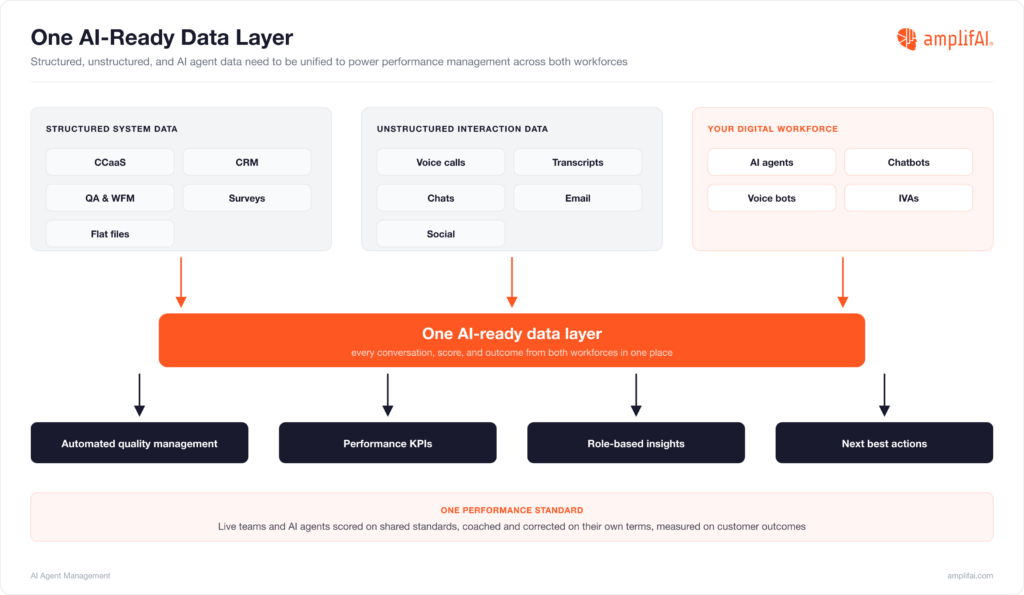
The 97% of enterprises and BPOs adding more AI agents to their digital workforce don’t need to relearn what early rollbacks already proved: performance management belongs in place before rollout, not after rollback. Deeper returns are landing where AI agents and live agents run under one unified performance management system; both workforces are scored on shared standards, coached and corrected on their own terms, and measured on whether the customer experience improved.
Rather than replacing your live team, AI agents have joined your workforce; managing both sides under one unified performance management system is where lasting ROI lives.
To see what your AI agents and live teams look like managed under one unified platform for CX and performance management, speak to a CX leader at AmplifAI.
Contributed blog post written by Sean Minter, CEO/Founder, AmplifAI