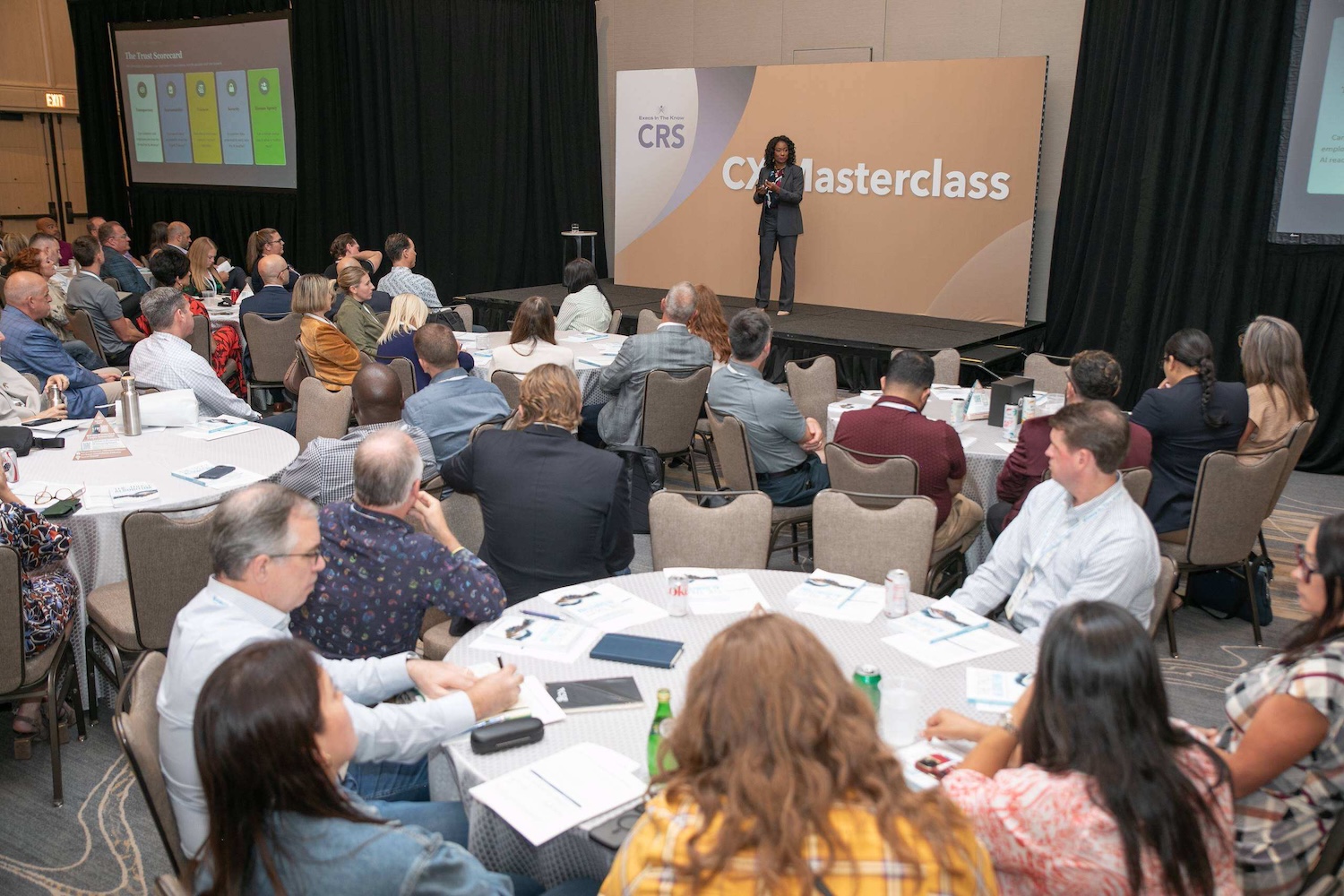
“We are in a trust recession.” That was the opening line of our CX Masterclass at CRS Scottsdale last week, led by Alice Sesay Pope, author of The Trust Algorithm, whose CX leadership spans Amazon, Visa, Capital One, Microsoft, and USAA.
Customers don’t trust institutions to resolve issues without multiple handoffs. Employees don’t trust that transformation will improve their work rather than eliminate it. Boards don’t trust that AI will create advantage without reputational, regulatory, or security risk. And then generative AI arrived.
The Paradox Every CX Leader Lives Under
Deploy AI for efficiency while strengthening trust. Reduce expense while improving experience. Move with urgency while satisfying regulators.
Contain cost-to-serve while raising the standard of care. None of these is an either/or choice, and that is what makes the job so hard.
The Same Wrong Answer, Twice
Alice made it real with a true story. A customer asked an AI assistant a simple question and got a confident, policy-backed answer. Two days later, unsure, she called. The associate checked the same knowledge base and confirmed it. She made a financial decision on it, then discovered the answer was wrong.
The failure wasn’t the AI or the associate. It was the system. When both draw from the same source of truth, one wrong answer becomes two, delivered with the illusion of independence.
Empathy Plus Precision
The fix starts with a core equation: empathy plus precision, never one at the expense of the other. Without precision, empathy becomes theater, and customers feel understood but still misinformed. Without empathy, precision turns cold, and customers get the right answer and leave anyway.
Alice then introduced the TERV model: four variables that determine whether AI earns trust or erodes it: Trust, Ease, Recovery, and Value. Her Trust Scorecard turns trust into something leaders can diagnose across transparency, accountability, fairness, security, and human agency.
Builders, Breakers, and the J-Curve
Trust builders include explaining what AI can and can’t do up front, designing fast escalation to a human, and involving frontline associates in design. Trust breakers include hiding automation behind a human-sounding voice and optimizing for handle time over customer confidence.
The field lessons agreed. The biggest gains came from pairing automation with an always-available human path. The costliest missteps came from scaling pilots before building governance. And because AI adoption follows a J-curve, leaders must lead through the dip, not restructure during it.
Myths to Let Go
Gen AI doesn’t replace the frontline; it reshapes it. Deflection isn’t a strategy; resolution is. And governance doesn’t slow innovation; it’s what makes scale possible.
The Choice
Every leadership team now faces two paths: AI as a blunt cost-cutting instrument, or AI as a trust amplifier that elevates employees, strengthens relationships, and enables organizations to scale faster to increase revenue growth. As Alice put it, trust is not a feature you ship. It is a debt you pay, one human decision at a time. Technology doesn’t transform organizations; leaders do.
Join us in Dallas
Conversations like this are why CX leaders come to CRS. Join us at our next CRS in Dallas, March 10-12, 2027, to keep building trust into every layer of the customer experience. Save your seat today.