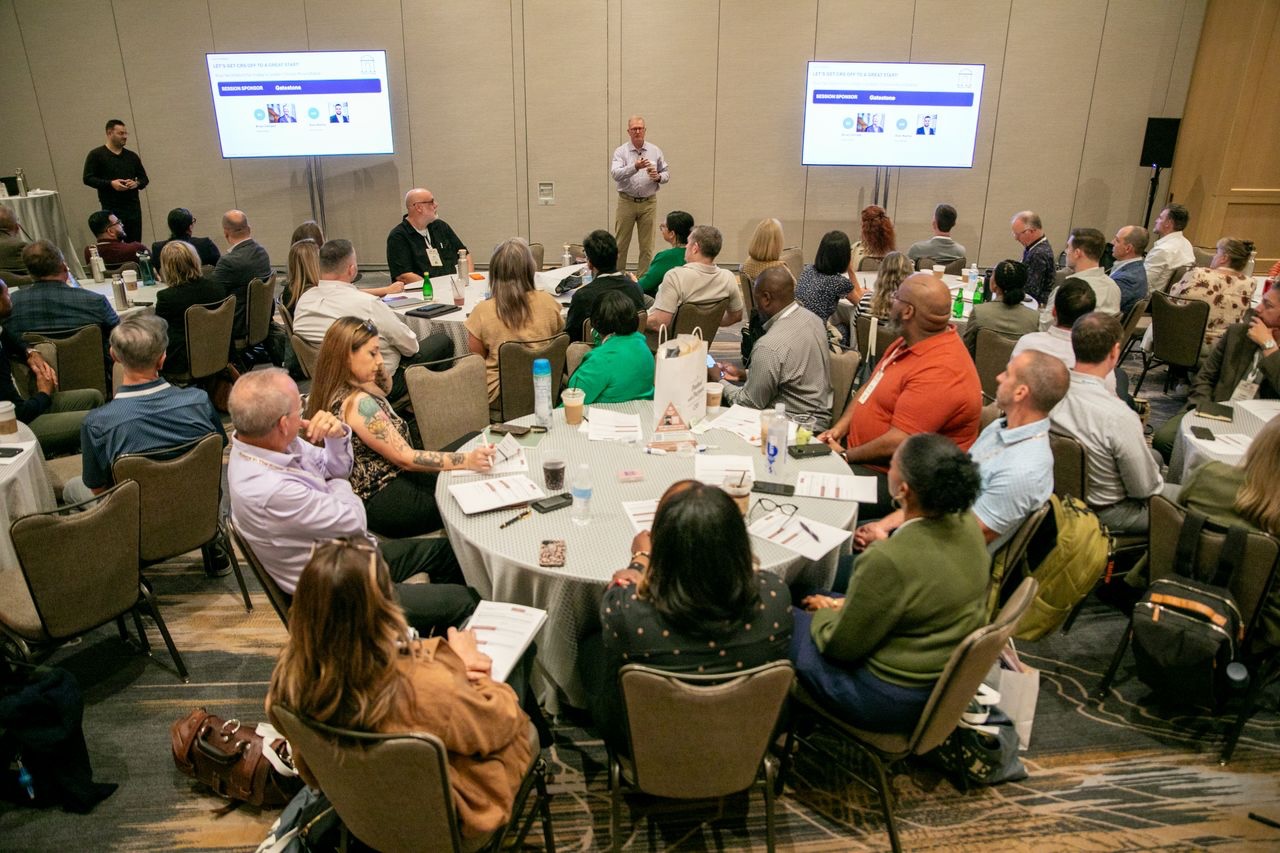
I left CRS in Scottsdale with one overriding thought: The customer experience conversation around artificial intelligence needs to evolve.
For the past several years, much of the discussion has focused on what AI can do. What can we automate? How quickly can we deploy it? How much efficiency can we create?
Those questions still matter. But as AI in customer experience moves from experimentation into everyday operations, leaders need to ask a more important question: Does this technology create a better experience for the customer?
AI adoption is accelerating. Salesforce Research found that 66% of customer service organizations were using agentic AI in 2026, up from 39% in 2025. More importantly, those organizations reported improving customer satisfaction as their top KPI after deployment.
As AI becomes commonplace, deploying it won’t be a differentiator. The advantage will come from how intelligently we use it.
The Human Agent Isn’t Disappearing. The Role Is Changing.
As AI handles more predictable interactions, human agents increasingly inherit what remains: exceptions, complex problems, emotionally charged situations, and moments where judgment matters.
That changes the frontline role.
Tomorrow’s strongest agents will spend less time retrieving information and more time interpreting situations, navigating ambiguity, solving problems, and building customer confidence.
Salesforce Research projects that AI could handle 50% of service cases by 2027, up from 30% in 2025, creating an environment where people can focus more on complex, higher-value interactions.
For leaders, the question should shift from “How many people can technology replace?” to “How much better can technology make our people?”
Efficiency Cannot Be the Only Scorecard
CX leaders understandably care about the economics of automation. Cost per contact, handle time, containment, and productivity all matter.
But they don’t tell the entire story.
An interaction can be “contained” without being resolved. A customer can complete an automated journey and still leave frustrated. Lowering cost per contact creates little value if repeat contacts, complaints, or attrition increase.
McKinsey & Company has noted that customer-care AI adoption is producing uneven results, with some organizations capturing meaningful value while others struggle to translate the technology into improved customer experience and operational performance.
That means the scorecard needs to broaden.
Leaders should also ask:
- Was the customer’s issue actually resolved?
- How much effort did the experience require?
- Did the customer need to contact us again?
- Could the customer reach a person easily when automation wasn’t enough?
- Did the interaction strengthen or weaken trust?
AI’s real promise emerges when customer outcomes and operating economics improve together.
Trust May Become the Ultimate CX Differentiator
One idea that particularly resonated with me coming out of Scottsdale was Customer Assurance.
As AI becomes more deeply embedded in customer journeys, trust becomes increasingly important.
PwC research illustrates the challenge: 90% of executives surveyed believed customers highly trusted their companies, yet only 30% of consumers said they did. PwC also found that 40% of consumers had stopped buying from a company because they didn’t trust it.
That gap should command every CX leader’s attention.
Customers need confidence that: You understand me. You can solve my problem. You will protect my information. And when I need a human being, I can reach one.
Those expectations aren’t new. But in an increasingly automated environment, delivering against them becomes more important, not less.
The Winning Model is Human + AI
I don’t believe the future of customer care is a choice between people and technology.
The stronger model combines the best of both.
AI excels at speed, scale, knowledge retrieval, pattern recognition, and repetitive tasks. People excel at empathy, judgment, creativity, negotiation, and navigating ambiguity.
That suggests four priorities for CX leaders:
- Automate predictable interactions. Start slow with repetitive contacts.
- Augment complex interactions. Give agents better context while removing administrative work.
- Preserve human engagement where it matters. Identify high-emotion, high-value, and high-risk moments where judgment and empathy are critical.
- Build graceful escalation into automation. A customer trapped in an ineffective automated journey is not successfully contained. Access to an informed human should be part of the design.
McKinsey & Company’s customer-care research reaches a similar conclusion, emphasizing that successful AI transformation extends beyond technology to operating models, talent, governance, and trust.
From AI Adoption to AI Discipline
For years, organizations have asked what AI can do.
It’s time to ask a more important question: What should AI do?
Sometimes the answer is automation. Sometimes it is augmentation. And sometimes technology’s highest value is simply helping a highly capable employee have a better conversation with a customer.
The future of customer experience won’t be defined by how much AI an organization deploys. It will be defined by how effectively we use AI to create better human outcomes.
When technology becomes ubiquitous, trust may ultimately become the most powerful CX differentiator.
Guest blog post written by Brian W. Zempel, EVP & Chief Revenue Officer at Gatestone
Sources
- McKinsey & Company, “Building trust: How customer care leaders pull ahead with AI,” 2026
- McKinsey & Company, “Gen AI in customer care: Early successes and challenges,” 2024
- PwC, “2024 Trust Survey”
- Salesforce Research, “State of Service,” Seventh Edition