
First, let me make one thing perfectly clear: I am a big fan of AI agents. If a virtual agent can reset a password, answer an order-status question, or handle a routine billing request in seconds, great! Give the customer the answer and let the technology do what technology is good at.
But there is a workforce question hiding inside all that efficiency: Tier 3 agents are not born in the Tier 3 queue.
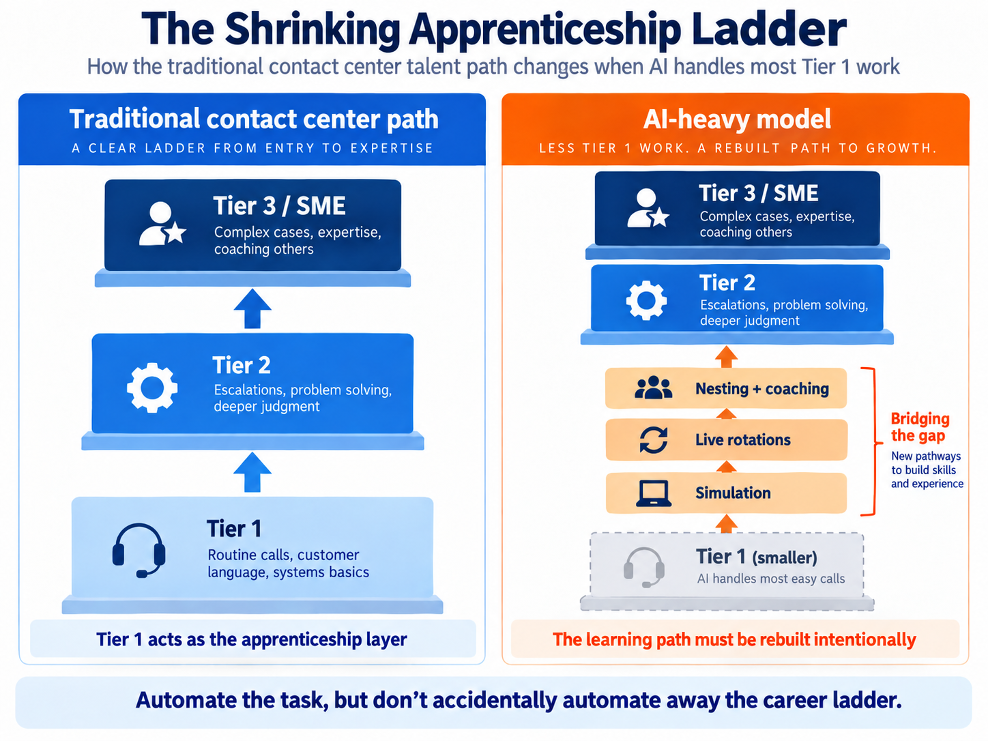
For decades, Tier 1 has been more than the queue for simple cases. It has also been the contact center’s apprenticeship program. Fresh agents learn how customers actually describe problems, how systems connect, when a policy answer creates another question, and when something that sounds routine is about to become an exception. If AI takes the lion’s share of that work, CX leaders need a deliberate plan to replace the learning that disappears with it.
Tier 1 Was Quietly Teaching More Than We Gave It Credit For
 A Tier 1 interaction can look simple on a workflow map. To the new agent handling the 200th version of it, something else is happening.
They are learning the language customers use when they are confused, angry, embarrassed, or simply wrong about what the problem is. They are learning where to look first, what questions expose the real issue, which systems can be trusted, and when to ask for help. They are building the muscle memory that lets an experienced agent hear a small detail and think, “This one is going somewhere else.”
That kind of judgment develops through experience. It can’t be downloaded.
Stanford Digital Economy Lab research on learning with intelligent machines makes the broader point. Much of the skill required to perform a job is learned by doing the job, with experienced people coaching less-experienced people through real work. When automation removes trainees from those learning opportunities, organizations must intentionally rebuild the development path. In a contact center, that means replacing the learning path before the routine work disappears.
That also changes how you think about hiring. Entry-level hiring becomes a talent-development decision, not just a staffing decision. Even with less Tier 1 volume, you may still need a deliberate flow of beginners entering the operation, so the next generation of experts has somewhere to begin.
The Remaining Human Queue Is Not a Beginner Queue
Picture the new agent entering production after most routine contacts have been automated. Their first live customer may be there because self-service or the AI agent has already failed. The account history may be unusual. The customer may be angry. The answer may live across three systems. The policy may not quite fit.
That is not Tier 1 with a nicer title. That is judgment-heavy work that requires expertise.
Now add the hiring problem. If you stop bringing in entry-level agents because you expect AI to absorb the work, you also shrink the population that would have become tomorrow’s escalation agents, subject-matter experts, trainers, quality leaders, and supervisors.
You can recruit people with that experience from the outside, of course. So can everyone else.
The contact center industry could end up competing for a smaller pool of experienced people while simultaneously reducing the number of places where people become experienced. That is a talent supply problem wearing an automation costume.
Build the New Apprenticeship Before You Remove the Old One
If Tier 1 volume declines, contact centers need to preserve the learning, not the inefficiency. That means asking a more useful question: what did people learn in Tier 1, and where will they learn it now?
- Map the hidden skills inside Tier 1. Customer-language fluency, system navigation, escalation judgment, documentation, emotional control, and pattern recognition are all being practiced even when the contact looks routine.
- Keep selected live-work rotations where they still add learning value. Not every contact needs to stay with a person, but some lower-risk interactions may still be useful as a controlled development step.
- Make simulation much more serious. McKinsey has described how GenAI-based contact center simulations can recreate realistic customer scenarios, provide real-time suggestions, and help agents practice before they enter live work. That is exactly the kind of capability the new apprenticeship model will need.
- Strengthen nesting and measure readiness, not attendance. A new agent should progress because they can demonstrate sound judgment, quality performance, appropriate escalation, and confidence using AI, not because they complete a certain number of classroom days.
AI Should Change the Career Ladder, Not Remove It
As I said at the beginning, the point is not to preserve every Tier 1 job. It is to preserve the development path that Tier 1 quietly provided.
AI can remove work that people should no longer have to do. It can help agents find answers faster, handle documentation, surface knowledge, and give customers immediate service when a human adds little value. That’s progress.
But the human role that remains will require more judgment, not less. So the development system must get better at the same time as the automation gets better.
The strongest workforce model will not be “AI instead of people.” It will be AI handling what it does well, humans handling what they do well, and a deliberate path that teaches people how to become the experts who will still be needed alongside the machine.
Technology can help rebuild parts of that apprenticeship. AI simulations can give agents realistic practice before live work, while shared virtual operating environments can keep trainers, supervisors, and experienced agents close during nesting and production.
Don’t Drain the Bench While the AI Agent Is Still Warming Up
The business case for AI is real. Nobody needs to defend keeping repetitive work just so humans have something to do. The danger is making workforce decisions on the assumption that an AI implementation will reach its planned scope, quality, and timeline exactly when the spreadsheet says it will.
Laivly’s 2026 AI Deployment Index, based on a survey of 200 CX leaders, found that 43% of recent contact center AI projects were delayed or stalled and 53% exceeded budget. CX Dive, reporting on the same research, highlighted an even more uncomfortable wrinkle: pressure to show AI savings can lead companies to reduce headcount before the technology has actually proven it can carry the workload.
Gartner has issued a similar warning. It predicts that by 2027, half of companies that cut customer service staff because of AI will rehire people to perform similar work, often under different job titles and with less experience.
This is where the implementation timeline matters. If an AI project takes six months longer than expected, the organization still has customers to serve during those six months. If leadership pauses hiring based on the original timeline, the gap lands on the people who remain. Overtime rises, experienced agents carry more of the difficult queue, and supervisors have less capacity to coach and train.
The safer approach is not to keep headcount forever “just in case.” Tie workforce reductions to proven operational performance, not the planned go-live date. A pilot that resolves a narrow set of cases is not the same thing as stable production at scale.
That does not mean leaders should slow down AI investment. It means they should be careful about cutting the runway before the plane is actually in the air.
Automate the task. Just make sure you do not accidentally automate away the career ladder that produces the people you will still need.
Guest post, written by: Jason Hiland, Chief Revenue Officer at CollaborationRoom.ai
CollaborationRoom.ai is a SaaS Virtual Floor platform that connects distributed, in-office, multi-site, and outsourced contact center teams in one live operating environment for operational visibility, training, nesting, coaching, and agent support.
To learn more about building a connected operating environment for training, nesting, and supporting agents, visit CollaborationRoom.ai.